
Automating Knowledge Growth: A Framework for an Evolutionary Learning Workflow
Harnessing Technology to Enhance Continuous Learning and Adaptation in Modern Environments

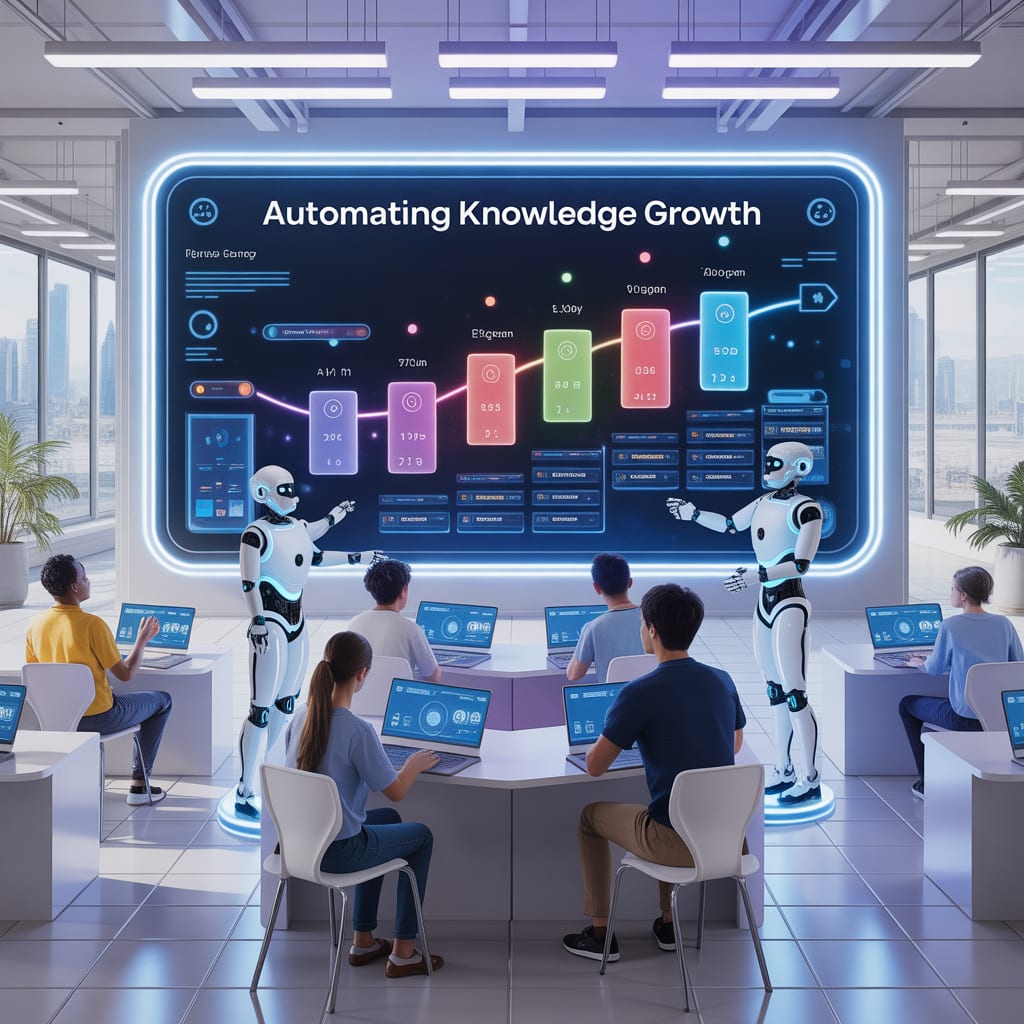
Automating Knowledge Growth: A Framework for an Evolutionary Learning Workflow
In the ever-evolving landscape of artificial intelligence (AI) and machine learning, the ability to create adaptive systems that can learn and grow autonomously is gaining significant traction. The concept of an Evolutionary Learning System (ELS) parallels natural evolution by incorporating principles such as variation, selection, and inheritance—allowing AI to develop robust models with minimal human oversight. This article will explore a comprehensive framework for automating a learning workflow, detailing how to build a knowledge base from minimal initial information and enhance it using AI tools, delving into the underlying mechanisms and practical considerations for implementation.
The Evolutionary Learning System Framework
The ELS framework can be broken down into several key components that work together to create a self-improving learning system:
1. **Population of Models Initialization:** The journey begins by seeding the system with a diverse *population* of AI models. Imagine starting not just with a single blueprint, but many—perhaps neural networks with varying depths and activation functions, or decision trees pruned at different levels. This initial heterogeneity, potentially generated by random parameter assignment or by incorporating existing pre-trained models with slight perturbations, is vital to ensure the system doesn't immediately converge on a mediocre solution, allowing for a broader exploration of the solution space.
2. **Fitness Function:** Next, a *fitness function* becomes the arbiter of success. This isn't merely about accuracy; it's a metric quantifying how well each model performs on a given task. For instance, in a natural language processing task, it might be the F1-score for entity recognition, or the perplexity for language generation. Crucially, this function isn't static; it can be designed to dynamically incorporate new challenges—perhaps by adding a penalty for computational cost or a bonus for explainability—thereby mimicking the ever-shifting pressures of a natural environment.
3. **Variation through Mutation and Crossover:** Innovation within the ELS flourishes through two primary mechanisms: *mutation* and *crossover*. Mutation injects controlled randomness, like a subtle genetic drift. For a neural network, this could involve randomly perturbing a few weights by a small epsilon value, or even adding/removing a neuron or a layer. Crossover, conversely, mimics sexual reproduction, where "genetic material" from two parent models is combined to form offspring. Picture taking half the weights from one neural network and combining them with half from another, or swapping entire sub-networks. Common crossover operators include one-point or two-point crossover if models are represented as fixed-length "chromosomes" of parameters. The delicate balance between these exploratory (mutation) and exploitative (crossover) forces is what allows the system to both discover entirely new solutions and meticulously refine promising existing ones.
4. **Selection Process:** With variations generated, the *selection process* then embodies the "survival of the fittest" principle. Algorithms such as tournament selection, where a subset of models competes and the best one wins, or roulette wheel selection, which gives proportionally higher chances to fitter models, are commonly employed. To safeguard against losing valuable progress, an optional "elitism" strategy can be implemented, ensuring that the absolute best-performing models from the current generation are directly carried over to the next, guaranteeing a non-decreasing performance trend.
5. **Inheritance Mechanism:** The chosen survivors then propagate their "genes" through an *inheritance mechanism*. Offspring models derive their parameters, structures, or configurations from their successful predecessors, ensuring that beneficial traits are passed down. This could be a direct copy of parameters from a winning parent, or an average of parameters from selected parents, ensuring a continuous generational progression toward improved performance.
6. **Environmental Feedback:** The system is not static; it thrives on *environmental feedback*. This involves dynamically altering the tasks or data distributions against which models are evaluated. For instance, if the ELS is optimizing a fraud detection system, new types of fraud patterns could be introduced, forcing the models to adapt beyond previously learned indicators. This continuous perturbation ensures models remain robust and agile in an ever-changing operational landscape.
7. **Minimal Human Oversight:** Ultimately, the ELS aims for *minimal human oversight*. While initial design and high-level goal articulation require human intelligence, the system is engineered to largely self-organize and self-improve. Human intervention becomes akin to a strategic steering committee, periodically reviewing overall system performance, recalibrating major objectives, and troubleshooting unforeseen systemic anomalies rather than micro-managing individual learning iterations.
Automating the Workflow
An automated learning workflow can significantly enhance the efficiency and scalability of the knowledge base. Below are detailed steps to create such a workflow:
**Step 1: Define the Learning Objective**
Clearly articulate the purpose of the learning workflow. Whether it's building a knowledge base or training an AI model, having a defined scope will guide subsequent steps.
**Step 2: Set Up the Infrastructure**
This foundational step involves selecting a robust technological stack. Scalability often dictates leveraging cloud platforms like Google Cloud Platform (GCP), Amazon Web Services (AWS), or Azure, which offer flexible compute and storage. For orchestrating the workflow, Python, with its rich ecosystem, is indispensable. Specific libraries like `Pandas` for data manipulation, `NumPy` for numerical operations, and `Scikit-learn` for foundational machine learning tasks form the core. Alongside these, tools like NotebookLM can serve as intelligent organizers for derived knowledge, while various domain-specific APIs become critical for data retrieval.
**Step 3: Automate Data Collection**
Efficiency hinges on automating *data collection*. This means deploying sophisticated web scraping tools, such as `BeautifulSoup` or `Scrapy` in Python, to programmatically extract structured or semi-structured information from websites. Concurrently, leveraging specialized APIs—like those from academic databases (e.g., Semantic Scholar, PubMed, ArXiv), financial data providers, or news aggregators—allows for direct, programmatic access to vast datasets, ensuring a continuous influx of current and relevant information.
**Step 4: Preprocess and Organize Data**
Raw data is often noisy; thus, *preprocessing and organization* are paramount. This involves employing robust text extraction methods (e.g., `PyPDF2` for PDFs, `python-docx` for Word documents) and advanced Natural Language Processing (NLP) techniques. Crucially, *entity recognition* (identifying people, organizations, locations using libraries like `spaCy` or `NLTK`) and *relation extraction* are used to pinpoint key information. For high-level categorization, unsupervised methods like *topic modeling* (e.g., Latent Dirichlet Allocation (LDA) or Non-negative Matrix Factorization (NMF) via `Gensim`) can cluster documents into thematic categories. The ultimate goal here is often to construct a *knowledge graph* (using graph databases like Neo4j or triples stores like RDF), visually representing intricate relationships between extracted entities and concepts.
**Step 5: Automate Knowledge Synthesis**
With data structured, *knowledge synthesis* takes center stage, powered by sophisticated AI. This involves using state-of-the-art Natural Language Generation (NLG) models, perhaps fine-tuned large language models (LLMs) like GPT variants or summarization models like BART or T5, to automatically summarize lengthy articles into concise insights. For `cross-referencing`, semantic similarity algorithms, often relying on vector embeddings (e.g., `SentenceTransformers`) to find conceptually related documents or entities, are employed. Furthermore, time-series analysis and clustering algorithms can be applied to identified entities and topics over time to perform *trend analysis*, pinpointing emerging patterns and shifts in the knowledge landscape.
**Step 6: Refine and Validate Knowledge**
Accuracy is non-negotiable, necessitating rigorous *refinement and validation*. This means integrating automated `fact-checking mechanisms`, potentially by cross-referencing extracted claims against trusted external databases, reputable scientific literature, or even integrating with commercial fact-checking APIs. Beyond automation, robust `feedback loops` are essential: a user interface feature might allow subject matter experts to flag inaccuracies directly, triggering a re-evaluation process. To maintain an auditable trail and ensure integrity, strong `version control` akin to Git for codebases is implemented, tracking every modification to the knowledge base, allowing rollbacks and transparent evolution.
**Step 7: Scale and Expand**
Continuously add new data and update existing information to enrich the knowledge base. Allow user contributions with AI moderation to ensure quality and relevance.
**Step 8: Monitor and Optimize Performance**
The final, continuous phase involves *monitoring and optimizing performance*. Key metrics are tracked diligently—these could include the precision and recall of entity extraction, the latency of data ingestion, the update frequency of specific knowledge areas, or even user engagement metrics. Regular *error analysis*, perhaps using clustering techniques to identify common categories of extraction or synthesis errors, informs iterative improvements. This data-driven approach allows for precise *automation tuning*, adjusting parameters within scraping scripts, NLP pipelines, or summarization models to enhance overall efficiency and the quality of the derived knowledge.
Actionable Advice for Implementing the Workflow
1. **Start Small and Iterate:** Begin with a limited scope and gradually expand the knowledge base. This approach allows for manageable data collection and processing while iterating on the workflow based on feedback.
2. **Leverage AI Tools:** Utilize AI-powered tools, such as NotebookLM, for organizing and synthesizing information. These tools can help streamline processes and enhance productivity. Consider exploring open-source libraries like Hugging Face Transformers for custom NLP tasks or pre-trained models for immediate impact.
3. **Engage the Community:** Foster collaboration by allowing users to contribute to the knowledge base. Active engagement can lead to diverse inputs and innovative ideas, enriching the overall quality of information.
Conclusion
Building an automated learning workflow that mimics natural evolutionary processes presents a unique opportunity to create adaptive and robust AI systems. By leveraging tools and frameworks that facilitate knowledge growth from minimal information, organizations can enhance their learning capabilities while minimizing human oversight. The steps outlined in this article provide a clear roadmap, offering both conceptual understanding and specific technical avenues, for implementing such a system, ensuring that it evolves and improves over time, much like the natural world itself. Embracing this approach not only promises efficiency but also positions organizations to stay ahead in the rapidly advancing field of AI and machine learning.
About the Creator
Maxim Dudko
My perspective is Maximism: ensuring complexity's long-term survival vs. cosmic threats like Heat Death. It's about persistence against entropy, leveraging knowledge, energy, consciousness to unlock potential & overcome challenges. Join me.
Keep reading
More stories from Maxim Dudko and writers in Education and other communities.
The Intersection of Technology and Consciousness: Exploring the Role of AI in Understanding Life After Death
The Intersection of Technology and Consciousness: Exploring the Role of AI in Understanding Life After Death For millennia, humanity has grappled with the profound question: What truly happens to consciousness after the demise of the physical body? It's a query that echoes through ancient philosophies, spiritual traditions, and modern scientific inquiries alike. Now, in an era of breathtaking technological acceleration, where AI advancements are not just automating tasks but fundamentally reshaping our understanding of intelligence itself, we find ourselves at an extraordinarily fertile, if audacious, crossroad. This isn't just about academic curiosity; it's an ambitious intellectual expedition into the profound unknown, presenting immense conceptual hurdles that demand both rigorous thought and a daring embrace of the deeply speculative. Yet, the unique confluence of rapidly advancing technological sophistication and our deepening scientific understanding makes this inquiry uniquely timely, even urgent. AI, from intelligent coding companions like GitHub Copilot to sophisticated conversational agents, isn't merely streamlining our daily lives; it's powerfully expanding the very limits of human cognitive reach. This expansion opens up unprecedented avenues for tackling humanity's most enduring philosophical inquiries, particularly the enigmatic nature of consciousness and what might lie beyond physical demise. This article endeavors to bridge the gap between cutting-edge technology and these age-old explorations, ultimately examining how these innovations might genuinely redefine our understanding of life, death, and the enigmatic realms that may lie beyond, even as we acknowledge the monumental premise.
By Maxim Dudko8 months ago in Futurism
Leading in a Remote World: Tips for Virtual Team Success
In today’s fast-paced, interconnected world, remote work has become more than just a trend—it’s a fundamental shift in how businesses operate. Leaders now face the unique challenge of managing virtual teams while ensuring productivity, collaboration, and team morale. This article delves into practical tips for successfully leading remote teams and overcoming common obstacles.
By Sanjeev Kumar4 days ago in Education
China’s Belt and Road Expansion in Africa and Latin America 2026: Global Influence and Economic Implications
1. Overview of the Belt and Road Initiative in 2026 The Belt and Road Initiative is now active in over 140 countries, with major projects spanning infrastructure, energy, transportation, and digital networks. In 2026, China has intensified its focus on two critical regions outside Asia:
By shahkar jalal4 days ago in Education
Pearl
1980 something. we all hung out at Pearl and you and i were nothing special, or so i thought. i mean we all danced, drenched in our own sweat, our own saline solution of fear, too many beers, shots, laughter, tears, fucks in the bathroom and i don't know when we began to be afraid. do you?
By ROCK aka Andrea Polla (Simmons)3 days ago in Fiction




Comments
There are no comments for this story
Be the first to respond and start the conversation.