
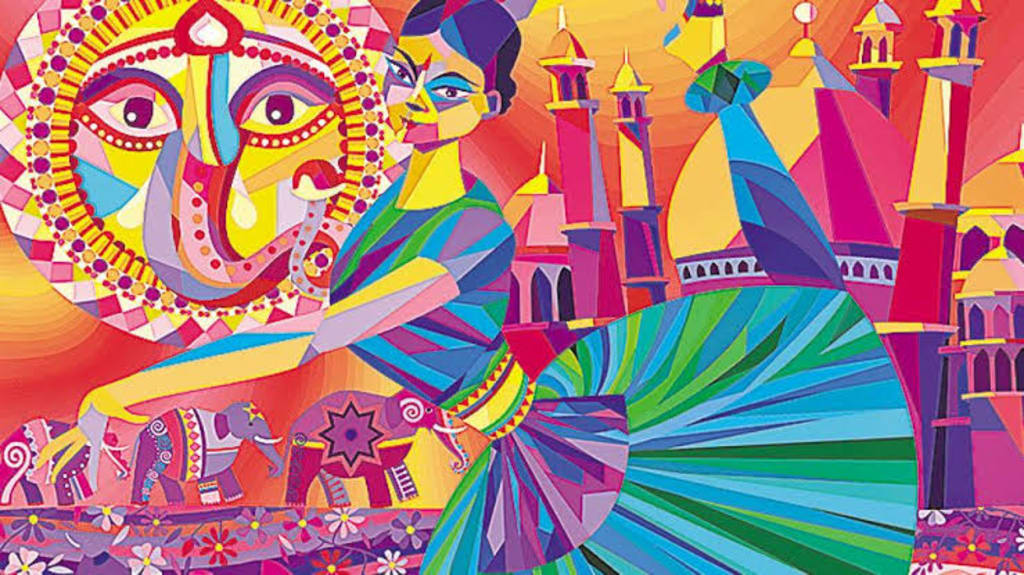
India is a country with boasts of rich culture .The country of India refers to a collection of miner unique culture.
The culture of India comprises of clothing ,festival ,dancing ,music, languages, food and art of India.
Through,
Indian culture is very popular across the world because of its Diversity in the field of art literature and philosophy.
The Indian culture is one the oldest culture in the world evolved 4500 year ago .Indian culture has been deeply influenced by Persian, Islamic and the Turkish cultures.
~PHILOSOPHY.
Indian philosophy comprises the phiolosophical traditions of the INDIAN SUBCONTINENT. There are six schools of orthodox "Hindu philosophy-Nyana", "Vaisheshika", "Samkhya", ''Yoga", "Mimamsa" and ''Vedanta" -and four heterodox school-"Jain", "Buddhist", "Ajivika" and "Carvaka" -last two are also schools of Hinduism. However, there are other methods of classification; Vidyaranuia for instance identifies sixteen schools of Indian philosophy by including those that belong to "Saiva" and "Rasesvara traditions.
~CUSINE.
Indian food is diverse as India. Indian cuisines use numerous ingredients, deploy a wide range of food preparation styles, cooking techniques, and culinary presentation. From salads to sauces, from vegetarian to meat, from spices to sensuous, from bread to deserts, Indian cuisine is invariably complex.
HAROLD McGEE,
A favourite of many Michelin-starred Chefs, ''for sheer inventiveness with milk itself as the primary ingredient no country on earth can match the India."
" I travel to India at least three to four time a year. It's always inspirational. There is so much to learn from India because each and every state is a country by itself and each has its own cuisine-it just amazes me. I keep my mind open and like to explore different places and pick up different influences as i go along. I don't actually think that there is a single state in India that i haven't visited."
~PERFORMING ARTS.
India has had a long romance with the art of dance. the Hindu Sanskrit texts " Natya Shastra" (science of dance) and " Abhinaya Darpana" (Mirror of gesture) are estimated to be from 200 BCE to early centuries of the 1st millennium CE.
The Indian art of dance as taught in these ancient book, according to Ragini Devi, is the expression of inner beauty and the divine in man. It is a deliberate art, nothing is left to chance, each gesture seeks to communicate the ideas, each facial expression the emotions.
~Clothing.
Traditional clothing in India greatly varies across different parts of the country and is influenced by local culture, geography, climate, and rural\urban settings. Popular styles of dress include draped garments such as "Sari" and "mekhela sador" for women and "Dhoti" or "Lungi" or "Panche" (in kannada) for men.
Stitched clothes are also popular such as "Churidar" or " salwar-kameez" for women with a long scarf (dupata) thrown over shoulder completing the outfit .The salwar is often loose fitting, while churidar is tighten cut.
The DASTAR, a headgear worn by Sikhs is common in Punjab ...
~Martial Arts.
One of the best known forms of ancient Indians martial arts is the "KALARIPPAYATTU" from Kerala. The ancient fighting style is mentioned in "SANGAM LITRERATURE" 400 BCE and 600 CE and is regarded to one of the oldest surviving martial arts.
In this form of martial arts, various stage of physical training include AYUREDIC massage with Sesame OIL to impart suppleness to the body (uzichil); a series of sharp body (miapayattu) and, complex sword fighting techniques.
For sure, I wrote only a few Artifacts and there is still lot of untold and unwritten info about Indian Culture but still a huge thanks for reading all of it :)
Stay blessed..
About the Creator
Keep reading
More stories from writers in Education and other communities.
7 Online Skills That Can Change Your Financial Future in 2026
7 Online Skills That Can Change Your Financial Future In today’s digital world, one skill can completely transform your life. Just a decade ago, making money online sounded unrealistic to many people. Today, thousands of people are building careers, businesses, and even financial freedom using only their laptops and internet connections. The truth is simple: the internet has created opportunities that never existed before. But the biggest mistake most people make is waiting for the “perfect moment” to start learning. The reality is that learning just one valuable online skill can open doors to income streams you never imagined. Here are seven powerful online skills that can truly change your financial future. 1. Content Writing Content writing is one of the easiest online skills to start with. Every website, blog, and online business needs high-quality content to attract readers and customers. If you can write helpful, interesting, or informative articles, you already have the foundation for this skill. Content writers earn money by writing: Blog posts Website content Product descriptions News articles Platforms like freelance marketplaces, blogging websites, and digital publications are always looking for good writers. With practice, many writers turn this skill into a full-time career. 2. Graphic Design In the online world, visuals matter. Businesses need logos, social media graphics, advertisements, and brand designs to attract attention. Graphic design allows creative people to turn their imagination into income. Even beginners can start by learning simple tools and gradually improving their skills. Graphic designers can work with: Small businesses Online brands Content creators Marketing agencies A single well-designed logo or brand package can sometimes earn more than weeks of traditional work. 3. Video Editing Video is the most powerful form of content on the internet today. From social media platforms to online courses, videos dominate the digital world. But most creators don’t have the time or skill to edit their own videos. This is where video editors come in. If you learn how to cut clips, add music, create smooth transitions, and improve video quality, you can become extremely valuable. Video editors are needed by: YouTubers Businesses Online educators Social media influencers The demand for video editing continues to grow every year. 4. Social Media Management Millions of businesses rely on social media to reach customers. But many business owners don’t know how to grow their pages, create content, or engage with their audience. Social media managers help brands: Plan content Post regularly Respond to followers Grow their audience With the right strategy, social media managers can manage multiple accounts and earn steady monthly income. This skill combines creativity with marketing knowledge, making it highly valuable. 5. Digital Marketing Digital marketing is one of the most powerful online skills you can learn. It involves promoting products, services, or brands through online channels such as search engines, social media, and email. Digital marketers help businesses get: More website visitors More customers More sales Companies are willing to pay well for people who can increase their revenue. Learning digital marketing can open doors to freelance work, remote jobs, or even your own online business. 6. Web Development Every business needs a website. But building a professional website requires technical skills. Web developers create and maintain websites using coding languages and development tools. Although this skill takes more time to learn than others on this list, it is also one of the highest-paying online skills. Many web developers work remotely and build websites for clients all around the world. Once you gain experience, the opportunities become endless. 7. AI Content Creation Artificial intelligence is rapidly changing the online world. Many creators and businesses now use AI tools to produce content faster and more efficiently. AI content creators use technology to generate: Articles Images Videos Marketing content People who understand how to use AI tools effectively have a huge advantage in the modern digital economy. Instead of replacing creativity, AI often amplifies it. Those who learn how to combine creativity with technology will be ahead of the curve. Final Thoughts The internet has made it possible for anyone, anywhere in the world, to build valuable skills and create new income opportunities. But knowledge alone is not enough. The real difference comes from taking action. Pick one skill from this list and start learning today. Practice consistently. Improve a little every day. Over time, that single skill could become the foundation of a completely different financial future. Because sometimes, all it takes is one skill to change everything.
By Baseer Shaheen 4 minutes ago in Education
A More Human Vocal
When we launched Vocal nearly a decade ago, the world was a very different place. LLMs did not exist, and stories were created one at a time by people sitting down to write, revise, and share something personal. Many of our assumptions about publishing, trust, and participation were built for a world where effort and output were inseparable.
By Justin @ Vocala day ago in Resources
"Scream 7" (2026): Running out of Fresh Screams
This is the seventh time we’ve had a Ghostface crisis. Scream 7 is the latest edition of the Scream franchise. Sydney Prescott and her family are under attack by another anonymous killer dressed in a Ghostface costume. While having issues with her daughter, Tatum, they run from the bloody murders, trying to determine who is behind it all.
By Marielle Sabbag5 days ago in Horror



Comments
There are no comments for this story
Be the first to respond and start the conversation.