
Architectural Feng Shui: The Role of the Bagua Map in Traditional Chinese Residences
Understanding the Bagua’s Influence on Traditional Home Layouts

Introduction: The Dual Bagua Maps in Feng Shui
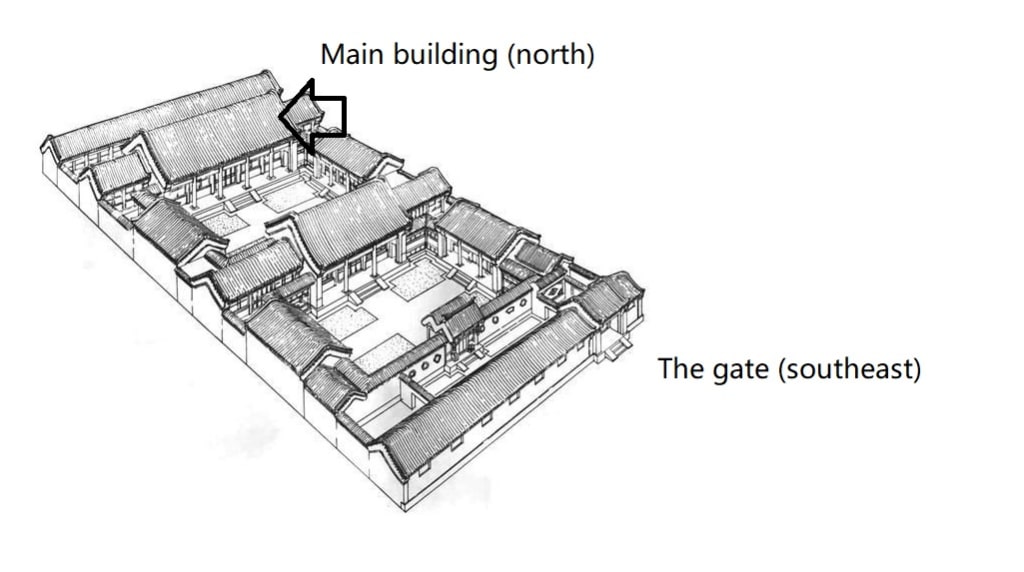
In Feng Shui, the two Bagua Maps from the I Ching serve distinct purposes. The "Later Heaven Chart" is primarily used to determine the orientation of a building and the relationships between its structural components. Since traditional Chinese architecture often adopts the courtyard house style (Siheyuan, 四合院), this article uses a siheyuan as an example to illustrate the correct application of the Bagua Map, focusing on the relationship between the main building and the courtyard gate.
Siheyuan: A Traditional Example of Feng Shui Application
As one of the three foundational theories of traditional Chinese architecture, Feng Shui deeply influences the siheyuan design. This architectural style incorporates numerous Feng Shui elements, and over time, these elements became part of a standardized framework. Readers will be gradually introduced to this architectural Feng Shui knowledge in future lessons.
Traditional Chinese architecture is laid out following the principles of the Later Heaven Chart. In a standard siheyuan layout, the main building is positioned in the Kan trigram of the Bagua, corresponding to the north of the courtyard and facing south. The courtyard gate, meanwhile, is located in the Xun trigram position, corresponding to the southeast at the front left of the main building. This layout is referred to as the "Kan Residence, Xun Gate" (坎宅巽门) design (Figure 1).
The Harmony Creation Cycle of Water and Wood
The "Kan Residence, Xun Gate" terminology reflects the relationship between the Five Element energies of the two orientations. According to the Later Heaven Chart, the north (Kan trigram) corresponds to the Water element, while the southeast (Xun trigram) belongs to the Wood element. In Five Element theory, Water generates Wood, creating a harmonious and supportive energy flow between these two positions. This "creation cycle" ensures that the energy fields of the main building and the gate are balanced and complementary.
The Role of the Main Entrance in Feng Shui
In Chinese Feng Shui, the main entrance of a building holds significant importance. It serves as a buffer, facilitating the communication and transformation of energy between the external environment and the internal space. A well-placed gate can enhance the overall energy dynamics of the residence.
The Southeast Xun Trigram: An Ideal Gate Location
From the perspective of Bagua theory, the southeast Xun trigram represents wind and the transitional energy field between spring and summer. This soft and gentle energy field makes the southeast a particularly suitable location for a gate. Consequently, traditional Chinese residences often place their gates in the southeast Xun trigram, forming a standard architectural Feng Shui pattern.
Avoiding the Ghost Gate: A Critical Difference in Western Feng Shui
In contrast, Western Black Hat Sect Feng Shui uses a concept called the "Three Door Bagua," which includes different gate positions. One such position is the northeast Gen trigram ( ) of the Bagua Map. However, in traditional Chinese Feng Shui, the northeast Gen trigram is known as the "Ghost Gate" (鬼门), and placing a gate in this location is avoided. For example, ancient Chinese cities followed the Later Heaven Chart for gate placement, opening gates at seven trigram positions while deliberately excluding the northeast Gen position to avoid the "Ghost Gate."
About the Creator
Lidong Yu
I am a Chinese Feng Shui consultant and educator, raised and trained in China. My work draws on classical Feng Shui traditions to help people better understand the relationship between themselves, their environments, and time through Qi.
What Real Residents Reveal About Co-Living in New York City
Finding housing in New York City can be overwhelming, especially for students, interns, and professionals moving from different parts of the world. While listings and pricing matter, real-life experiences often give the clearest picture of what living in a shared space is actually like. Looking at resident reviews can help uncover what truly makes a co-living experience successful—or challenging.
By Ausfab Groupabout 17 hours ago in Education



Comments (1)
Very interesting but complex. I will have to reread this but am excited about putting a gate in the south east!