
Ancient education system in India
Gurukulas
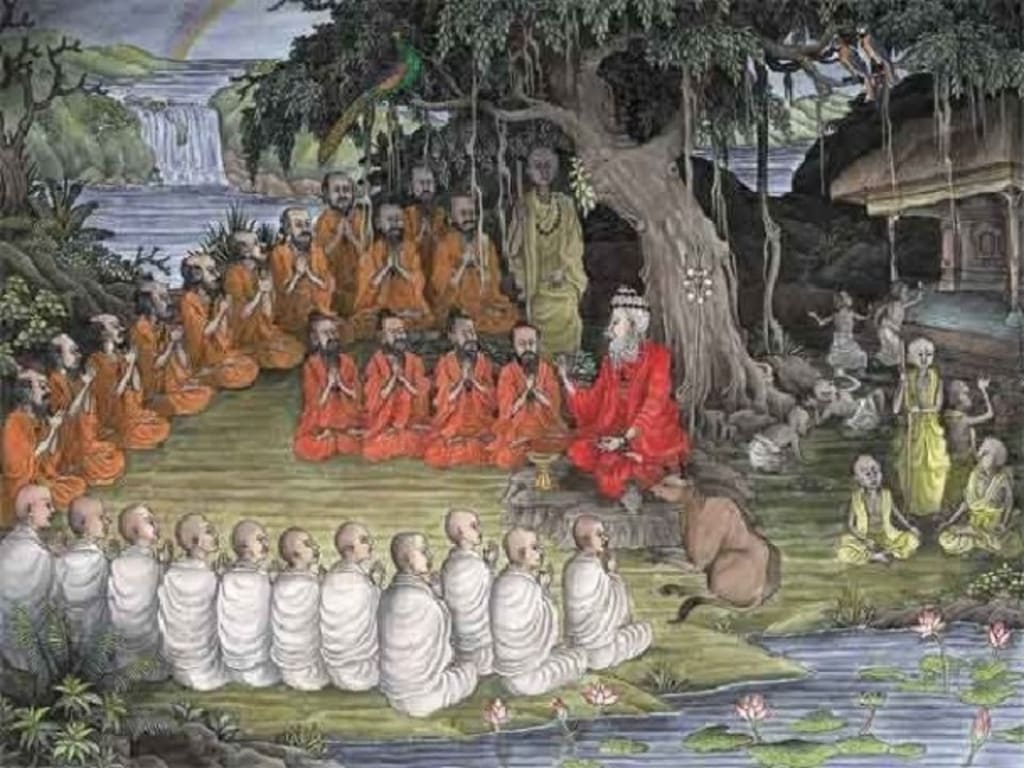
Ancient Indian Education System:
The education system in ancient India was known for its rich and diverse traditions of learning, which encompassed a wide range of subjects and disciplines. Education in ancient India was not limited to schools or universities, but was a lifelong process that started from an early age and continued throughout one's life.
The education system was divided into two categories: formal and informal. Formal education was mainly imparted in institutions known as gurukuls, where students lived with their teachers and received instruction in various subjects, including the Vedas, mathematics, astronomy, politics, and economics. The gurukul system was based on the guru-shishya parampara (teacher-disciple tradition), where the teacher imparted knowledge to the students and guided them in all aspects of life.
In addition to formal education, there was also a strong tradition of informal education in ancient India, where individuals could acquire knowledge through personal interactions with experts in various fields, such as philosophers, scholars, and artists. This tradition of informal education was based on the concept of guru-kula (family of teachers), where individuals would learn from multiple gurus throughout their lives.
In ancient India, the Gurukula system was a prevalent method of education. Gurukula, which literally means "the teacher's house," was a residential school where students lived with their teacher and received education in various subjects, including the Vedas, philosophy, mathematics, astronomy, medicine, and other arts and sciences.
The Gurukula system was based on the principle of personal and direct interaction between the teacher and the student, where the teacher imparted knowledge through lectures, discussions, and practical training. The students were also expected to perform various household and other chores, as a way of developing their character and learning the value of hard work.
The Gurukula system was prevalent in ancient India for centuries, and some famous Gurukulas included those of Takshashila, Nalanda, and Vikramshila. The students in these institutions were trained in various fields, including medicine, astronomy, mathematics, and other sciences.
The Gurukula system declined with the arrival of the British in India and the introduction of the Western education system. However, there have been attempts in recent times to revive the Gurukula system, and some schools in India still follow this ancient system of education. These schools aim to combine the traditional wisdom of the Gurukula system with modern educational methods, providing a holistic and well-rounded education to students.
One of the most important aspects of the ancient Indian education system was the emphasis on character building and moral values. Students were taught to cultivate virtues such as humility, respect, discipline, and compassion, which were seen as essential for leading a meaningful and fulfilling life.
Overall, the education system in ancient India was highly advanced and sophisticated, and its legacy continues to influence modern education systems in India and beyond.
EXAMPLES OF SOME ANCIENT LITERACY WORK:
1) ARTHASASTHRA:
Kautilya's Arthashastra is an ancient Indian treatise on statecraft, economics, and military strategy. It is attributed to Chanakya, also known as Kautilya or Vishnugupta, who was a renowned scholar and advisor to the Mauryan emperor Chandragupta. The Arthashastra is believed to have been written around the 3rd century BCE.
The Arthashastra is divided into 15 books, with each book discussing various aspects of statecraft, governance, economics, and military strategy. The topics covered in the Arthashastra include the organization of government, taxation, law and order, foreign policy, espionage, war and diplomacy, trade and commerce, and social welfare.
The Arthashastra emphasizes the importance of a strong and efficient government and provides detailed instructions on how to achieve this. It also lays out a comprehensive system of espionage and intelligence gathering, including the use of spies and secret agents. The Arthashastra also discusses the use of force in diplomacy and warfare, including the use of assassination, deception, and subterfuge.
Overall, the Arthashastra is a comprehensive and detailed treatise on statecraft and governance, providing valuable insights into the political and economic systems of ancient India.
2) THOLKAPPIAM:
Tholkappiam is a Tamil language grammar text written by the ancient Tamil scholar Tholkappiar. It is one of the earliest known works on Tamil grammar and was written in the 3rd century BCE. The text is divided into three parts: Ezhuththu, Sol and Porul.
Ezhuththu deals with the Tamil script and its letters. It explains the formation of words and their pronunciation. Sol explains the rules of Tamil grammar, including the different types of words, their classifications and the formation of sentences. Porul deals with the semantics of Tamil and explains the different ways in which words can be used to convey meaning.
Tholkappiam is an important text for Tamil linguistics and has had a significant impact on the development of Tamil language and literature. It is studied by Tamil scholars and students to this day and is considered a foundational work in Tamil grammar.
3) MANUSMRITI:
Manusmriti is an ancient Hindu legal text, believed to have been written between 200 BCE and 200 CE. It is one of the most important and influential texts in Hinduism and is considered to be one of the authoritative sources of Hindu law and social order.
The Manusmriti covers a wide range of topics, including the duties and responsibilities of kings, priests, and householders, the caste system, marriage, inheritance, and the treatment of women and other marginalized groups. It also contains teachings on morality, ethics, and spirituality.
The Manusmriti has been the subject of controversy in modern times due to its endorsement of the caste system and its treatment of women and other marginalized groups. Some critics argue that these teachings are outdated and should not be followed in modern society, while others argue that they are an important part of Hindu tradition and culture.
About the Creator
Keep reading
More stories from Ezhilarasan Pachamuthu and writers in Education and other communities.
Education system in present India
The education system in present-day India consists of a diverse mix of public and private institutions and a range of educational programs. The system includes primary, secondary, and tertiary education, with a focus on providing basic education to all citizens.
By Ezhilarasan Pachamuthu3 years ago in Education
Brands With Heart: How Purpose Drives Stronger Connections Than Products Alone
Today’s consumers don’t just shop for products. They search for meaning. While quality and price still matter, people are choosing brands that reflect their values. This is where building brands that connect through purpose becomes powerful. A brand with purpose tells a story people want to support. That story goes beyond selling something. It speaks to identity, belief, and belonging.
By Nathalie Kyriakouabout 16 hours ago in Education


Comments
There are no comments for this story
Be the first to respond and start the conversation.