
America’s Military Power: A Comprehensive Look at U.S. Armed Forces and Global Reach
Inside the World’s Most Powerful Armed Forces: How America’s Military Dominance Extends Across Land, Sea, Air, Space, and Cyberspace

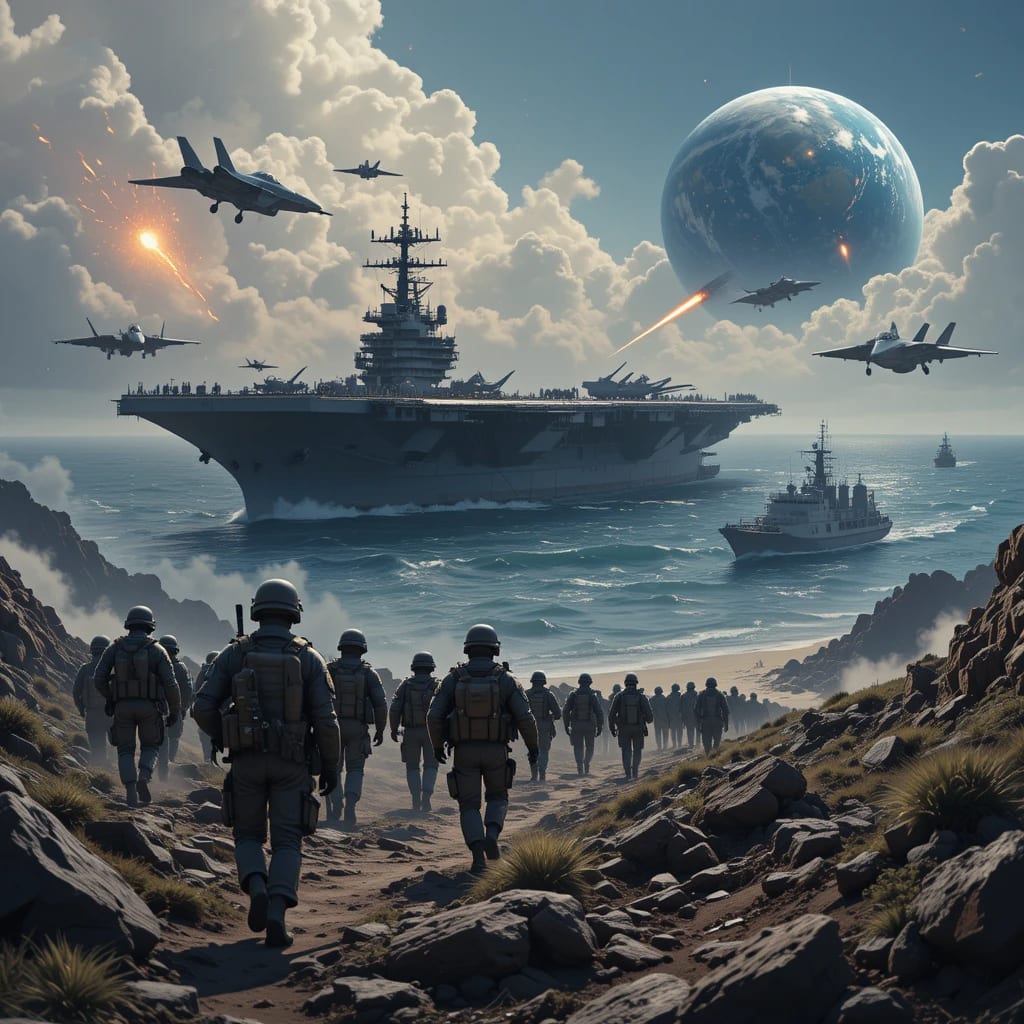
The United States of America possesses the most advanced and powerful military force in the world. Spanning multiple branches with cutting-edge technology, a massive budget, and a truly global presence, America’s armed forces play a central role in international security and geopolitical affairs.
Structure of the U.S. Military
The U.S. military is composed of six primary branches, each with its own mission and capabilities:
1. U.S. Army
The Army is the largest and oldest branch, responsible for land-based military operations. It includes infantry, armored divisions, artillery, and specialized units. The Army has more than 1 million active-duty and reserve soldiers.
2. U.S. Navy
America’s naval power is unmatched. The Navy operates aircraft carriers, submarines, destroyers, and amphibious ships. Its primary mission is to protect maritime interests, ensure freedom of navigation, and project power across oceans. The U.S. Navy has 11 nuclear-powered aircraft carriers, more than any other nation.
3. U.S. Air Force
The Air Force commands the skies with fighter jets, bombers, drones, and transport aircraft. It is also responsible for America’s nuclear missile arsenal and operates advanced reconnaissance satellites. With fleets like the F-22 Raptor and B-2 Spirit Stealth Bomber, it is a cornerstone of U.S. military supremacy.
4. U.S. Marine Corps
The Marines are a rapid-response force specializing in amphibious assault and expeditionary warfare. They can quickly deploy to crises worldwide, often operating from Navy ships. The Marine Corps emphasizes speed, flexibility, and the ability to seize and hold critical terrain.
5. U.S. Space Force
Established in 2019, the Space Force is the newest branch, responsible for defending American interests in space. It oversees military satellites, missile warning systems, and space surveillance networks. The Space Force reflects the growing importance of space in defense strategy.
6. U.S. Coast Guard
While often associated with maritime law enforcement, the Coast Guard is a military service operating under the Department of Homeland Security in peacetime and the Navy during wartime. It conducts search and rescue, drug interdiction, and security missions along U.S. coastlines and international waters.
Global Footprint and Alliances
America maintains over 750 military bases in more than 80 countries, a presence unmatched by any other nation. Bases in Germany, Japan, South Korea, and the Middle East enable the U.S. to respond rapidly to threats and support allies. NATO, a military alliance formed after World War II, further amplifies American influence by integrating forces across Europe and North America.
Nuclear Triad
A defining feature of U.S. military power is the nuclear triad, which consists of:
Land-based intercontinental ballistic missiles (ICBMs) in underground silos.
Submarine-launched ballistic missiles (SLBMs) aboard Ohio-class submarines.
Strategic bombers capable of delivering nuclear weapons anywhere in the world.
This triad ensures second-strike capability and serves as a deterrent against nuclear attacks.
Technology and Innovation
America invests heavily in military technology. The annual defense budget exceeds $800 billion, funding advanced programs such as:
Hypersonic weapons, capable of traveling more than five times the speed of sound.
Cyber warfare units defending critical infrastructure and conducting offensive operations.
Artificial intelligence to process battlefield information and support decision-making.
Next-generation aircraft like the B-21 Raider stealth bomber.
Special Operations Forces
The U.S. military has elite special operations units known worldwide:
Navy SEALs, famous for high-risk missions, including the operation to eliminate Osama bin Laden.
Army Delta Force, specializing in counterterrorism and hostage rescue.
Air Force Pararescue, trained to save lives in the most dangerous conditions.
These forces are often deployed in small teams for precision missions with strategic impact.
Humanitarian and Peacekeeping Roles
Beyond combat, the U.S. military plays a vital role in disaster relief and humanitarian assistance. After earthquakes, tsunamis, or disease outbreaks, American forces provide food, medical care, and engineering support. The Navy’s hospital ships, like the USNS Mercy, have treated thousands during crises.
Conclusion
America’s military power is built on a combination of professional training, unmatched technology, and global alliances. Its reach extends across every domain—land, sea, air, cyber, and space—making it a decisive force in world affairs.
While its capabilities are formidable, the U.S. military also bears great responsibility. Balancing strength with diplomacy and maintaining ethical standards remain central to ensuring that this power contributes to stability and peace.
About the Creator
Kiranmala: the legend of the princess who considered magic mountain
Long ago, in a land far away, the queen was panicked, her grasp on reality seemingly slipping. She had given birth to two boys and one girl. But to her horror, before even meeting their father, each child vanished, something else taking their place. She faced accusations of witchcraft and demon sorcery. And though the king loved her, he was easily swayed. He soon grew doubtful and banished his wife, who left the kingdom in anguish. Little did they know, the queen’s jealous sisters were the ones to replace the newborns
By Munesh Yadav3 days ago in Education
Restored to Its Roots: The Homecoming of a Historic Waterwheel
The quiet sound of rushing water once again spins a historic waterwheel in its original location. After decades of absence, the wheel has returned to the same stream it once relied on for power, bringing a sense of closure and continuity to a community that never forgot its value. This return marks not just the restoration of a structure but the revival of a piece of living history.
By Grady Gastonabout 3 hours ago in Education
Center Stage with Paul Stewart
*** I'm keen to republish the interviews I did for my series with Vocal creators. It's been a few years and I thought it might be nice to revisit these wonderful conversations. I'll be releasing them one at a time for a few weeks/months.
By Heather Hubler4 days ago in Interview



Comments
There are no comments for this story
Be the first to respond and start the conversation.