
Alternative Investments for Passive Income: A Comprehensive Guide
Discover the best alternative investments for passive income, including real estate, peer-to-peer lending, dividend-paying stocks, ships and more. Learn how to diversify your portfolio and generate sustainable income.


In today’s economy, generating passive income is increasingly appealing to individuals looking to diversify their financial resources and achieve greater financial independence. While traditional options like stocks and bonds are popular, alternative investments are now gaining traction for their potential to provide sustainable, steady cash flows with the benefit of lower correlation to the stock market.
I. Introduction
Definition of Passive Income
Passive income refers to earnings generated with minimal effort on the part of the investor. Unlike traditional active income from a job or business requiring daily involvement, passive income offers a way to earn while reducing the amount of ongoing, hands-on effort.
Importance of Diversifying Income Streams
Relying on a single source of income often carries risks, especially in volatile markets. Diversifying income sources offers a hedge against market downturns, industry disruptions, and employment risks, building a more resilient financial future.
Brief Overview of Alternative Investments
Alternative investments encompass a broad range of assets outside traditional stocks, bonds, and cash. These assets can include real estate, commodities, peer-to-peer lending, private equity, and more. Many of these investment types are well-suited to generate passive income and may provide the added benefit of diversification.
Thesis: How Alternative Investments Can Generate Sustainable Passive Income
By investing in alternative assets, individuals can create multiple income streams that offer unique advantages, including reduced stock market correlation, inflation hedging, and tax benefits. This guide will dive into the most effective alternative investment types and show how each can become a valuable addition to your passive income portfolio.
II. Understanding Passive Income from Alternative Investments
What Constitutes Passive Income?
Passive income differs from earned income in that it does not require day-to-day involvement. It can come from dividends, rental payments, interest from lending, and various other methods that require only initial capital and limited maintenance.
Key Benefits of Passive Income Strategies
Passive income is highly desirable for the stability it brings to one's financial life. Key benefits include:
Financial Independence: Passive income streams provide a safety net that allows more freedom from traditional work.
Time Flexibility: With less day-to-day involvement, passive income allows you to spend your time on other pursuits.
Scalability: Passive income strategies can be expanded, reinvesting returns to create exponential growth over time.
Potential of Alternative Investments in Generating Passive Income
Alternative investments offer unique ways to earn income, often with lower correlation to the stock market. For those looking to generate consistent income, alternative investments can provide returns through dividends, rent, or interest payments while offering diverse risk exposures.
III. Top Alternative Investments for Passive Income
Real Estate Investment Options
Real estate has long been a popular asset class for passive income, providing a tangible asset that can appreciate over time.
Real Estate Investment Trusts (REITs)
REITs allow investors to gain real estate exposure without directly owning or managing properties. Publicly traded REITs offer liquidity, and their dividends are often substantial.
Crowdfunded Real Estate Platforms
Platforms like Fundrise and RealtyMogul allow small investors to participate in large real estate projects with relatively low capital. These platforms often provide quarterly or monthly payouts, which contribute to passive income streams.
Rental Property Investments
Rental properties provide income from tenant payments and can appreciate over time, further growing wealth. However, property management can require some involvement, though hiring a management company can make this a more passive investment.
Peer-to-Peer Lending
P2P lending platforms enable investors to lend small amounts to individual borrowers or businesses, offering the potential for substantial returns.
Platform Overview
Platforms like LendingClub and Prosper facilitate P2P lending by connecting investors with individuals seeking loans. The platforms handle loan applications and credit evaluations, making this a relatively passive investment.
How P2P Lending Works
Investors earn interest payments from borrowers, generating passive income over the loan term. Loan terms vary, and investors can select different risk levels that affect their return rate.
Risk Assessment
P2P lending carries credit risk since borrowers may default. Diversifying across numerous borrowers can help mitigate individual risk.
Expected Returns
Returns vary by platform and loan grade, with many investors earning between 5% and 12% annually.
Dividend-Paying Stocks
Dividend stocks, particularly those in alternative sectors, offer regular payments without selling shares.
Preferred Stocks
Preferred stocks typically offer fixed dividend payments with a higher claim on assets than common stocks, making them a reliable income source.
Dividend Aristocrats in Alternative Sectors
Dividend Aristocrats—companies with consistent, rising dividends—are a popular choice for passive income. Sectors like energy, utilities, and telecommunications often provide alternative options outside traditional markets.
Maritime Assets Investment
Investing in maritime assets like shipping containers and vessels offers unique diversification opportunities with potential for strong cash flow.
Container Investment
Investors can purchase containers leased to shipping companies. This investment can yield returns based on container utilization and shipping demand.
Ship Investment
While higher risk, investing in ships can provide significant returns through charter fees. Platforms now make ship investment accessible, pooling smaller investments for greater participation.
Investment Platforms and Methods
Various platforms facilitate maritime asset investment, providing streamlined ways to purchase shares or full ownership in maritime assets.
Income Generation Methods
Maritime investments generate income through leasing fees and freight rates, which fluctuate with global trade demands.
Risk Management
Managing risks involves careful selection of asset types and contracts to minimize losses from fluctuating demand or maintenance costs.
IV. Strategies for Building a Passive Income Portfolio
Diversification Techniques
A diversified portfolio spreads risk across asset classes, reducing vulnerability to single-asset fluctuations.
Risk Management
Effective risk management involves selecting investments that align with your risk tolerance and balancing higher-risk assets with more stable options.
Portfolio Allocation Strategies
Allocating funds based on income needs, risk profile, and growth goals can help optimize returns and maintain financial stability.
Regular Portfolio Review and Rebalancing
Periodic rebalancing ensures alignment with financial goals, adjusting for market changes and reinvesting returns to compound growth.
V. Tax Considerations
Tax Implications of Different Alternative Investments
Each alternative investment type has unique tax implications. Understanding capital gains tax, dividend tax, and rental income tax will help optimize tax efficiency.
Strategies for Tax-Efficient Passive Income Generation
Investors can use tax-advantaged accounts, defer gains, or harvest losses to reduce tax impact and increase net returns.
Consulting with Tax Professionals
Consulting a tax professional ensures compliance with tax laws and allows you to explore potential deductions and credits.
VI. Common Pitfalls to Avoid
Over-Concentration in a Single Asset
Investing too heavily in one asset class increases risk. Diversifying into multiple alternative investments provides greater stability.
Ignoring Due Diligence
Due diligence is essential. Avoiding thorough research can lead to unanticipated losses and missed opportunities.
Underestimating Investment Complexity
Some alternative investments are complex and may require specialized knowledge to manage effectively.
Unrealistic Return Expectations
Setting realistic return expectations prevents disappointment and reduces the risk of taking excessive risks in pursuit of high returns.
VII. Technology and Passive Income
Role of Fintech Platforms
Fintech platforms make alternative investments more accessible, automating processes and reducing the need for intermediaries.
Emerging Investment Technologies
New technologies, such as blockchain and AI, enable innovative approaches to asset management and portfolio diversification.
Automation Tools for Passive Income Management
Automation tools help streamline the passive income process, automating reinvestment and income distribution for efficient portfolio growth.
VIII. Getting Started: Step-by-Step Guide
Assess Your Financial Goals
Identifying financial goals shapes investment choices and prioritizes income stability, growth, or capital preservation.
Understand Your Risk Tolerance
Knowing your risk tolerance helps you select alternative investments that match your comfort level and financial objectives.
Research Investment Options
Conducting thorough research ensures you choose investments suited to your financial goals and passive income needs.
Start Small and Scale Gradually
Beginning with small investments minimizes risk, allowing you to build confidence and experience before scaling up.
Continuous Learning and Adaptation
Markets and technologies evolve, so continued learning is essential to adapting investment strategies and maximizing returns.
IX. Conclusion
Alternative investments present a compelling way to generate passive income and diversify portfolios. By exploring opportunities across real estate, P2P lending, maritime assets, and more, investors can build robust passive income streams. Researching, diversifying, and managing risk effectively are the keys to creating a sustainable, profitable portfolio. Embrace the journey into alternative investments and take your financial future to new heights.
FAQs About Alternative Investments for passive income
What is passive income?
Passive income refers to earnings generated with minimal ongoing involvement, often through investments.
How do alternative investments provide passive income?
Alternative investments offer income through dividends, rental payments, interest, and appreciation, often requiring less daily management.
What are REITs, and how do they generate income?
REITs (Real Estate Investment Trusts) invest in income-generating properties and pass on rental income to investors as dividends.
Are P2P loans a safe investment?
P2P loans carry risk, as borrowers may default. Diversifying across many loans can reduce individual risk.
How can I minimize taxes on my passive income?
Tax strategies like using tax-advantaged accounts and consulting a tax professional can help reduce tax liabilities on passive income.
Is it necessary to diversify alternative investments?
Diversifying alternative investments can help reduce risk and improve the stability of passive income streams over time.
About the Creator
Keep reading
More stories from Johnny Cash and writers in Education and other communities.
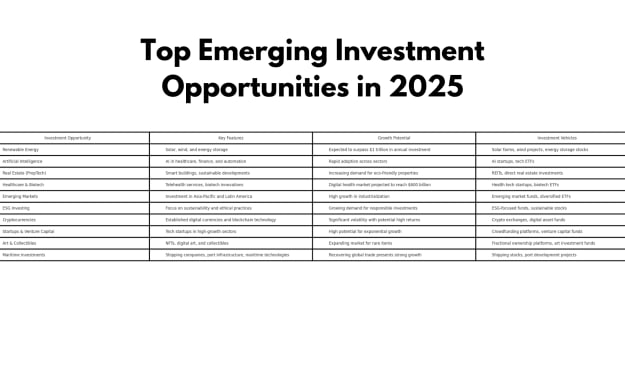
Top Emerging Investment Opportunities in 2025
Introduction to Emerging Investment Trends in 2025 As we approach 2025, the investment landscape is evolving rapidly, driven by technological advancements, shifting economic dynamics, and changing consumer behaviors. Identifying emerging investment opportunities is crucial for diversifying your portfolio and maximizing returns. Whether you're an experienced investor or just starting, staying adaptable and informed is essential in navigating these trends. The next few years promise exciting avenues for growth, and now is the perfect time to explore them.
By Johnny Cashabout a year ago in Education
Cover Assembly Screened in Aircraft Systems: Function, History, and Aerospace Applications
Introduction: My Research into Cover Assembly Screened Aircraft Components While studying aircraft hardware and aerospace structural parts, I recently explored a catalog listing dedicated to Cover Assembly Screened components used in aviation systems. During my research, I realized that even small parts like protective covers are essential for the reliability, safety, and longevity of aircraft electronics and mechanical assemblies.
By Beckett Dowhanabout 5 hours ago in Education
How the Sun Shapes Planetary Orbits: The Gravitational Power Behind the Solar System
The Sun’s Gravitational Dominance The Sun contains more than 99.8% of the total mass of the solar system. Because gravity depends on mass, the Sun’s enormous mass gives it overwhelming gravitational influence.
By shahkar jalal5 days ago in Education



Comments
There are no comments for this story
Be the first to respond and start the conversation.