


Artificial Intelligence (AI) is rapidly transforming the landscape of work, ushering in an era where automation, digital collaboration, and human-AI partnerships are redefining job roles and industries. Here's an overview of how AI is shaping the future of work:
---
### 🔄 From Co-Pilots to Autopilots: The Rise of AI Agents
AI systems are evolving from simple "co-pilots" that assist with tasks to more autonomous "autopilots" capable of executing complex operations with minimal human intervention. These advancements, driven by large language models and increased computing power, are enhancing productivity across sectors like healthcare, finance, and logistics. However, full autonomy remains a future goal, as current systems still require human oversight to manage challenges like data compatibility and ethical considerations. ([Financial Times][1])
---
### 📚 AI as a Personal Tutor and Equalizer
Nvidia CEO Jensen Huang utilizes AI tools like ChatGPT and Gemini Pro daily for learning, highlighting AI's potential to democratize education. By enabling natural language interactions, AI lowers barriers to information access, allowing individuals without technical backgrounds to acquire new skills. Huang emphasizes that embracing AI is crucial: "You're not going to lose your job to AI; you'll lose it to someone who uses AI." ([Business Insider][2])
---
### 🧠 Complementing Human Skills
Research indicates that AI often complements rather than replaces human skills. There's a growing demand for abilities like digital literacy, teamwork, and adaptability, which AI cannot replicate. Conversely, tasks involving routine data processing are more susceptible to automation. This shift underscores the importance of reskilling and focusing on uniquely human competencies. ([arXiv][3])
---
### 🧑💼 The Emergence of AI Managers
Microsoft envisions a future where employees act as "agent bosses," overseeing AI agents that handle various tasks. This model aims to enhance efficiency and innovation but also raises concerns about job displacement and the erosion of institutional knowledge. Balancing AI integration with human oversight is essential to maintain organizational integrity and customer relationships. ([The Guardian][4])
---
### 📉 Job Displacement and Economic Inequality
AI's impact on employment is multifaceted. While it can automate repetitive tasks, leading to job displacement in certain sectors, it also creates opportunities in AI development and maintenance. However, without strategic policies, there's a risk of exacerbating economic inequalities, as benefits may not be evenly distributed across the workforce. ([LinkedIn][5])
---
### 🧑🏫 AI in Education and Career Development
AI is poised to revolutionize education by providing personalized learning experiences and career guidance. Tools powered by AI can assist in CV writing, interview preparation, and identifying suitable career paths, especially beneficial in regions with limited access to traditional career counseling. This technological support can help bridge gaps in educational resources and employment opportunities. ([Latest news & breaking headlines][6])
---
### 🌍 Towards a Post-Work Society?
The concept of a post-work society, where AI and automation handle most tasks, is gaining attention. Proponents argue that this could lead to increased leisure time and a focus on creative and interpersonal pursuits. However, such a transition would require significant societal adjustments, including rethinking economic models and implementing measures like universal basic income to ensure equitable distribution of wealth. ([Wikipedia][7])
---
### 🔮 Navigating the AI-Driven Future
As AI continues to evolve, its integration into the workforce presents both opportunities and challenges. Embracing AI's potential while proactively addressing its implications on employment, ethics, and society is crucial. By fostering adaptability, continuous learning, and inclusive policies, we can harness AI to enhance human capabilities and build a more equitable future of work.
If you're interested in exploring how AI is impacting specific industries or seeking resources for upskilling in the AI era, feel free to ask!
About the Creator
you Don,t Need to Be perfect to Be creative - just start ugly
Creativity often gets trapped in the myth of perfection. We imagine that in order to create something worthwhile, we must have flawless ideas, the best tools, and impeccable execution. But the truth is, creativity doesn’t thrive under pressure for perfection—it thrives when we give ourselves permission to be messy, awkward, and imperfect. In other words: **just start ugly**.
By asma Khan9 months ago in Motivation
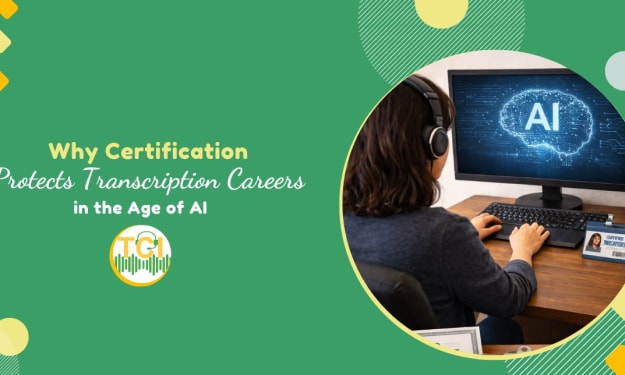
Why Certification Protects Transcription Careers in the Age of AI
Artificial Intelligence has rapidly transformed the transcription industry. Speech-to-text tools now promise instant results, lower costs, and effortless productivity. For businesses focused purely on speed, AI often appears to be the perfect solution. However, beneath this promise lies a critical reality: speed without accuracy creates risk.
By Mahesh Kumar6 days ago in Education
How Japan saved its biggest city from collapse
400 years ago, modern-day Tokyo was known as Edo, and it was already one of the biggest cities in the world, with a population approaching 1 million. However, it was on the verge of ecological collapse. Years of intense logging had led to massive deforestation. The city now faced timber shortages and the impacts of severe erosion and frequent flooding that threatened food supplies. But over just a few decades, Edo will transform and become one of the most sustainable and efficient cities in history.
By Munesh Yadav4 days ago in Education



Comments
There are no comments for this story
Be the first to respond and start the conversation.