
Afghanistan Up Close: Geography, People, and Diplomatic Dynamics
English
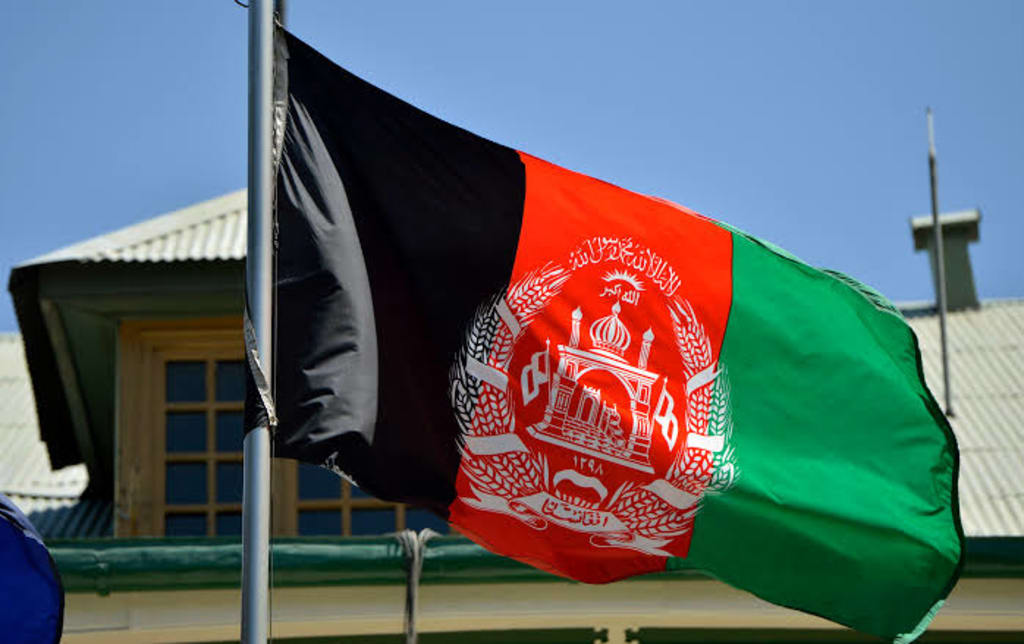
nistan, a country nestled in Central Asia, boasts a fascinating blend of history, culture, and geography that's often hidden from the world's view. As we embark on this exploration, let's begin by dissecting the emblematic Afghan flag, which serves as a visual representation of the nation's past, present, and future.
The flag is a composition of three horizontal stripes: red, black, and green. Each stripe carries profound symbolism. The red stripe stands as a tribute to the valiant individuals who fought to defend Afghanistan's sovereignty. Black, the color of the middle stripe, resonates with the nation's tumultuous history, reflecting the struggles and challenges it has faced. The green stripe, positioned at the bottom, embodies hope, the promise of a brighter future, and the Islamic faith, which holds a significant place in Afghanistan's cultural tapestry.
Central to the flag's design is Afghanistan's emblem, a work of intricate artistry. This emblem showcases a mosque flanked by miniature Afghani flags on both sides, a unique detail that sets Afghanistan apart on the global stage. Within the emblem, sheaves of wheat allude to the nation's agricultural prowess. The Shahada, the fundamental creed of Islam, is prominently displayed, emphasizing the religious foundation of Afghan identity. Arabic inscriptions include Afghanistan's name and the year 1298 in the Arabic calendar, which corresponds to 1919 in the Gregorian calendar. This symbolic year marks Afghanistan's transition from a British protectorate to an internationally recognized independent nation.
Shifting our gaze to Afghanistan's geographical landscape, we find a land steeped in history and strategic importance. The country shares its borders with six neighboring nations. If we consider the Jammu Kashmir region as part of India, the count rises to seven, igniting discussions of complex regional dynamics. The northeastern part of Afghanistan stretches into the formidable Hindu Kush mountain range, creating a long and slender territory. This panhandle holds historical significance, entwined with the power struggles of the British and Russian empires in the 1800s. As these empires vied for dominance, Afghanistan stood as a pivotal crossroads. Ultimately, the British gained control, leading to the delineation of borders. The Durand Line demarcated the frontier with British India, while the Panj and Pamir rivers defined Afghanistan's boundaries with the Russian Empire, leaving the enigmatic Wakhan Corridor as a buffer zone.
Geographically, Afghanistan's landscape is a symphony of diversity. Mountains dominate the scene, particularly the Hindu Kush range that blankets the northeastern and central regions. This range acts as a source of life-giving snowmelt, nourishing the extensive river systems that crisscross the nation. These rivers breathe life into lush valleys, where much of Afghanistan's agriculture thrives. Yet, despite this abundance of water, Afghanistan remains arid. Transitioning southward, especially around Kandahar, the terrain transforms into the Sistan Basin, a once-water-rich area now transformed into a desolate desert.
In terms of demographics, Afghanistan's population hovers around 31 million, akin in size to Canada. The Pashtuns, the largest ethnic group, form a slender majority and converse in Pashto. Other ethnic minorities include Uzbeks, Tajiks, and Hazaras. Interestingly, about 85% of Afghans, even the Pashtuns, communicate in Dari, a dialect of the Persian language Farsi. This linguistic commonality facilitates seamless interaction between Afghanistan and Iran. Notably, Afghanistan is also home to its last Jewish resident, Zablon Simintov, who resides in Kabul and upholds the sole remaining synagogue in the nation.
Afghanistan's relationships with its neighboring countries weave a complex web. Cultural bonds tie it to Iran, though tensions often cloud the horizon. Pakistan and India hold vital trade connections, albeit with occasional friction. Turkey stands as a steadfast ally, and their cooperative history spans over a century, fostering peace and collaboration.
In summary, Afghanistan is a hidden gem on the world map, characterized by a rich history, vibrant culture, and diverse geography. Its flag serves as a poignant symbol of its journey, while its intricate emblem echoes stories of resilience and faith. From the rugged mountains to the serene valleys, Afghanistan beckons explorers to uncover its beauty and complexity, revealing a narrative often untold.
About the Creator
Keep reading
More stories from Amalia Marina and writers in Education and other communities.
The Power Of Self Talk
As your morning alarm blares, a groggy thought slips from your lips, "Why did I set it so early?" Amid brushing your teeth, you contemplate the need for a haircut, or perhaps a new style altogether. Hastily rushing out the front door, you reach for your keys, only to discover their absence. Frustration bubbles up, leading to a muttered, "I can't do anything right!" just as your neighbor catches your eye. Speaking to yourself is an experience many share, yet it's often accompanied by embarrassment or even a stigma labeling it as a sign of mental instability. However, decades of psychological research have unveiled that talking to oneself is entirely commonplace. In fact, the majority, if not all, of us engage in some form of self-talk daily. The question then arises: Why do we talk to ourselves? And does the content of our inner monologue hold significance?
By Amalia Marina2 years ago in Humans
The Neural Network: China’s Automotive Wiring Harness Revolution in 2026
The automotive industry is often judged by its exterior design or engine horsepower, but in 2026, the real battle for dominance is happening under the chassis. As China solidifies its position as the world’s leading Electric Vehicle (EV) powerhouse, the Automotive Wiring Harness the literal nervous system of the vehicle has undergone a radical transformation. What was once a bundle of simple copper wires has evolved into a high-tech, high-voltage network capable of supporting rapid charging and autonomous driving. Driven by the 15th Five-Year Plan and the "Smart Mobility" mandate, the China automotive wiring harness market is currently valued at over $18.4 Billion in 2026. This "Neural Revolution" is not just about connectivity; it is about the survival of the fittest in an era where vehicles are becoming "computers on wheels."
By Neeraj kumarabout 2 hours ago in Education
One Hard Thing
Stop me if you’ve heard this one before: You have the number, you know your schedule- you’ve even picked out the perfect day and time to make this appointment. Shoot, you’ve even picked out alternative days and times just in case their schedules can’t accommodate you!
By Taylor Rigsby7 days ago in Motivation



Comments
There are no comments for this story
Be the first to respond and start the conversation.