
ADAM & EVE (First Man and Woman)
First Man and Woman)

Adam and Eve: The First Man and Woman
Adam and Eve are perhaps the most well-known figures in the Judeo-Christian tradition, representing the first human beings created by God in the biblical account of the Book of Genesis. Their story has been retold and reinterpreted countless times throughout history, inspiring art, literature, and religious thought across cultures and religions.
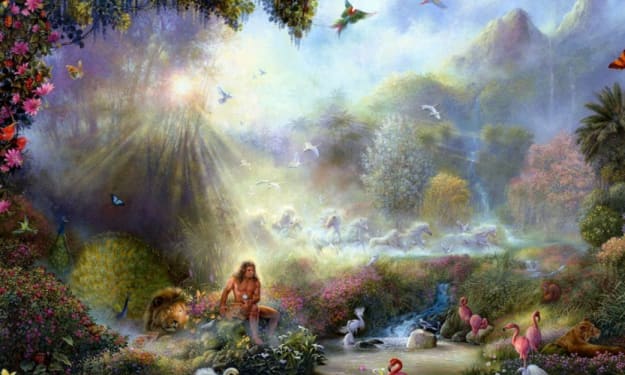
According to the biblical account, God created Adam out of the dust of the earth and breathed life into him, making him a living being. He then created Eve from one of Adam's ribs while he slept, thus creating the first man and woman. God placed them in the Garden of Eden, a paradise where they had everything they needed and were free to enjoy the fruits of the land. However, God warned them not to eat the fruit from the tree of knowledge of good and evil, or they would surely die.
But one day, tempted by the serpent, Eve ate the fruit and gave some to Adam, who also ate it. As a result, they became aware of their nakedness and were cast out of the Garden of Eden as punishment for disobeying God's commandment. This story has been interpreted in many ways throughout history, inspiring various religious and philosophical traditions.
In Christianity, Adam and Eve are often seen as the original sinners, whose disobedience brought sin and death into the world. Their fall from grace marked the beginning of humanity's separation from God, leading to a world filled with sin, suffering, and death. But their story also represents the hope of redemption and salvation through Jesus Christ, who came to save humanity from sin and restore our relationship with God.
In Judaism, the story of Adam and Eve is seen as a metaphor for the human experience, representing the struggle between our animal instincts and our higher nature. The tree of knowledge of good and evil symbolizes the human capacity for free will and moral choice, and our ability to choose between right and wrong.
Adam and Eve, the first man and woman, are central figures in the biblical account of creation. Their story has been a source of inspiration, contemplation, and debate for millennia, and has played a significant role in shaping religious and cultural traditions around the world. In this essay, we will explore the story of Adam and Eve in depth, examining its theological and philosophical implications, as well as its enduring relevance in contemporary society.
According to the biblical account, God created Adam from the dust of the earth and breathed life into him, making him the first human being. He then placed him in the Garden of Eden, a paradise filled with every type of fruit-bearing tree, where he was free to live and work as he pleased. However, God also gave Adam a commandment: not to eat the fruit from the tree of knowledge of good and evil. If he did, he would surely die.
Adam lived alone in the Garden of Eden for some time, tending to the plants and animals, but eventually, God saw that he was lonely and decided to create a companion for him. He put Adam into a deep sleep and took one of his ribs, from which he fashioned Eve, the first woman. When Adam awoke and saw Eve, he exclaimed, "This is now bone of my bones and flesh of my flesh; she shall be called 'woman,' for she was taken out of man" (Genesis 2:23).
Together, Adam and Eve lived in the Garden of Eden in perfect harmony, enjoying the bountiful fruits of the land and the company of one another. However, one day, they were tempted by the serpent, who convinced Eve to eat the forbidden fruit from the tree of knowledge of good and evil. She then gave some to Adam, who also ate it. As a result, they became aware of their nakedness and were cast out of the Garden of Eden as punishment for disobeying God's commandment.
The story of Adam and Eve has been interpreted in many different ways throughout history. For some, it is a literal account of the first humans and their fall from grace, while for others, it is a symbolic representation of the human experience. In either case, it raises important theological and philosophical questions about the nature of God, the origins of humanity, and the problem of evil.
One of the key theological implications of the story of Adam and Eve is the concept of original sin. According to Christian doctrine, Adam and Eve's disobedience in the Garden of Eden introduced sin into the world, tainting all of humanity with a fundamental inclination towards sinfulness. This doctrine has been central to many Christian traditions, particularly those that emphasize the need for salvation and redemption through faith in Jesus Christ.
However, the story of Adam and Eve also raises important philosophical questions about the nature of free will and the problem of evil. If God created humanity with the capacity to choose between good and evil, why did he punish Adam and Eve for exercising that choice? And if God is all-powerful and all-good, why does evil exist in the world at all?
These questions have been the subject of much debate and discussion among theologians, philosophers, and scholars throughout history. Some argue that the story of Adam and Eve is a metaphorical representation of humanity's struggle to reconcile its divine and earthly natures, while others see it as a cautionary tale about the dangers of hubris and disobedience.
Regardless of one's interpretation, the story of Adam and Eve remains a powerful and enduring symbol of the human experience. It speaks to our deepest fears and desires, our hopes and aspirations, and our capacity for both good and evil. It challenges us to question our assumptions, examine our values, and strive for a deeper understanding of ourselves and the world around us.
About the Creator
Keep reading
More stories from Ehsan Masih and writers in Education and other communities.
The Garden of Eden
The Garden of Eden: Portal of God's Glory The Garden of Eden is perhaps the most famous garden in all of history, known as the idyllic paradise created by God in the biblical account of the Book of Genesis. It is described as a place of lush beauty, abundant fruits, and perfect harmony between humanity and nature. But beyond its physical beauty, the Garden of Eden is also a symbol of God's glory and the portal through which humanity can enter into communion with the divine.
By Ehsan Masih3 years ago in Education
IQ Tests and the Human Mind: A Deeper Look
The human mind has fascinated scientists, philosophers, and educators for centuries. One of the most widely known tools for exploring human intelligence is the IQ test. Today, with easy access to an iq test free online, millions of people are discovering more about their cognitive abilities. But what do IQ tests really tell us about the human mind, and how should we interpret their results? Taking a deeper look reveals both the strengths and limitations of IQ testing in understanding intelligence.
By Fast Learnera day ago in Education
Life in the Ranks: The Overlooked Struggles of Military Service
Military life is often admired from a distance. The uniform, the discipline, and the mission all project a powerful image of strength. Yet, behind this image are real people facing real challenges. The structured lifestyle and constant state of readiness can be mentally and emotionally exhausting. Service members don’t just serve during deployments—they live a demanding reality every day, regardless of where they are stationed.
By Trish Schnabel3 days ago in Education



Comments
There are no comments for this story
Be the first to respond and start the conversation.