
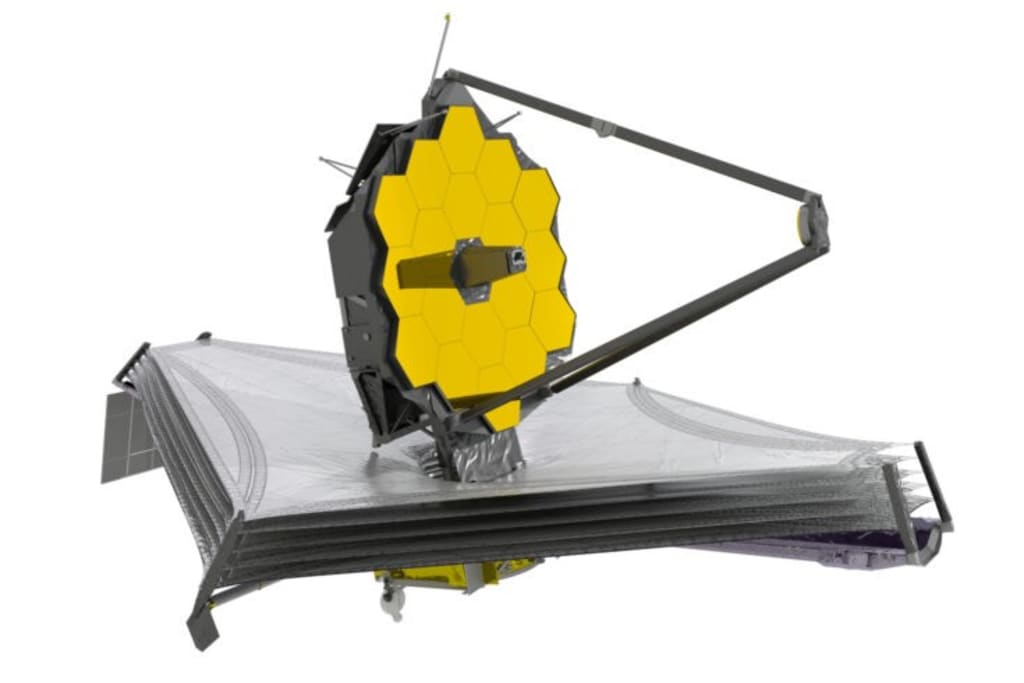
The James Webb Space Telescope (JWST) is a large, infrared space observatory developed by NASA in partnership with the European Space Agency (ESA) and the Canadian Space Agency (CSA). It is set to be the successor to the Hubble Space Telescope and is planned to be launched in 2021. JWST will be positioned at the second Lagrange point, approximately 1.5 million kilometers from Earth. It will have a 6.5-meter primary mirror and will be capable of observing the universe in infrared light, allowing it to study the formation of galaxies, stars, and planetary systems, as well as the evolution of planetary atmospheres and the search for habitable environments.
The James Webb Space Telescope (JWST) has the following specifications:
Launch Date: planned for 2021
Observatory type: Space-based, infrared
Orbit: Second Lagrange point, about 1.5 million km from Earth
Primary Mirror Diameter: 6.5 meters
Sunshield Size: Tennis court-sized, made of 5 layers of Kapton
Instrument Suite: Four main scientific instruments: Near InfraRed Camera (NIRCam), Near InfraRed Spectrograph (NIRSpec), Mid-Infrared Instrument (MIRI), and Fine Guidance Sensor/Near InfraRed Imager and Slitless Spectrograph (FGS/NIRISS)
Field of View: Approximately 100 times the size of the full moon
Operating Lifetime: Designed for at least 5.5 years, with a goal of 10 years or more.
These specifications, along with its advanced technology, make the JWST a powerful tool for studying the universe and answering important questions about the origins of galaxies, stars, and planetary systems, as well as the search for habitable environments.
The James Webb Space Telescope (JWST) is a re-designed version of the Next Generation Space Telescope (NGST), which was originally intended to be the successor to the Hubble Space Telescope. The project was renamed in 2002 to honor James E. Webb, who served as NASA's administrator during the Apollo program and played a key role in the development of many of the agency's early space missions. The JWST is a collaboration between NASA, the European Space Agency (ESA), and the Canadian Space Agency (CSA), and is designed to be the premier observatory for observing the universe in the infrared range. With its large primary mirror (6.5 meters in diameter) and advanced instrument suite, the JWST will provide scientists with new insights into the formation and evolution of galaxies, stars, and planetary systems, as well as the search for habitable environments. The JWST is planned to be launched in 2021.
The James Webb Space Telescope (JWST) is a large international collaboration involving hundreds of scientists, engineers, and technicians from around the world. The project is led by NASA, with significant contributions from the European Space Agency (ESA) and the Canadian Space Agency (CSA).
NASA's Goddard Space Flight Center is responsible for the overall management and development of the JWST, as well as the integration of the scientific instruments and the sunshield. The Space Telescope Science Institute (STScI) is responsible for the science operations of the JWST and for the selection of astronomical targets for observation.
ESA is providing the Ariane 5 rocket for the launch of the JWST and is also responsible for the development of the MIRI instrument. CSA is responsible for the development of the Fine Guidance Sensor and Near InfraRed Imager and Slitless Spectrograph (FGS/NIRISS) instrument.
In addition, a large number of industrial partners, universities, and research institutions are also involved in the development and testing of various components of the JWST. The total manpower involved in the JWST project is difficult to quantify, but it likely involves hundreds of individuals working over many years.
THANK YOU FOR READ
About the Creator
Reader insights
Nice work
Very well written. Keep up the good work!
Top insights
Expert insights and opinions
Arguments were carefully researched and presented
On-point and relevant
Writing reflected the title & theme
Keep reading
More stories from RIKAS MOHAMED and writers in Education and other communities.
The Human Guide Behind Technical Excellence
Mentorship of skilled technicians plays a decisive role in shaping strong careers and reliable work standards. Technical skill alone does not make a technician capable. Real growth comes from shared experience, steady guidance, and trust built over time. In many industries, mentorship fills the gap between classroom learning and real job demands. It helps technicians move from basic ability to confident performance. This article explores how mentorship supports learning, builds skills, and strengthens the future workforce.
By Michael Gastinela day ago in Education
Pioneering Therapies for Untreated Diseases
Medical science has made incredible progress in treating many illnesses. Yet, some diseases remain resistant to conventional therapy. These untreated diseases affect millions of people worldwide, causing long-term disability or shortened lifespans. Pioneering therapies for untreated diseases aim to fill this gap, offering hope where traditional treatments have failed. Scientists, clinicians, and biotech companies are working together to create therapies that are both innovative and effective.
By Dr. Janet Chollet2 days ago in Education



Comments
There are no comments for this story
Be the first to respond and start the conversation.