
A World Transformed by Technology
How Cutting-Edge Innovations Are Redefining Our World

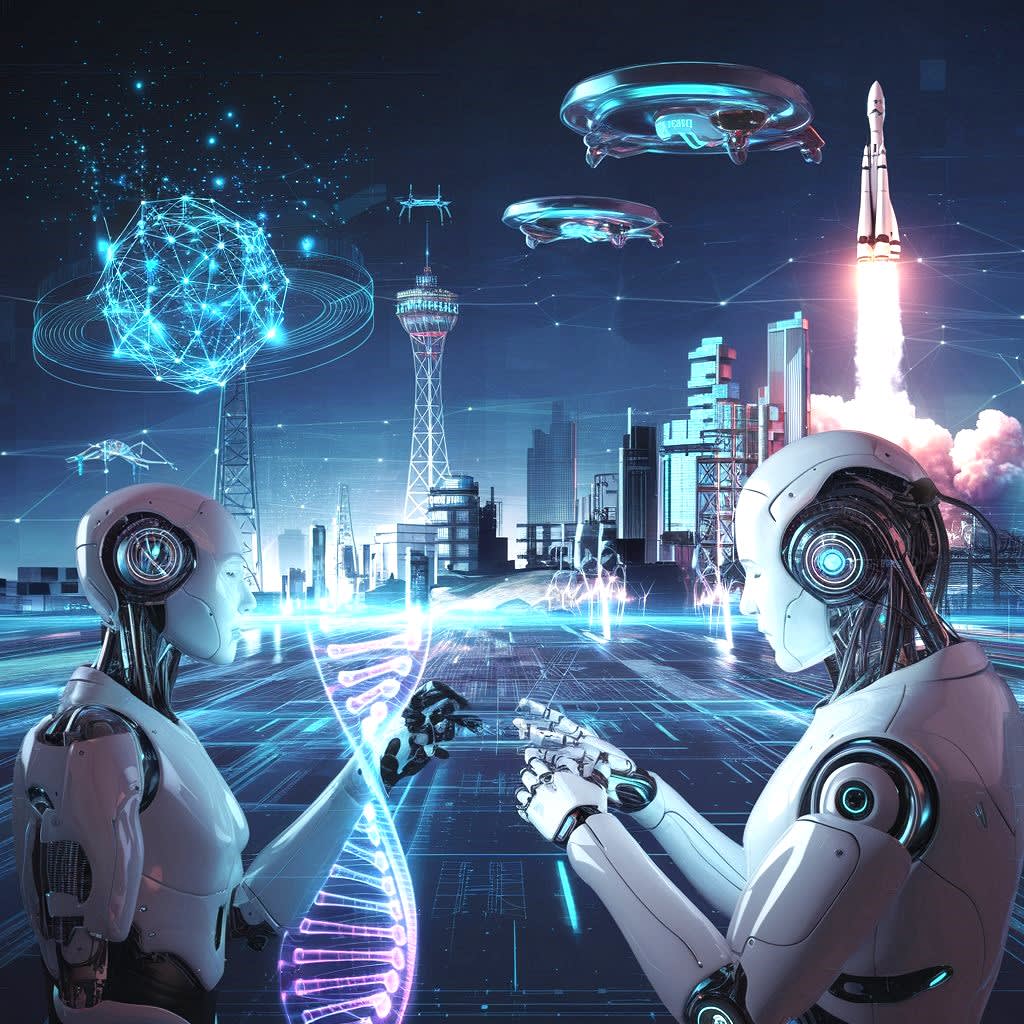
We are living in an era of unprecedented technological acceleration. Innovations are emerging at a rate that is reshaping entire industries, economies, and our day-to-day lives, making science fiction into reality. As we move through 2024, several key technologies stand out for their transformative potential. From artificial intelligence that can create and reason to quantum computers solving previously impossible problems, these advancements promise to redefine human capabilities. This article explores the seven most significant technological breakthroughs that are currently changing our world and will continue to do so in the coming years.
1. The Creative Revolution in AI and Generative AI Artificial Intelligence has evolved beyond simple pattern recognition to become a creative and analytical powerhouse. One of the most significant advances has been the rise of Generative AI: Multimodal Systems like GPT-4 and Google's Gemini can now process and generate text, images, audio, and video simultaneously, enabling more natural human-computer interactions.
As AI automates complex tasks in software development (GitHub Copilot) and legal research (AI contract analysis), industry transformations are taking place. Healthcare Breakthroughs include AI systems that can predict protein structures (AlphaFold) and assist in early disease detection through medical imaging analysis.
Ethical Frontiers have emerged as governments race to establish frameworks for responsible AI development, addressing concerns about bias, misinformation, and job displacement.
What makes 2024 particularly remarkable is how these AI systems are moving from research labs into practical, everyday applications across all sectors of the economy.
2. Quantum Computing: Solving the Impossible
Quantum computing has transitioned from theoretical research to practical applications, with several key milestones reached in 2024
Qubit Stability has improved dramatically, with companies like IBM and Google maintaining quantum coherence for longer periods, enabling more complex calculations.
Emerging Real-World Applications include: Financial modeling for predicting complex markets Materials Science for discovering new superconductors
Logistics Optimization for global supply chains
Security Implications are profound as quantum computers threaten current encryption standards, spurring development of post-quantum cryptography.
While full-scale quantum advantage may still be a few years away, 2024 has seen the first commercially viable quantum solutions for specific niche applications.
3. Extended Reality: Blending Digital and Physical Worlds
The extended reality (XR) spectrum - encompassing AR, VR, and MR - is achieving mainstream adoption:
Apple's Vision Pro has demonstrated the potential of spatial computing, offering seamless integration of digital content into physical spaces.
Enterprise Adoption is accelerating with:
Virtual training simulations for high-risk professions
Remote collaboration tools that create shared 3D workspaces
Digital twin technology for manufacturing and urban planning
Consumer Applications are expanding into areas like immersive education, virtual tourism, and next-generation entertainment.
The technology has moved beyond the initial hype phase into practical, value-driven implementations across multiple sectors.
4. The Connectivity Revolution: 5G Evolution and 6G Horizons
Connectivity infrastructure is undergoing its most significant transformation since the advent of mobile internet:
5G Advanced deployments in 2024 are delivering:
Ultra-reliable low-latency communication for industrial automation
Network slicing capabilities for customized enterprise solutions
Enhanced mobile broadband for data-intensive applications
6G Research is already underway, with prototypes demonstrating:
Terahertz frequency communication
AI-integrated network management
Holographic-type media streaming
IoT Expansion is being enabled by these networks, supporting smart cities with millions of connected devices per square kilometer.
This connectivity leap is creating the foundation for other technologies like autonomous vehicles and Industry 4.0 to reach their full potential.
5. Biotechnology: Engineering Life Itself
Biotech innovations in 2024 are blurring the line between biology and technology:
CRISPR 2.0 systems offer unprecedented precision in gene editing, with applications including:
Genetic disease treatments now in clinical trials Agricultural improvements for climate-resistant crops Bio-manufacturing of sustainable materials
Neural Interfaces are achieving remarkable milestones, with brain-computer devices restoring mobility to paralysis patients.
Longevity Science has seen significant investments, with AI-driven drug discovery identifying promising anti-aging compounds.
These advancements raise important ethical questions that society must address as the technology progresses.
6. Robotics & Autonomous Systems: The Rise of Intelligent Machines
Robotics technology has reached an inflection point in capability and adaptability:
Humanoid Robotics platforms like Tesla's Optimus are demonstrating:
advanced mobility in environments that are not structured Learning capabilities through AI and simulation
Potential for mass production and affordability
Autonomous Systems are expanding into:
Last-mile delivery drones
Robotic process automation in offices Self-maintaining industrial equipment Swarm Robotics enables coordinated groups of simple robots to accomplish complex tasks collectively.
The robotics revolution is transforming labor markets and creating new opportunities across industries.
7. Sustainable Technology: Saving Our Planet with Innovation
Climate challenges are driving remarkable clean tech innovations:
Nuclear Fusion has achieved net energy gain in multiple experimental reactors, with private companies like Helion making rapid progress.
Carbon Tech includes:
Direct air capture systems scaling up globally
Advanced battery recycling solutions
Green hydrogen production breakthroughs
Circular Economy technologies are enabling near-complete material reuse in manufacturing.
These solutions are becoming economically viable just as climate urgency reaches critical levels.
Conclusion: Navigating the Future
The technologies of 2024 represent both extraordinary opportunities and significant challenges. As these innovations mature and converge, they promise to
Solve some of humanity's greatest problems
Create entirely new industries and job categories
Raise important questions about ethics, security, and equality The pace of change requires continuous learning and adaptation from individuals, businesses, and governments alike. The best people to succeed in the coming decade of change will be those who comprehend and embrace these technologies.
About the Creator
Keep reading
More stories from Rocky Brahma and writers in Education and other communities.
A Multifaceted Journey from Battlefield to Newsroom
Pete Hegseth stands out as a figure whose life has been shaped by military service, conservative advocacy, and a talent for provocative commentary in the dynamic media and politics of the United States. As a Fox News host, decorated veteran, and author, Hegseth embodies a fusion of patriotism and political fervor, making him a polarizing yet influential voice in contemporary discourse. This article explores his journey, values, and the controversies that have defined his public persona.
By Rocky Brahma11 months ago in Education
Leading in a Remote World: Tips for Virtual Team Success
In today’s fast-paced, interconnected world, remote work has become more than just a trend—it’s a fundamental shift in how businesses operate. Leaders now face the unique challenge of managing virtual teams while ensuring productivity, collaboration, and team morale. This article delves into practical tips for successfully leading remote teams and overcoming common obstacles.
By Sanjeev Kumar5 days ago in Education
I wanted to title this something different, but worried that my chosen title might cause problems entering the United States in the future so this is the new title. It's the greatest title. No one has ever written a title better than this. (All titles unrelated to content).
Let me be honest. I am finding this difficult. Now, I like a challenge, a stretch, a bit of an obstacle course. “Write about the decline of the British Empire in the form of a narrative poem in which your protagonist is an artichoke” I read, and flex my fingers. “Write a haiku to evoke the sensation of sibilance using only the first half of the alphabet.” “Well”, I think to myself, “this should be fun.” But “write about a system that isn’t working”? A system that isn’t working? Now? In 2026? ONE system? My favourite system that isn’t working? The sexiest system that isn’t working? The one giving me the most angst day to day? The one giving me the most existential dread? I am, as I say, finding this difficult. I will own that I have contemplated writing a thousand words on why the steady “all on” setting on my fairy lights is the EIGHTH of seven options which must be sequentially activated to get there, because that is a system that some fool came up with and it definitely doesn’t work, and now who is paying the price, eh? But how can I write about my fairy lights when…. When…. When….
By Hannah Moore4 days ago in Humans




Comments
There are no comments for this story
Be the first to respond and start the conversation.