
A True Hero!
Chalk, Passion, and Microsoft Word: The Inspiring Story of Owura Kwadwo

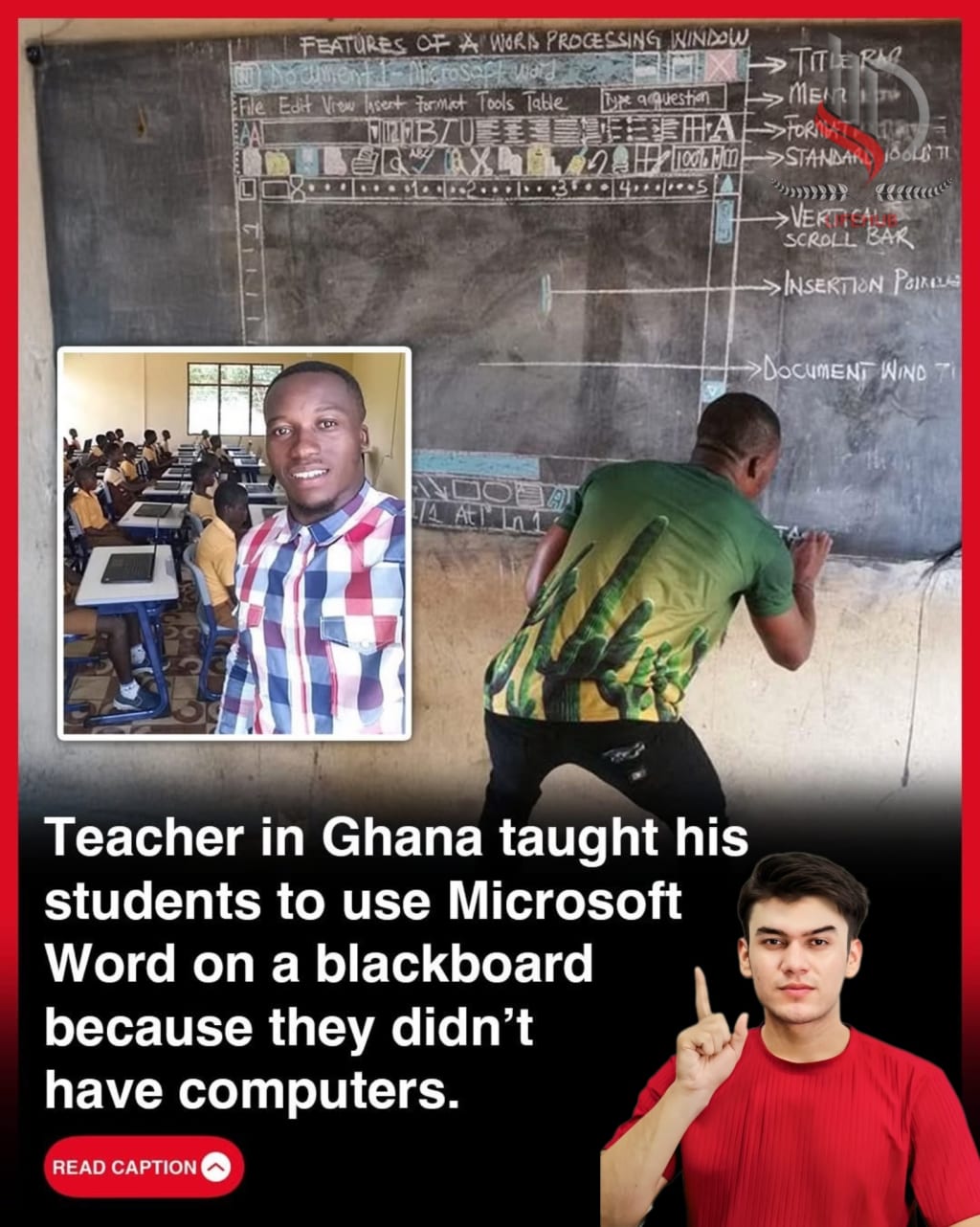
In 2018, the world’s attention turned to a rural classroom in Ghana where a teacher named Owura Kwadwo captured hearts and headlines. The reason was as surprising as it was inspiring: in the absence of computers, he taught his students Microsoft Word by hand-drawing the entire interface on a chalkboard. With meticulous precision, he sketched toolbars, menus, and formatting icons, transforming an ordinary blackboard into a digital screen of possibility. That moment, immortalized in photographs that went viral, became a global reminder of the resilience, creativity, and sacrifice that define the teaching profession.
The context of this story is as important as the story itself. Many rural schools in Ghana, and indeed in several parts of the world, operate under severe constraints. Computers, internet access, and modern teaching facilities are often nonexistent. Yet the expectations placed on both students and teachers remain the same as those in well-equipped schools. National examinations in Ghana require familiarity with digital tools, meaning that students without access to computers face an unfair disadvantage before they even sit for their tests. For Owura Kwadwo, this inequity was unacceptable. Instead of resigning himself to limitations, he chose innovation.
On the day that changed his career and his students’ perception of learning, Kwadwo stood before his class with chalk in hand and began carefully outlining Microsoft Word’s screen. His chalkboard displayed every drop-down menu, every icon, every formatting button. He annotated and explained with patience, ensuring his students understood the function of each element. It was not just about drawing, it was about bringing to life a digital world that his students had never touched. The classroom buzzed with energy as young learners eagerly engaged with a subject that suddenly felt within their reach, even though they had never pressed a key on a keyboard.
The images of his chalkboard lessons quickly spread across social media, striking a chord worldwide. People were stunned by the sheer dedication it took to replicate a computer program by hand and inspired by the commitment to teaching that transcended material limitations. The global response was swift and heartening. Microsoft, upon learning of his story, reached out and donated equipment to his school. What began as a local act of resourcefulness became an international symbol of how passion can overcome the harshest barriers.
Owura Kwadwo’s story holds deeper meaning for teachers and education systems everywhere. It highlights an uncomfortable truth: around the globe, countless educators labor in silence without the tools they need. They innovate, adapt, and sacrifice daily to ensure their students do not fall behind. Many will never go viral, never receive global recognition, yet their dedication is no less heroic. This reality reminds us to approach the teaching profession with sensitivity and respect. Educators are more than deliverers of information; they are mentors, creators, problem-solvers, and often the only bridge between a child and their future.
For teachers, Kwadwo’s story is a mirror reflecting their own struggles and victories. Sensitive vocabulary is essential when telling such stories because words carry weight. Instead of portraying teachers as victims of broken systems, we must honor them as champions of resilience and ingenuity. Describing their efforts as “resourceful,” “transformative,” and “visionary” captures the dignity of their work. Kwadwo was not simply a man without resources, he was a man who refused to let resources dictate the boundaries of his teaching.
The impact of his chalkboard lessons also sparks important conversations about the role of technology in education. While the digital divide remains real, Kwadwo showed that technology itself is not the only determinant of effective teaching. Passion, creativity, and empathy are equally critical. However, his story should not be used to romanticize hardship. It is unjust that any child should have to learn digital literacy without a computer. It is unjust that teachers must bend reality to compensate for systemic shortcomings. The lesson, therefore, is twofold: celebrate teacher dedication, but also commit to building fairer, better-resourced educational systems.
Students who experienced Kwadwo’s lessons will likely never forget them. Beyond learning the mechanics of Microsoft Word, they learned something more valuable: the power of persistence, the beauty of imagination, and the truth that education is not limited by physical tools but expanded by human will. A child sitting in that classroom in 2018 may one day work with computers effortlessly, yet they will carry the memory of their teacher’s chalkboard drawings as proof that learning can happen anywhere.
Internationally, Kwadwo’s story touched educators who saw themselves reflected in his actions. Teachers in underfunded schools in Asia, Latin America, and even parts of developed nations shared the images, relating to the challenge of doing more with less. His chalkboard became a universal symbol: education requires not just resources, but resourcefulness. At the same time, it fueled advocacy for closing the digital divide, reminding governments and organizations that inspiring stories should not replace structural change.
There is also a philosophical dimension to this story. Education is often described as planting seeds for a future we may never see. Kwadwo planted seeds not just of knowledge but of resilience. He embodied the principle that true teaching is about meeting students where they are and leading them to where they need to be, even if the path requires unconventional methods. For many teachers, this is the silent, daily truth of their profession: the willingness to sacrifice comfort, time, and sometimes even recognition for the sake of their students’ growth.
When Microsoft responded with equipment donations, it was more than just charity. It was a recognition that stories like Kwadwo’s deserve not only applause but tangible support. The act symbolized how global organizations can partner with local educators to bridge gaps. Yet, it also raised an important question: how many other classrooms, hidden from viral cameras, still wait for such attention? How many teachers continue to draw with chalk what others take for granted as accessible through a click of a mouse?
For readers on platforms like Vocal Media, this story is more than a viral anecdote, it is a call to action. It challenges us to reflect on the value we assign to teachers in our societies. Do we see them only as employees of a system, or do we recognize them as the frontline builders of human potential? Do we only celebrate them when they make headlines, or do we support them daily with the respect, resources, and recognition they deserve?
The legacy of Owura Kwadwo is not confined to a chalkboard drawing. It lives on in the countless conversations about educational equity, in the renewed appreciation for teacher creativity, and in the aspirations of students who witnessed firsthand what it means to never give up on learning. His story is a powerful reminder that while tools and technology are vital, the heart of education will always be the teacher.
Conclusion: Honoring the Unseen Architects of the Future
At its core, the story of Owura Kwadwo is about more than chalk and Microsoft Word. It is about the immeasurable power of a teacher’s will. It demonstrates that education is not defined by resources alone but by the relentless spirit of those who teach. Yet it also underscores the urgent need to provide teachers with the tools they require, so that passion does not have to substitute for equity.
Every teacher, whether in Ghana or elsewhere, deserves to be celebrated not only for surviving challenges but for shaping futures with courage and hope. Owura Kwadwo may have become famous for his chalkboard lesson, but in truth, his story belongs to every teacher who has ever gone the extra mile for a student. As we reflect on his example, let us remember to advocate for better conditions, greater respect, and deeper appreciation for educators worldwide. For they are, in every sense, the unseen architects of tomorrow’s possibilities.
About the Creator
Lifehub
Some stories fade, but some stay forever, shaping how we feel, think, and see the world. Here, we share the ones that matter most: stories of love, hope, and humanity 💙. Subscribe and be part of a journey that inspires and connects. ✨
The Role of Telehealth in Bridging the Rural-Urban Healthcare Divide
Telehealth has emerged as a powerful tool in addressing the disparities between rural and urban healthcare access. For individuals living in remote areas, accessing timely and quality medical care can be a significant challenge due to geographical barriers, provider shortages, and limited resources. Telehealth eliminates these obstacles by leveraging technology to connect patients with healthcare providers, ensuring equitable access to care regardless of location.
By Dr. Marshall Bahr7 days ago in Education
The Day Gravity Failed for 9 Seconds
At 11:42:17 a.m., the world loosened its grip. There was no warning siren. No emergency broadcast. No flicker in the sky or tremor in the ground. One moment, the Earth was doing what it has always done — holding oceans in their basins, keeping feet on sidewalks, anchoring coffee in cups — and the next moment, it wasn’t.
By Abubakar220about 22 hours ago in Education



Comments
There are no comments for this story
Be the first to respond and start the conversation.