
A Parisian Parole in America
Observations on the alluring use of French loanwords in North American (U.S.) speech

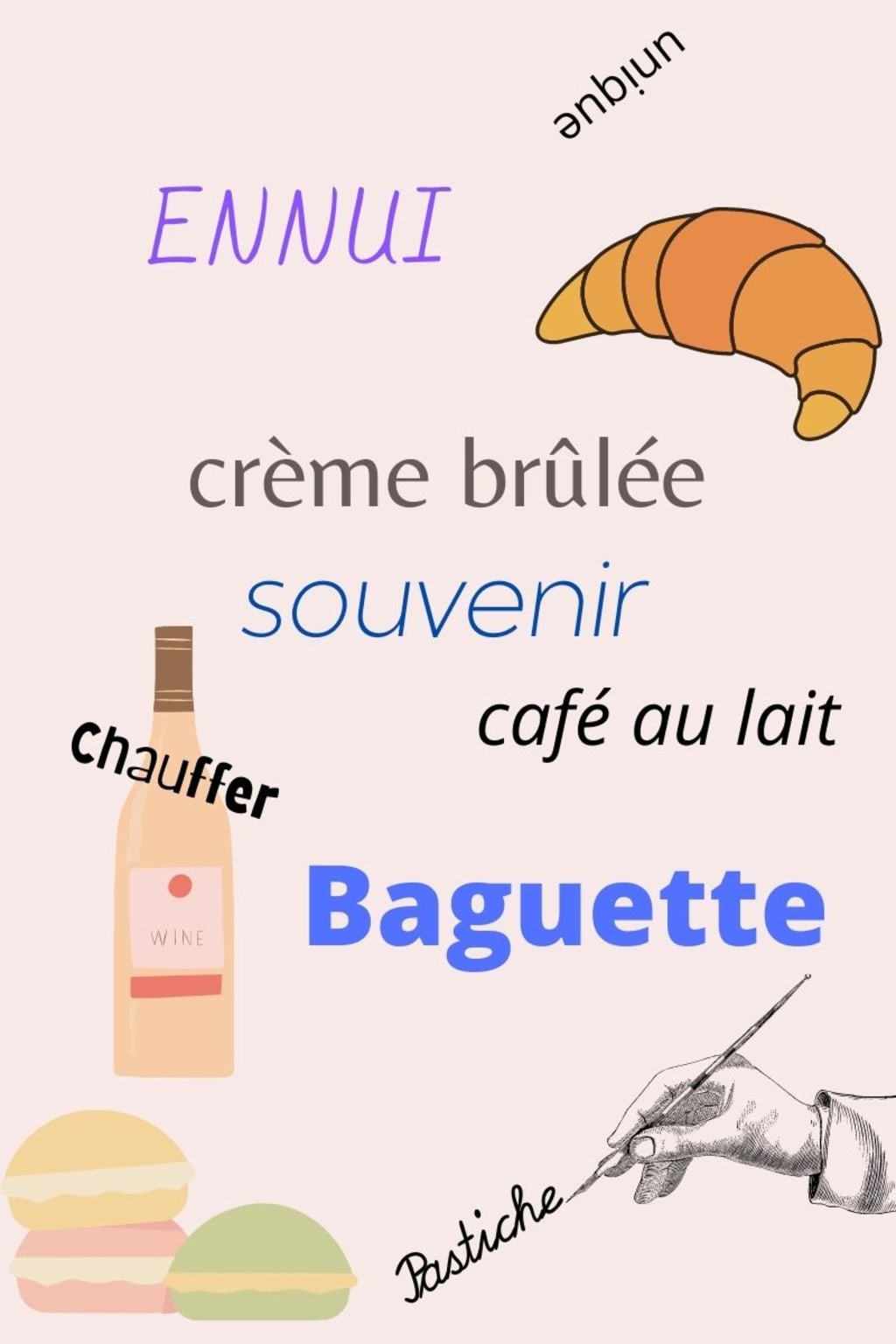
I have to admit, there is certainly a certain je ne sais quois about the French language; sounding intelligently foreign can be seductive when done the right way. But why can’t we just stick to good ol’ American English vocabulary?
As a linguist, these questions often come to mind at bedtime after I’ve had my fourth (although quite possibly fifth) dose of nerve-rattling caffeine. And like the mad-hatter-scientist I aspire to be, I quickly move back into my writing lab to find out the mysteries of French loanwords.
According to Dictionary.com French ranks No. 2 in terms of loanwords in the English dictionary (Latin being No. 1). We use loanwords throughout the day without noticing, and we don’t typically think about where our seemingly English vocab originates.
Let’s take a look at how French loanwords help English speakers express themselves in a rather foreign manner.
Untranslatable concepts use single words/simple phrases for efficiency.
Language evolution often involves condensing ideas into smaller phrases or utterances. In English, for example, speakers shorten longer words like “financial technology” to “fintech”. We could say financial technology, but it won’t be as efficient to use, especially when the concept is mentioned multiple times throughout a conversation.
“Amirite'' is a slang form of “am I right”; it graphically shortens the phrase into a single word. Like fintech, amirite makes conveying and processing information faster than saying the whole phrase.
A similar process occurs when we use terms such as crochet, which involves using a hooked needle and a single thread of yarn to make an article of clothing or other needlework project. Crochet, a french word, is used to identify a specific type of needlework; the single word encompasses its definition of a particular concept without having to explain it.
Upon using the term crochet, a person can immediately recognize what the other party is referring to; the use of a single thread and hooked needle for a yarn craft.
Just like the shortening of words and phrases, some terms borrowed from French are used to label a whole concept and condense it for the sake of linguistic efficiency.
Words borrowed from other languages are often modified to fit the borrower’s language rules.
Timothée Chalamet is a name that’s been popping up online recently. Can anyone pronounce his name the French way, though? Well, no. English speakers therefore resort to the English pronunciation, Timothy. There are times when a French term has a very distinct French spelling and French prononciation. In such cases, English will modify it to fit an American English way of speaking and writing (fun fact: this linguistic process is called anglicization). Words like “musketeer”, “omelet”, and “poetic” have French origins which aren't apparent at first sight.
Let’s explore a little of each:
Musketeer is originally spelled mousquetaire. Upon entering the English lexicon, the ou, que and aire were replaced with “u”, “k” and “eer”. It’s original pronunciation shifted as well. Entering it in a translation website will show the various shifts in vowels.
Omelette is spelled the same way in French, but the way it is said is subtly changed to fit English speech. In this case, the o sounds like a soft “oh” or “ohm” in French while English speakers say it with an “ah” sound, similar to “palm”.
The word poetique may have its audiovisual charm, yet English modified it to “poetic”. Every language has its rules and will often change how a word is spelled and/or spoken in order for it to transition smoothly into the people’s vocabulary.
Certain loanwords refer to concepts that are unfamiliar to the word borrower.
Something else happens when English sees a new term and a new concept that didn’t exist in the U.S. American’s realm of reality- a complete adoption of both term and concept. Something that exists in one society will not always exist in another. One way to think about it is introducing dishes to a person with no prior knowledge of another culture’s cuisine. It is unfamiliar to the individual, and because there is no exact American version, the dish doesn’t have an English name. That is when both concept and term are adopted. Ratatouille is a classic French dish (and one of my favorite Pixar films) that originated in France.
Such a dish may not have existed in the U.S. before; if it had, it probably would’ve been given an equivalent English name. With no equivalent English term nor equivalent U.S. dish, both dish and name are adopted into the English speaker’s realm of reality.
Concluding Notes...
Whilst swiveling in the chair at my writer’s lab, now sipping on soul-searching champagne, I came to some conclusions:
The word-loaning process is an efficient one as it doesn’t require a society to invent a new vocabulary altogether; it’s easier to borrow from relatives and neighbors than to make something up from scratch. Of course little changes happen here and there which makes the word more familiar to the target language. As a result of linguistic modifications, people may learn and remember the term more easily. Some French concepts have English equivalents while others, at some point, were entirely new to the U.S. The introduction of ideas then adds different experiences to the English speaker’s world.
The English language is a collection of words extracted from other languages, including French. This transaction of vocabularies demonstrates that there is a network that connects languages with each other through the simple act of borrowing a word, idea, or phrase. While we can stick to good ‘ol English, it’s much more exciting to express yourself in a foreign manner. Like adding spices to a dish, French truly adds a certain je ne se quois to English conversation.
These ideas began to bubble while reading two books: Zen in the Art of Writing by Ray Bradbury and Good with Words: Writing and Editing by Patrick Barry. If you must satisfy that thirst to learn about language and writing, feel free to browse the pages of either book mentioned.
About the Creator
XM
Language: Romance, Hobbies: Temporary, Limits: Theoretically-- None; Realistically-- Some.
What is Affiliate Marketing: A Beginner's Step-by-Step Guide
Affiliate marketing is a performance-based online business model that generates over $12 billion annually in the U.S. alone and continues to grow as e-commerce expands. At its core, affiliate marketing allows individuals to earn commissions by promoting products or services created by other companies. Affiliates share unique tracking links through websites, blogs, social media, email lists, or videos, and earn a percentage of each sale or action completed through those links. Because affiliates don’t handle product creation, inventory, payment processing, or customer support, it’s one of the most accessible ways to monetize an online presence.
By Mohammad Sufyaan4 days ago in Education
Wild Card Weekend Recap: What Happens Now?
I think I figured out why I love Wild Card Weekend so much. It's because it's the first playoff anything of the calendar year. The NFL season starts in the fall, and once upon a time, the champion was crowned either on or slightly before New Year's. The evolution of the NFL schedule has resulted in the playoffs starting just into the New Year, and currently, the final week of the season falls on the first weekend of the New Year, with Wild Card Weekend coming a week after that. So yes, chronologically, the NFL's Wild Card Weekend serves as the first playoff anything of the calendar year.
By Clyde E. Dawkins4 days ago in Unbalanced




Comments
There are no comments for this story
Be the first to respond and start the conversation.