
A panel discussion dissects Budget 2025’s impact on the common man
The Budget Breakdown: Insights & Impact session by ASM and AIMC offered an invigorating experience for students and faculty
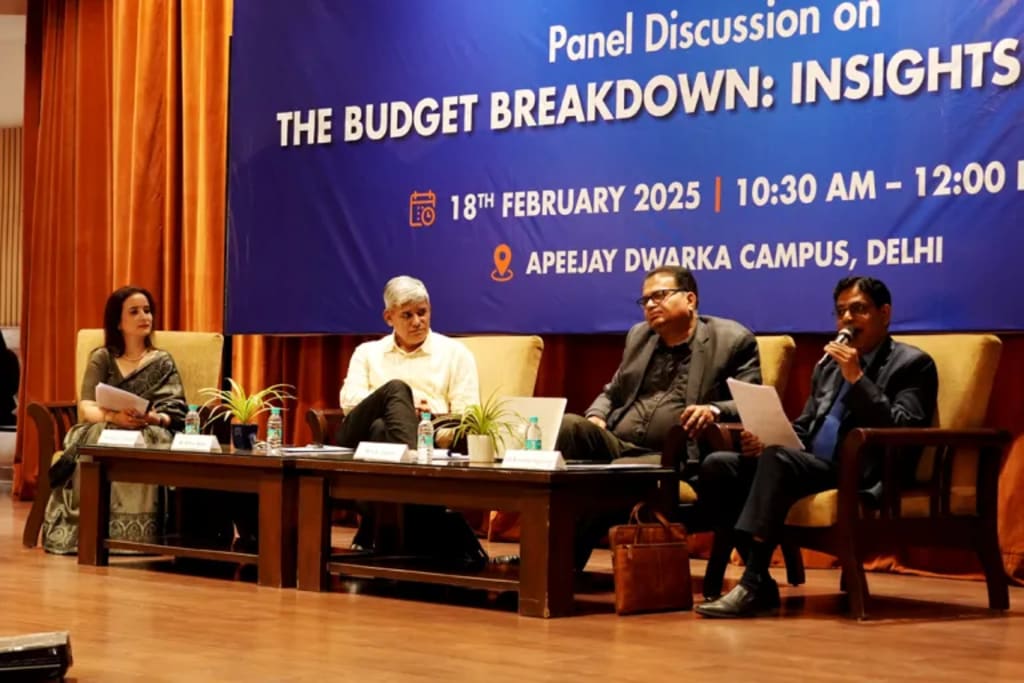
We must prioritise wealth creation with righteousness, as economic prosperity lays the foundation for all progress. This principle aligned perfectly with a discussion on – The Budget Breakdown- Insights & Impact. The panel discussion that was jointly presented by Apeejay School of Management (ASM) and Apeejay Institute of Mass Communication (AIMC) in Dwarka emphasised the importance of financial stability, economic wisdom, and ethical governance in shaping a prosperous future.
The heartfelt and warm welcome was extended to the esteemed panelists Mr Shishir Sinha, Associate Editor, The Hindu BusinessLine, Mr VK Cherian, journalist, author, filmmaker, and public affairs strategist, and CA Ravinder Aggarwal, a financial expert with 34 years of experience in auditing, taxation, project management and insolvency resolution. A warm welcome was also extended to the faculty members and students. The moderator for the day was Dr Pooja Chaturvedi Sharma, Assistant Professor, Finance & Accounting, Apeejay School of Management.
“It is truly a privilege for me to moderate this engaging session on The Budget Breakdown: Insights & Impact. The Union Budget is far more than just numbers — it is a policy, a strategic plan that defines the economic growth of a nation. More importantly, it also shapes career opportunities, especially for all of us in the audience today. Whether you’re here to understand how economic policies influence business strategies or how they shape communication trends, there is a lot to learn and absorb,” she said and invited Mr Sinha to share his insights.
Taking centrestage, Mr Sinha decoded the 2025 Budget and said, “This year’s budget placed a strong focus on the common man, continuing a trend that began in the 2019 Interim Budget. The middle class, often the focal point of such discussions, plays a crucial role in the economy. Generally, individuals earning between ₹5 lakh and ₹30 lakh annually are categorised as middle class. This segment contributes significantly to the economy, accounting for over 50% of total income, 48% of total expenditure, and 52% of total savings. Hence, when the budget is said to be “for the middle class,” it’s essential to understand who they are and why their economic role is so vital.”
One of the most debated aspects of this year’s budget was the income tax announcement, he said. “Confusion arose when it was stated that individuals earning up to ₹12 lakh annually would not have to pay income tax. In reality, those earning ₹12 lakh still fall under the tax net but are eligible for rebates. The concept of marginal relief further clarifies this — up to ₹12.74 lakh, the tax rate is reduced, but beyond ₹12.75 lakh, standard tax slab rates apply,” Mr Sinha explained.
Another significant topic of discussion was the comparison between the old and new tax regimes. “Many salaried individuals prefer the old regime as it allows tax savings through investments in instruments like post office savings, insurance, and provident funds. While the government may not highlight this, it remains a key factor for taxpayers. The good news is that both regimes will continue, allowing taxpayers to choose the one that best suits their needs,” he said.
The budget also introduced important economic theories like marginal propensity to consume and the consumption multiplier. “The budget also addressed critical policy areas like the Pulse Mission and MSME sector support. While the MSME funding boost aims to help startups, the high failure rate — around 70% — raises questions about the long-term effectiveness of these policies. Additionally, concerns about the fiscal deficit remain, with 24% of funds coming from borrowings and 20% allocated to interest repayment,” he shared.
Mr Cherian gave the students a corporate view of the budget. “When I read the newspapers the day after the budget, I reflected on my time in the corporate sector when I was considered part of the ‘rich’ group. Now that I’m back in the middle class, I appreciate not paying as much tax as I once did. But it made me wonder — out of 145 crore Indians, only about 8 crore pay income tax, with just 3 crore classified as rich. That leaves around 5 crore middle-class taxpayers. So, should we be so excited about tax cuts that benefit such a small segment,” he asked.
The media often focuses on middle-class benefits, this is because many journalists fall into that group, he said. “But the budget is meant for all 145 crore Indians, not just the 8 crore taxpayers. What about the rest? That’s a question we need to ask. We’re already overtaxed. I recall sitting at a coffee shop drinking coffee, and realising that out of ₹20, nearly ₹7 was tax. Our outdated tax system has been inherited and left unchanged by successive governments. Hopefully, the younger generation will push for reforms,” Mr Cherian stated but added not all is negative.
There are positives too, he said. “The government allocated ₹500 crore for AI development and plans to double IIT student intake. While these moves sound promising, concerns about maintaining educational quality remain. I also noticed the mention of BharatNet, which aims to connect every village with telecommunication services. Despite being in the works for over a decade, it still lacks a clear completion date.
“The fiscal deficit is another concern. With 40% of the budget going towards debt servicing, the government heavily relies on borrowing. This unsustainable model echoes past financial crises, like the one in 1990 that led India to seek IMF assistance. Instead of focusing solely on annual budget figures, we should look at long-term policies and structural reforms. Annual numbers will change, but policies will shape the economy’s future,” Mr Cherian shared.
Mr Aggarwal sharing his insights said that at first glance, this year’s budget appears impressive. An important change involves rental income. “While it was announced that rental income up to ₹6 lakh wouldn’t be taxed, the reality is that only ₹15,000 per month is exempt from TDS. If you rent your property for even part of a month, you’ll get a proportional exemption. The budget also addressed Tax Collected at Source (TCS) on foreign remittances, particularly for students studying abroad. Now, if you obtain a loan for sending money overseas, no TCS will be deducted.
“Investments in cryptocurrency were also a key focus. Regardless of profit or loss, any crypto transaction requires filing a return, with profits taxed at 30%. This rule applies even if your overall income is below ₹4 lakh. The government has tightened tax rules on capital gains from stocks and mutual funds, ensuring even minor gains are taxed. The budget’s core intent is to give people more control over their money, promoting personal financial responsibility. It focuses on four sectors: Agriculture, MSMEs, investment, and exports, with an overarching goal of achieving Viksit Bharat. The five guiding principles are accelerating growth, securing inclusive development, encouraging private investment, boosting household spending, and enhancing the spending power of the rising middle class,” Mr Aggarwal shared.
After the invigorating panel discussion, an interactive Q&A followed where students from ASM and AIMC and faculty members asked questions that helped all the attendees present decipher the 2025 Budget. From students in the first year to the second year, the student questions ranged from scholarship schemes to Internship programmes available in the budget FIIs.
The esteemed panellists were then felicitated with mementoes. Mr Aggarwal was felicitated by Professor Rahul Singh, Director of ASM. Mr Sinha was felicitated by Dr. Etinder Pal Singh, Deputy Director and Professor of ASM and Mr Cherian was given a memento by Professor Sajal Mukherjee, Director of AIMC.
Dr. Etinder Pal Singh in his vote of thanks, expressed his delight at how engaging The Budget Breakdown: Insights & Impact session turned out to be. He extended heartfelt gratitude to everyone who made the event possible. He especially thanked Mr Sinha for his insightful analysis, highlighting uncertainties in the economy and their impact on the common man.
Professor Singh also appreciated Mr Aggarwal for his valuable advice on personal finance, particularly on budgeting and understanding sections like 87A and long-term capital gains. Professor Singh thanked Mr Cherian, who brought a corporate perspective to the discussion.
A special mention went to Dr Chaturvedi for brilliantly moderating the session and to directors, Professor Rahul Singh and Professor Sajal Mukherjee, for their unwavering support.
He concluded with valuable life advice, “Differentiate between wealth and worth, embrace simplicity and contentment, and invest in yourself. He encouraged students to see this session as the beginning of deeper financial learning and thanked all participants, faculty, staff, and volunteers for making the event a success.”
For such exceptional events, visit: www.apeejay.news
About the Creator
Keep reading
More stories from Apeejay Newsroom and writers in Education and other communities.
The IB Journey: How student directors brought a historical epic to life
The Annual Play at Apeejay’s IB School, Apeejay School International, Panchsheel Park, was a key highlight for the academic 2024-25 that took centrestage in the auditorium. This year’s production, The Conqueror–Ashoka the Great, brought to life the remarkable journey of Emperor Ashok, tracing his transformation from a fierce warrior to a symbol of peace and non-violence. Through powerful performances and immersive storytelling, the students displayed exceptional talent, while the play seamlessly reflected the core values of the IB curriculum, fostering creativity, collaboration, and leadership.
By Apeejay Newsroomabout a year ago in Education
Data Driven Private Investing: Why Deal Intelligence Determines Long-Term Returns
Private markets offer access to high-growth companies, specialized assets, and differentiated return streams. However, the complexity of private transactions requires more than capital commitment. Smarter investing begins with disciplined private deal intelligence, which transforms fragmented information into structured insight. Investors who rely on verified data rather than promotional narratives are better positioned to generate sustainable returns.
By Michael Christopher Venturino8 days ago in Education
The Piggy Project
I’ve had so many names in this life I lose track of which ones were ever really mine and which ones I wore because someone needed me to. Some were handed to me before I had words to refuse them, before I knew what they meant, before I knew I could say no. Most weren’t meant to hurt. That doesn’t mean they didn’t leave marks. Marks that told me who I belong to, who I am by way of who claims me, recognizes me in the good and bad, who walks beside me.
By Fatal Serendipity5 days ago in Confessions


Comments
There are no comments for this story
Be the first to respond and start the conversation.