
A Natural Language Processing-Based Framework for Autism Insights and Support Systems.
"Neurodiversity is not a flaw to be fixed, but a perspective to be embraced — in every unique mind lies a world of possibility." - Dr. Shalini S, Koustav Biswas. Department of Computer Science and Engineering, Dayananda Sagar Academy of Technology and Management, Bengaluru.
Autism or Autism Spectrum Disorder (ASD) is a neurodevelopmental disorder that impacts the way a person communicates, acts, and relates to others. It is also referred to as a "spectrum" since it represents a broad range of symptoms, abilities, and disability levels. Some might be very capable in some areas but have problems with social interaction, while others will have severe developmental delays. Autism tends to emerge in early childhood, most often before the age of three, and is a lifelong illness, with the severity and extent of the symptoms potentially changing throughout life. Individuals with autism often exhibit challenges with social communication, for instance, eye contact, understanding non-verbal hints, or two-way conversation. They can also show repetitive behaviors such as hand-flapping, arranging objects, or demanding strict routines. Individuals have strong interests in certain subjects and can be abnormally sensitive to sensory stimuli such as sounds, lights, or textures. The variety of symptoms differs greatly between individuals, making early diagnosis and tailored intervention essential. Genetic considerations are among the strongest causes of autism. Studies have pinpointed hundreds of genes that are linked to the condition. In a few instances, de novo mutations—random DNA alterations that arise in the egg or sperm—are responsible for autism but are not inherited. In others, people inherit gene variants that make them susceptible. Copy number variations (CNVs)—large chunks of DNA copied or deleted—can interfere with brain development and have been detected in many individuals with autism. Twin research has revealed that if one identical twin has autism, the other also has a 60–90% probability of developing the same condition, highlighting the genetic factor.
Studies have found that people with autism tend to have brain structural and functional variations. For example, some autistic children have enlarged head sizes (macrocephaly), which implies accelerated brain growth early in life. Brain imaging studies reveal amygdala (emotional processing), hippocampus (memory), and cerebellum (coordination) abnormalities. In addition, there are variations in the way the neurons establish contact (synapses), which result in abnormal connectivity between brain areas. Such aberrations can lead to sensory processing disorders, emotional regulation disorders, and communication disorders in individuals with autism.
Neurotransmitters, chemicals that carry signals in the brain, are also involved in autism. Unusual levels of serotonin, dopamine, and GABA have been found in individuals with ASD. Serotonin, which influences mood and behavior, is typically elevated in the blood of autistic individuals. Dopamine dysregulation can be associated with repetitive actions and social problems. GABA, the inhibitory neurotransmitter, can be low, potentially disrupting sensory filtering and making one more sensitive to stimuli. Such imbalances are believed to interfere with normal communication between brain cells and with overall brain function.
Although genes set the stage, environmental influences at key points in development potentially raise the risk for autism. Exposure to certain poisonous chemicals, including heavy metals (for example, lead, mercury), pesticides, and air pollution, particularly in the womb, could disrupt fetal brain development. Research has indicated that children of women who have been exposed to high levels of pollution or farm chemicals in the womb have a greater chance of having autism. Yet, such risks are typically low and combine with genetic vulnerabilities.
Increased parental age, especially paternal age, has been associated with elevated autism risk. Older fathers tend to bring with them more de novo mutations as a result of the natural aging process of sperm cells, which can influence the brain development of the child. Likewise, advanced maternal age is also linked with complications like gestational diabetes or preeclampsia, which can impact the neurological well-being of the fetus. Although indirect causes, these age factors can add to the overall risk when they are combined with environmental and genetic factors.
Certain drugs used during pregnancy have been found to raise the risk of autism. For instance, valproic acid, an anti-seizure medication, and thalidomide, previously used for treating morning sickness, have both been associated with an increased risk of ASD when the patient is exposed in the first trimester. Some pregnancy infections—rubella, cytomegalovirus, or severe influenza—can impact fetal brain development as well. When the immune system of a mother is strongly activated, inflammatory chemicals such as cytokines can pass across the placenta and disrupt the developing nervous system of a baby.
Birth complications are also a contributing cause of autism. Oxygen deprivation (hypoxia), prolonged labor, emergency C-section, low birth weight, or prematurity can interfere with normal brain development. Premature infants are also more susceptible to infections, brain bleeds, and fluctuating oxygen levels, which all contribute to a higher risk for neurodevelopmental disorders such as autism. These complications will not alone induce autism, but can do so when they are combined with other risk factors.
Recent research has brought the immune system into the center stage with regard to autism. Some scientists propose that maternal immune activation (MIA)—an overactive response of the mother's immune system during pregnancy—would disrupt fetal brain formation. Moreover, individuals with autism frequently exhibit chronic inflammation and aberrant immune responses. Hyperactive immune systems might affect brain cells such as microglia, which remove dysfunctional neurons and regulate neural networks.
The gut-brain axis is an active research area as well. Numerous individuals with autism have gastrointestinal issues, including bloating, constipation, diarrhea, or other changes. Researchers think that an imbalance of the gut microbiome (the collection of bacteria in the intestines) could affect brain development by creating neurotransmitters and immune molecules. The gut and brain communicate through the vagus nerve, and problems with this pathway can impact mood, cognition, and behavior. Although promising, this field of study is at an initial level and requires stronger evidence.
It's essential to dispel the long-standing myth that vaccines cause autism. This myth began when a fake study in 1998 was retracted and discredited, but not before it had caused widespread misinformation. Numerous large-scale studies in various countries have concluded that vaccines, including the MMR vaccine, have no link to autism. Vaccines are safe, highly effective, and essential for preventing serious diseases. Sharing vaccine misinformation can result in public health threats and undermine attempts to serve children with autism.
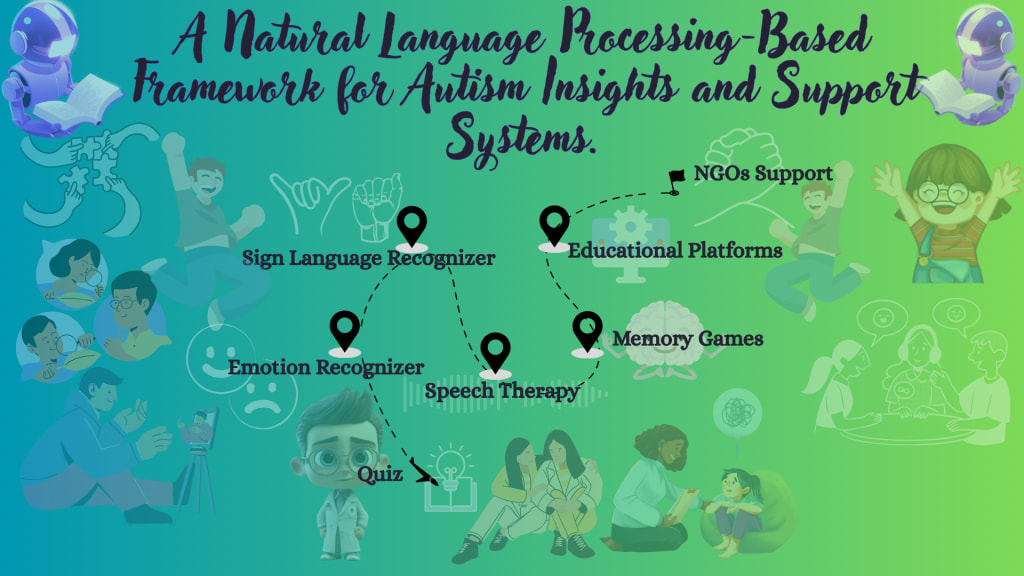
In this article, we will try to predict autism at the earlier stages and try to control it. At first, we have a set of questions for the individuals and the parents, which will help us catch autism at the earlier stages. The quiz has all multiple-choice questions where the person has to answer each one. After submitting the quiz, the result is downloaded and scanned through a chatbot, which will analyse the PDF and give a detailed medical analysis, like what type of treatment the person needs. The treatments are as follows:
Facial recognition plays a vital role in Autism Therapy Systems by interpreting users' emotional states from real-time facial expressions. This is done using webcams during chatbot or therapy sessions. Face detection algorithms like Haar Cascade or HOG help in aligning facial features for better emotion classification. A lightweight CNN model is used to recognize six emotions—Anger, Fear, Joy, Neutral, Sadness, and Surprise—after preprocessing steps like grayscale conversion, resizing, and normalization. The CNN architecture includes Separable Convolutional layers, max pooling, Dense, Dropout, and a final SoftMax layer, trained with the Adam optimizer for accurate and efficient real-time emotion detection.
The Autism Sign Language Detection tool leverages a pre-trained VGG16 model to identify sign language alphabets from uploaded images. The system ensures smooth operation by checking for model files and datasets beforehand. Uploaded images are preprocessed—converted, resized to 224×224, contrast-enhanced, blurred, and normalized—to match VGG16 requirements. The predicted output includes both the alphabet and a confidence score. The UI visually presents the original image, the enhanced version, and prediction confidence, along with a bar chart showing probability scores for better interpretability.
The Autism Speech Therapy System is a Streamlit-based web app powered by AI and ASR (Automatic Speech Recognition). It accurately captures speech even in noisy environments and analyzes it with NLP tools for grammar checking, sentiment analysis, and readability. The app also evaluates coherence, fluency, and complexity to provide feedback. Visual and interactive feedback helps users refine their speech in real time. Additional features include graphical analysis of pitch, energy, and frequency, as well as detection of stammering, grammar issues, and voice clarity using advanced NLP techniques.
The Autism Chatbot utilizes JavaScript, AJAX, and Bootstrap to create an accessible, fast, and interactive interface for users with Autism. Native JavaScript handles content updates dynamically, while AJAX enables real-time, asynchronous communication with the server, improving responsiveness and user experience without page reloads.. Educational platforms tailored for various learning levels provide structured content in accessible formats. Moreover, the system is supported by NGO partnerships, offering community assistance, real-time mentoring, and additional learning resources.
In this way, the article "A Natural Language Processing-Based Framework for Autism Insights and Support Systems" represents a transformative step forward in delivering accessible, AI-driven support to individuals with Autism. By seamlessly integrating emotion recognition, sign language detection, speech therapy, and interactive learning tools—including games and educational platforms—the system fosters independence, engagement, and growth. With strong backing from NGOs and a responsive AI chatbot interface, it ensures a compassionate and connected support network. As we continue to advance this platform, our goal remains clear: to create an inclusive digital ecosystem where every individual with Autism can thrive, learn, and express themselves fully. The journey toward neurodiversity inclusion begins with innovation—and this system stands as a testament to that vision.
About the Creator
Keep reading
More stories from writers in Education and other communities.
How Much Does It Cost to Copy a Key at Walmart?
If you've ever found yourself locked out of your house or needing a duplicate key for convenience, you might have considered heading to your local Walmart. Known for its one-stop shop experience, Walmart offers a variety of services beyond groceries and household items, including key duplication
By Master Binza day ago in Education




Comments
There are no comments for this story
Be the first to respond and start the conversation.