
A Guide to Calculating Exchange Funding Fees in Spot and Futures Trading
Funding fees are an important aspect of cryptocurrency trading, particularly in futures markets. While spot trading primarily involves direct asset exchange, futures trading includes contracts that are settled at a future date.

In this article, we’ll dive into the details of funding fees in both spot and futures markets, exploring how they are calculated, their purpose, and how they impact traders.
1. Understanding Funding Fees
Funding Fees in Futures Markets
In the futures market, funding fees are payments made between buyers (long positions) and sellers (short positions) to ensure that the futures price remains close to the underlying asset’s price. They play a crucial role in maintaining the balance between supply and demand in perpetual futures contracts, which have no expiration date.
The funding fee is not paid to the exchange but is transferred between traders. The rate and amount are influenced by the market’s current position bias — whether more traders are going long or short.
Funding Fees in Spot Markets
In contrast, spot trading does not involve funding fees. When trading on spot markets, you are directly exchanging one asset for another at the current market price. Spot markets are straightforward, and the only fees traders encounter are transaction fees, maker/taker fees, and possibly withdrawal fees, but no recurring funding payments are required.
2. Funding Fees Calculation in Futures Trading
Formula:
The funding fee you pay or receive in a futures contract is calculated using the following formula:
Funding Fee=Position Size×Funding Rate
Where:
Position Size refers to the value of the position you are holding (i.e., the contract value).
Funding Rate is the rate that applies at the time of settlement, typically set by the exchange based on the difference between the perpetual futures price and the spot price.
Example Calculation:
Let’s assume the following:
You are holding a long position worth 1 BTC on a perpetual futures contract.
The Funding Rate at the settlement time is 0.01%.
The funding fee you would pay (or receive, if you’re short) is:
Funding Fee=1×0.01%=0.0001 BTC
If you are long and the funding rate is positive, you will pay the fee. Conversely, if you hold a short position, you will receive the fee.
Factors Affecting Funding Fees:
Position Size: The larger your position, the higher your funding fee.
Funding Rate: The rate varies depending on market conditions. A high rate reflects a stronger demand for one side of the market (either long or short).
Leverage: While leverage does not directly impact the funding fee calculation, higher leverage amplifies your position size, which will, in turn, affect your funding fee.
Funding Interval:
Funding fees are typically charged at regular intervals, often every 8 hours or once per day, depending on the exchange. Some exchanges provide a countdown to the next funding period, so traders are aware of when they will need to pay or receive funding fees.
3. Spot Trading Fees
In contrast to futures trading, spot trading fees are much simpler and do not involve recurring funding payments. Instead, fees in spot markets are incurred at the time of the trade itself.
Types of Fees in Spot Trading:
Transaction Fee:
A percentage of the trade value charged by the exchange every time a trade is executed. This fee is usually divided into maker and taker fees.
Maker Fee: Applies when you place a limit order that adds liquidity to the order book.
Taker Fee: Applies when you place a market order that takes liquidity from the order book.
Withdrawal Fees:
If you move assets out of the exchange to an external wallet, a withdrawal fee may apply. This is often a flat rate in the cryptocurrency being withdrawn.
Example of Spot Trading Fee Calculation:
Suppose you are trading 1 BTC for USDT in a spot market, and the exchange charges a 0.1% taker fee.
Trading Fee=Trade Value×Fee Rate
If the price of 1 BTC is $40,000, your fee would be:
Fee=40,000×0.1%=40 USDT
This fee is deducted from your balance after the trade.
4. Comparing Spot and Futures Trading Fees
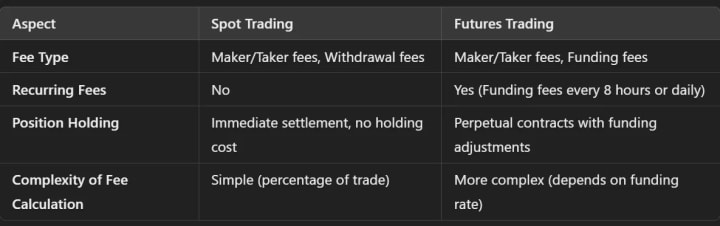
5. How to Minimize Fees
Whether trading spot or futures, minimizing fees can significantly impact your profitability:
Use Limit Orders: In spot and futures markets, placing limit orders rather than market orders can reduce fees since makers generally pay lower fees.
Monitor Funding Rates: In futures trading, staying aware of current funding rates and adjusting your position can reduce the impact of funding fees, especially in volatile markets.
Choose Exchanges with Lower Fees: Different exchanges have varying fee structures. Some offer discounted fees for high-volume traders or if fees are paid using the platform’s native token.
Leverage Sensibly: In futures trading, using excessive leverage can magnify your position size and the associated funding fees, even though it also increases potential gains or losses.
6. Conclusion
Funding fees are unique to futures trading and play a vital role in balancing the market. These fees, while potentially small, can accumulate and significantly affect your overall profitability, especially for large or highly leveraged positions. Spot trading, on the other hand, involves simpler fees, with no recurring payments required for holding positions.
By understanding how funding fees are calculated and staying mindful of market conditions, you can better manage your trading costs in both spot and futures markets. Whether you’re trading in the spot market or holding perpetual futures contracts, a good grasp of these fee structures is essential for optimizing your trading strategy and maximizing returns.
About the Creator
Keep reading
More stories from Eymeric Plaisant and writers in Education and other communities.
The best place to travel and visit in 2023
2023 promises to be an exciting year for travel, with many destinations around the world that are worth visiting. From exotic tropical paradises to historic European cities, there is something for everyone. Here are some of the best places to visit in 2023.
By Eymeric Plaisant3 years ago in Lifehack




Comments
There are no comments for this story
Be the first to respond and start the conversation.