
5 Reasons No One Is Reading Your Writing (And How to Fix It)
This is why I get 1,000 reads a day

Writing can feel like shouting into a void. You spend hours crafting ideas, polishing sentences, and hitting “publish” with hope—only to be met with silence. But the problem isn’t your talent, the algorithm, or luck. It’s about understanding what readers crave and delivering it consistently. Here are five critical reasons your work might be overlooked, along with actionable fixes to transform your writing journey.
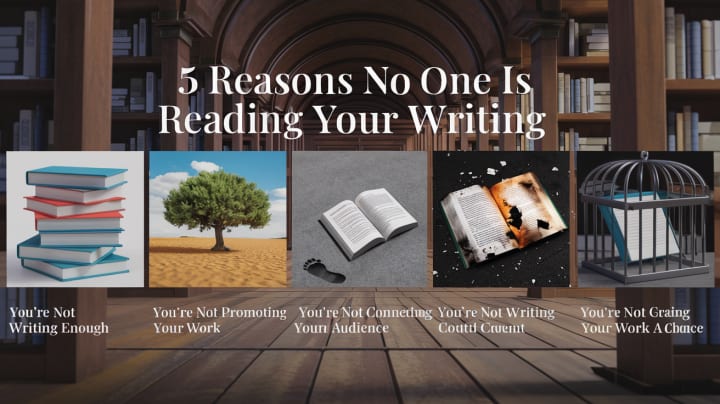
1. You’re Not Solving a Problem
Readers are detectives searching for clues to improve their lives. If your writing doesn’t address their pain points, they’ll scroll past. Many writers start with their own interests—a recipe for invisibility. Instead, begin with your audience’s needs . Ask: What keeps them up at night? What do they want to learn?
For example, a story titled “How I Overcome Procrastination” resonates more than “My Morning Routine.” Focus on actionable takeaways: tips, frameworks, or mindset shifts they can apply immediately. As one Medium writer shared, shifting from self-centered topics to problem-solving boosted their daily reads from 0 to 1,000 .
How to fix it:
- Use tools like Answer The Public or Reddit threads to identify trending questions.
- Structure articles as step-by-step guides (e.g., “5 Ways to…”).
- End with a clear call-to-action: “Try this today and let me know how it works.”
2. Your Voice Lacks Uniqueness
In a sea of generic advice, readers crave personality. If your writing sounds robotic or interchangeable with AI-generated text, it’s forgettable. Your Unique Selling Proposition (USP) lies in blending expertise with personal stories.
For instance, instead of writing “10 SEO Tips,” share “How I Ranked #1 on Google Using These 10 Unconventional SEO Hacks.” Inject humor, vulnerability, or cultural references. One writer tripled their engagement by weaving childhood anecdotes into productivity advice .
How to fix it:
- Write as if speaking to one person (use “you” instead of “folks”).
- Share failures alongside successes—readers connect with authenticity.
- Develop a signature style (e.g., punchy sentences, vivid metaphors).
3. You’re Ignoring Platform and Audience Alignment
Publishing on Medium? Submitting to niche blogs? Each platform has distinct rules. A common mistake is writing for Google SEO on Medium, where the algorithm prioritizes audience engagement over keywords . Similarly, submitting a tech tutorial to a poetry publication guarantees crickets.
How to fix it:
- Medium: Target curated publications (e.g., The Startup, Better Humans) and use human-centric headlines.
- Blogs/Websites: Optimize for SEO with keyword research.
- Social Media: Repurpose snippets into carousels or threads.
One journalist increased views by 300% after switching from broad platforms to niche communities passionate about her topic .
4. Your Headlines and Openings Are Weak
A dull headline is a death sentence. Readers decide in seconds whether to click. Titles like “Thoughts on Productivity” fail because they lack urgency. Compare it to “The Productivity Hack That Saved Me 10 Hours a Week.”
The opening lines must hook immediately. Avoid lengthy intros—jump into a story, statistic, or question. For example:
> “I almost quit writing last year. Then I discovered this one strategy…”
How to fix it:
- Use power words (secret, mistake, proven).
- Include numbers (7 Lessons…) or contradictions (Why Laziness Made Me More Productive).
- Test headlines with tools like CoSchedule’s Headline Analyzer.
A/B testing headlines increased one writer’s click-through rate by 40%
5. You’re Inconsistent and Lack Strategy
Writing sporadically or without goals is like planting seeds without watering them. Readers won’t follow someone who disappears for weeks. Building an audience requires **consistency** and a clear plan.
How to fix it:
- Set SMART goals: “Publish 2 articles/week” or “Grow email list by 500 subscribers.”
- Batch content: Dedicate days to writing, editing, and promoting.
- Leverage analytics: Track which topics resonate and double down.
A writer who scheduled 30-minute daily sessions finished a book draft in 3 months, while another grew followers from 4,000 to 18,000 in a year by sticking to a niche and posting weekly .
Conclusion: Write With Purpose, Not Ego
The difference between ignored writing and viral content lies in shifting focus from your insecurities to their needs. Solve problems, speak with authenticity, and align with your platform’s rules. As Franz Kafka’s unpublished works remind us, persistence matters—even if success feels delayed .
Start today: Audit your last three pieces. Do they pass the “reader-first” test? If not, apply these fixes. Remember, writing is a marathon. With strategy and empathy, those 1,000 daily reads are within reach.
About the Creator
K. B.
Dedicated writer with a talent for crafting poetry, short stories, and articles, bringing ideas and emotions to life through words.
Decoding the Rise and Fall of Global Commodity Markets
Commodity markets have always moved in waves, rising and falling in response to forces that stretch far beyond daily trading activity. These movements can appear chaotic on the surface, yet beneath the volatility lies a structure shaped by economics, human behavior, and long-term investment patterns. From energy and metals to agricultural products, commodities follow cycles that repeat over time, although never in the same way. Understanding these cycles offers clarity in markets often seen as unpredictable.
By Anthony Blumberg7 days ago in Education
Top 10 Essential Skills for Success in 2026
By 2026, the job market is no longer driven only by degrees or titles. Technology, especially Artificial Intelligence (AI), automation, and remote work, has changed how companies operate and how people work. Many routine tasks are now handled by machines, while humans are expected to do work that requires thinking, judgment, creativity, and emotional understanding. This shift means that skills — not just education — determine success. The following 10 skills are considered essential for 2026 because they combine technology awareness with human intelligence. Let’s understand them one by one, step by step.
By Talha khan6 days ago in Education
The Devil's Cut
“Comrade, finally you’re awake.” The voice was smooth, sensual. A flickering incandescent bar was all that lit the white, sterile room. All Vladimir remembered was everything going black. He tried to move his arms and found them strapped to the gurney.
By Matthew J. Fromm4 days ago in Fiction


Comments
There are no comments for this story
Be the first to respond and start the conversation.