
5 Must-Try AI Projects for 2025: From Beginner to Pro
AI Projects,Machine Learning,Artificial Intelligence 2025,Deep Learning,Tech Portfolio
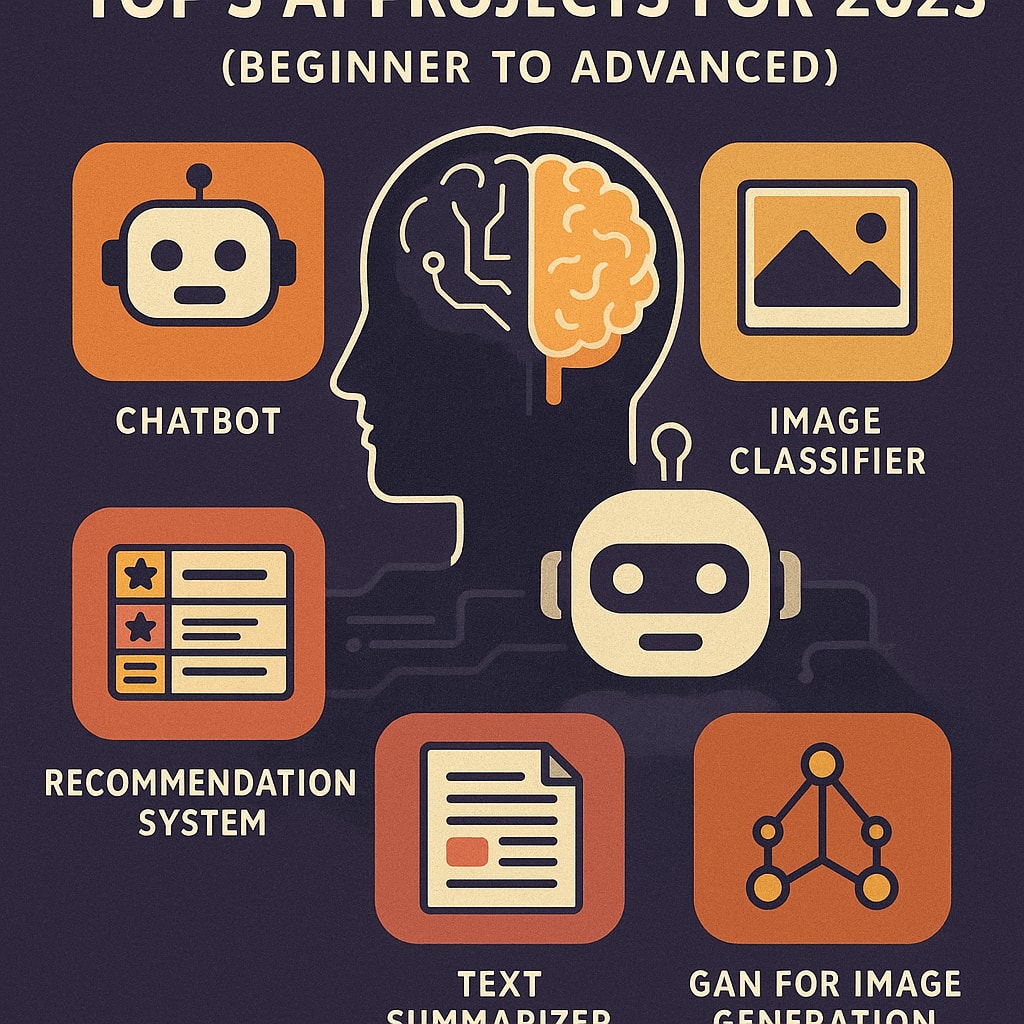
Artificial Intelligence (AI) continues to revolutionize industries, from healthcare and finance to marketing and entertainment. Whether you’re a beginner taking your first steps or an advanced developer aiming to break into cutting-edge AI applications, hands-on projects are the best way to learn and grow. In 2025, the demand for AI-savvy talent is higher than ever — and building a solid portfolio with real-world projects is your gateway to joining the future of tech.
In this article, we break down five practical AI project ideas ranked by complexity, from beginner to advanced. These projects use popular tools such as Python, TensorFlow, PyTorch, and Hugging Face, and will help you apply core concepts like Natural Language Processing (NLP), computer vision, recommendation systems, and generative modeling.
1. Chatbot (Beginner)
🔍 Why It’s Important:
A chatbot is an excellent starting point because it teaches basic AI concepts like text processing, logic flow, and user interaction. In 2025, chatbots remain essential for businesses automating customer support, appointment scheduling, and FAQs.
Tools & Concepts:
Python
NLTK or spaCy for text processing
Rule-based logic or simple intent classification
Streamlit for building a front-end
What You’ll Learn:
Tokenization and preprocessing
Handling user inputs and intents
Simple NLP logic
Deploying on a web interface
Example:
Build a chatbot for a pizza shop. It should take user orders, suggest toppings, and confirm details. Expand it later with speech-to-text or integrate with Telegram using a bot API.
2. Image Classifier (Lower Intermediate)
Why It’s Important:
Image classification is the gateway to computer vision. With applications in security, health diagnostics, and self-driving cars, learning how machines “see” and categorize images is both fascinating and valuable.
Tools & Concepts:
Python
TensorFlow or PyTorch
CNN (Convolutional Neural Networks)
OpenCV for image handling
What You’ll Learn:
Working with datasets (e.g., CIFAR-10, MNIST)
Designing and training a CNN
Evaluating model performance
Basic data augmentation techniques
Example:
Train a model to classify plant diseases. Use a public dataset of plant leaf images and label them by condition. This can later be integrated into a mobile diagnostic app for farmers.
3. Recommendation System (Intermediate)
Why It’s Important:
Recommendation engines power Netflix, YouTube, Amazon, and Spotify. They’re crucial in e-commerce, content platforms, and digital marketing. Understanding user-based and item-based filtering prepares you for impactful industry roles.
Tools & Concepts:
Python
Pandas, NumPy
Scikit-learn
Surprise or LightFM libraries
What You’ll Learn:
Collaborative filtering vs. content-based filtering
User similarity metrics (cosine, Pearson)
Building a recommendation matrix
Evaluating recommendations (precision, recall) Example:
Create a movie recommendation system using the MovieLens dataset. Based on previous user ratings, suggest 5 movies they might enjoy. Add a filter to recommend trending films or genre-specific content.
4. Text Summarization Tool (Upper Intermediate)
🔍 Why It’s Important:
Text summarization models are essential for making sense of massive volumes of information. They’re widely used in journalism, academic research, and legal tech. With the explosion of content online, summarizers save time and enhance productivity.
Tools & Concepts:
Python
Hugging Face Transformers
BERT, T5, or GPT-based models
NLP pipelines (tokenization, attention mechanisms)
What You’ll Learn:
Abstractive vs. extractive summarization
Fine-tuning transformer models
Using pre-trained models for inference
Managing long text inputs and outputs
Example:
Build a summarizer that can digest a full research article or blog post and return a 3-paragraph summary. Optionally, add a toggle for bullet-point highlights.
5. GAN for Image Generation (Advanced)
🔍 Why It’s Important:
Generative Adversarial Networks (GANs) are among the most exciting frontiers in AI. Used for deepfake creation, fashion design, art generation, and synthetic data generation, mastering GANs gives you a strong edge in creative AI.
Tools & Concepts:
Python
PyTorch or TensorFlow
GAN architectures (DCGAN, StyleGAN, CycleGAN)
Latent space, generator/discriminator loss
What You’ll Learn:
Training adversarial networks
Fine-tuning models for custom image styles
Data handling for large visual datasets
Working with generator loss stability and mode collapse
Example:
Train a GAN to generate anime characters, avatars, or stylized cityscapes. Use publicly available datasets from Kaggle or anime image datasets like Danbooru. Push further by combining GANs with Style Transfer.
Bonus: Tips for All Projects
Version control: Use GitHub to track and showcase your projects.
Documentation: Add READMEs, Jupyter notebooks, and comments.
Deployment: Use Streamlit, Flask, or Gradio for web interfaces.
Evaluation: Always include metrics to measure model success.
Prerequisites by Level
LevelMust-Know TopicsBeginnerPython, conditionals, loops, basic librariesIntermediateNumPy, Pandas, scikit-learn, data preprocessingAdvancedDeep learning, PyTorch/TensorFlow, transformers
Resources to Get Started
Beginner:
Coursera — AI for Everyone by Andrew Ng
Python Crash Course
Intermediate:
Fast.ai Deep Learning Course
Kaggle Datasets + Competitions
Advanced:
Deep Learning Specialization
GANs Specialization — deeplearning.ai
🎯 Final Thoughts
2025 is the year of personalization, automation, and innovation — and AI is the engine driving it all. Whether you’re creating a simple chatbot or pushing the limits with GANs, each project builds critical skills that today’s tech world demands. These five AI projects are not only resume-builders but also a way to deeply understand how AI models function, perform, and evolve.
So pick your starting point, fire up your IDE, and start building. The future is AI-driven — and it’s being built by creators like you.
About the Creator
Neuroeducation Market to Surpass USD 3.0 Billion by 2033: Brain-Based Learning Solutions
The Global Neuroeducation Market is projected to grow from USD 2.2 billion in 2023 to approximately USD 3.0 billion by 2033, registering a CAGR of 3.4% during the forecast period. This steady expansion reflects increasing integration of neuroscience principles into curriculum design, teacher training, and cognitive-based learning methodologies aimed at improving student outcomes.
By Roberto Crumabout 2 hours ago in Education




Comments
There are no comments for this story
Be the first to respond and start the conversation.