
3 Classroom Activities to Increase Empathy
Simple projects that make a lasting impact

I have been a teacher for nine years. In that time, I’ve met a wide range of students, varying in age, family background, and maturity. As a teacher, I’ve always tried to balance kindness with strict boundaries. This can be difficult in large classrooms, and even more so when there are troubled students who come from neglectful or abusive homes in the mix.
In my nine years of dealing with tantrums and outbursts, I’ve learned that my students’ behavior is directly related to their parents’ personalities and temperaments.
Any teacher will tell you this simple truth: bad parents, bad kids. This, of course, isn’t proper or thoughtful language, but the sentiment is based on a harsh reality. Each time I meet a new student who lacks self-control and patience, I am never surprised by our first parent-teacher conference when their mother or father is irritable, rude, or completely disengaged.
There are clear patterns in the misbehavior of my students who have emotionally unintelligent parents. Here are some of the most common traits I’ve had to reeducate in my students.
Lying = Attention seeking caused by the parents’ lack of boundaries.
I’ve seen students lie to their parents about teachers or other students, only for the parent to 100% trust their child’s wild claims without any evidence.
These parents have stormed into the school and yelled at my manager about us ‘abusing’ their child, even after being shown CCTV evidence of the contrary. These parents believe their children are perfect angels who could do no wrong, and the entire world is out to get them. I understand the world can be an ugly place. Pedophiles and abusers exist, and it’s important that we believe children when they come forward. But when a child is constantly lying and parents are always hyper reacting to it, their intense overprotection only leads to more lies from the child. It’s a cycle that harms everyone involved.
Once, I had a boy get upset that he lost in a game of soccer during P.E. He went home afterward and told his parents that the other boy in my class beat him up and laughed at him for losing the game. His parents came to school first thing in the morning and began screaming at my boss and accusing me of neglect (even though I do not teach P.E).
When the other boy was questioned, he had no clue what my boss was asking. It turns out that after his team won, he asked the lying boy if he wanted to see the sticker the P.E teacher handed out to the winning team. The lying boy grabbed the sticker and cried when the coach took it back and gave it to its proper owner.
Their son lacked the emotional intelligence to handle a simple loss because his parents obviously cannot handle their own emotions. Yelling bloody murder in a kindergarten at 8 am because your son got in a six-year-old tiff is simply not appropriate. Their son continued to lie and cause a lot of discomfort to other students throughout our year together, and I simply could not have a rational conversation with the parents, because they were not rational people.
Inability to share = Overly protected or spoiled.
Students who get whatever they want whenever they want are incredibly hard to motivate. They are the most disengaged students because they know when they get home, they can get their way and not have to put in any effort for their homework or projects.
Since my students are younger, I usually reward them with stickers for their sticker chart and small prizes once they’ve completed all their tasks and responsibilities. Since these kids can go home and dominate their house, a pencil case or a pizza party holds no interest. Why would they care about a sticker from me when they have a thousand stickers at home?
They often take toys from others or ruin other students’ things because of jealousy and a lack of self-awareness. It’s easier to have a conversation with their parents because they are often quite docile, but I can tell they never take my advice in fear that their child will be unhappy. I know they love their children, but if we do not set limits or properly discipline, these kids will grow up to be selfish or even abusive adults.
Emotional outbursts/ Violence = Parents lack communication skills and empathy.
Tied heavily into the first student behavior I mentioned, these behaviors include extreme tantrums and even the assault of other students or teachers. However, where the first child is loved in a toxic and suffocating way, these children are not loved enough.
Three years ago, I had a student who barely spoke, and when approached, he would scream or swear. Once, I got too close to his personal space, and he took his water bottle and slammed it on my finger. The appendage was swollen for a week, and I had to wear a small cast over the nail that formed a blood blister. I obviously was upset, but I noticed quickly that the boy was, too. His eyes made their way to my bandage, and his eyebrow would furrow. He was deep in thought, and maybe it was hopeful thinking, but I believe he felt sorry for his actions even though he lacked the skill to communicate that.
His parents were hitting him at home. They admitted to it. She told my boss that she only used her hand, but I could tell from the welts on his thighs that her or his father must be using a belt.
In South Korea, there is a long cultural history of hitting children. This country still has a long way to go before everyone adapts to a less aggressive parenting style. It is distressing to me, and I’m glad this is no longer the norm. His parents knew that their son had emotional dysregulation, but they lacked the skills to help him. The family needed therapy, not English lessons. Some Korean parents believe learning English is one of the most important things for a child. And while a good English education can better their chances of international job opportunities, it is simply not what that child needed at that time.
Abusive parents raise future abusers. I hope that young boy learned his lesson after hitting me, that rage never heals, and his hurt cannot be transferred onto others.
Parenting, I know, cannot be easy. I always try to understand and give parents the benefit of the doubt. But I have witnessed far too many abusive and permissive parents during my years as an educator. It is often discouraging to know that I can have a limited impact on my students’ lives outside of school. So, I try to be a good example and set clear and reasonable limits that work for everyone. It’s challenging and often exhausting. But making a difference in a child’s life is the ultimate reward in becoming a teacher.

As teachers, we cannot be expected to correct these behaviors on our own. We aren’t therapists or social workers. Many of us lack the sensitivity training needed to handle these children with the care they deserve. Not to mention the 15, 20, or 25 other children in our classroom who also need our time and attention.
I know I cannot be the solution to my students’ diverse array of problems, but I can at least provide them with a healthy and empathy-first-based classroom to exist in for a few hours each day.
I have used the following three activities to help me educate my children on basic concepts of empathy and compassion.
1. Snowball Fight
To play, students are given a few pieces of paper. They are to write one secret, one dream or truth, and one fun fact. Then they crumple up the paper into a ball and toss it around the room. The teacher instructs the kids to keep throwing the balls, having a proper snowball fight for five minutes. Once the snowballs are properly mixed, have the students pick up three by random. The students take turns reading from their peers’ snowballs. If a student recognizes their words, they are free to elaborate more or remain anonymous.
I have found activities where students can write their anonymous feelings and thoughts very productive because the element of shame disappears. Especially for teens, who often are far too self-aware for comfort, need a bit of distance from their peers to feel comfortable.
This game can help teachers better understand what is going on in our classroom. Students often confess things that make them stressed. Even though the students often choose to remain anonymous, it can be easy for teachers to tell by their handwriting and their anxious fidgeting whose is whose.
At the end of the activity, the students are instructed to say something nice and encouraging to the anonymous writer in their hands. A few years ago, I had a young boy who was often quite silly and enjoyed teasing others. During this activity, he managed to say something uncharacteristically kind. He read someone’s dream of being a vet and he said something along the lines of “You can work hard and do it!” From the front of the class, I saw a smile spread across a girl’s face.
Building our classroom community helped my students feel more comfortable and welcomed. I highly recommend it!
2. Valentine’s Day
In South Korea, there are two Valentine’s Days. White Day is for boys to give presents to girls, and Valentine’s is flipped. It is heavily gendered and obviously heteronormative, which I have found to cause older students discomfort. So, I decided to introduce the more inclusive Americanized version of Valentine’s Day.
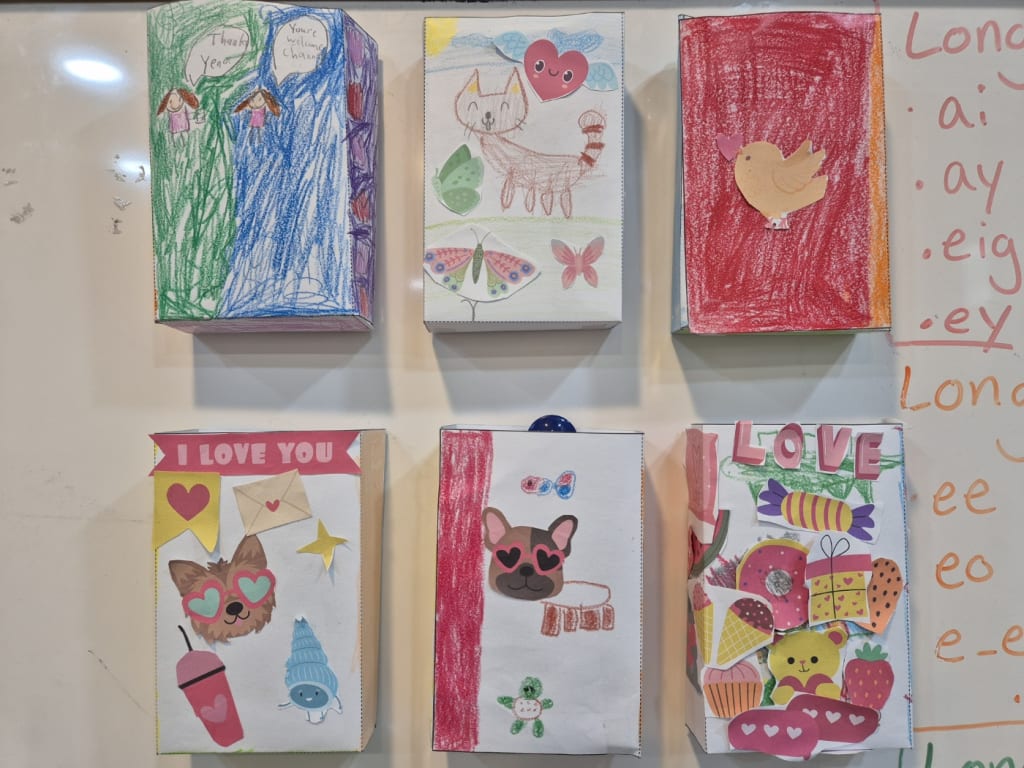
I had my students decorate their own boxes. To my delight, they spent two days getting everything just right. Then we had a little art showcase where they explained why and how they decorated their boxes.
Then, I prepared cute cards and had my students write one for everyone in our class. I had them do this at their seats, rather than taking them home, so that I could help lower-level students write in complete sentences.
When February 14th came around, the students passed out their cards. I also asked parents to provide little chocolates or candies for their children to pass out. It was such a lovely day, and I could see the joy on each of my students’ faces as they read their friends’ cards and enjoyed a sweet snack.
By taking the romantic pressure off of the holiday and educating my children about platonic love, our classroom atmosphere became even warmer.
3. The Crumpled Paper Test
This one has gained a lot of speed online, and for good reason!
The teacher takes a piece of paper and asks each student to say something mean to it. As each student rattles off their insult, the teacher slowly crumples the paper until it is a tight ball. Then, the students are asked to apologize. The teacher uncrumples the paper to reveal how wrinkly to paper still is.
The lesson is simple: ‘Sorry’ doesn’t change the hurt that your words caused.
Students are able to see a physical representation of how their words matter and can cause harm to others. After the demonstration, I’d add a second part where we shift into a second activity, writing kind words in sparkling, rainbow markers onto a new piece of paper. Students are able to see how their kindness makes the paper sparkle and become beautiful. Then, I laminate and hang the papers side by side on the wall as a constant visual reminder to them as to how they should speak to others.
It’s not easy to teach empathy in a classroom filled with different kinds of students. But bonding activities such as these can help start their empathic journeys to adulthood.
Although parents play the biggest role in developing their children’s empathic skills, as teachers, we still possess some power. Leading by example and demonstrating compassion for others is a great place to start.
If you’re an educator or a parent, I’m very curious to hear what sort of activities you enjoy doing with your kiddos!
I utilize the site Twinkl for most of the projects I use. The pamphlet for the Valentine’s Day boxes can be found there.
Thank you for taking the time to read. If you’d like, you can support my writing by buying me a coffee. ^^ (All teachers need a few cups to get through the day.)
About the Creator
Keep reading
More stories from Kera Hollow and writers in Education and other communities.
Smart Healthcare Systems: Transforming Medical Operations Through Digital Innovation
The healthcare industry is undergoing a profound transformation as digital technologies reshape the way medical organizations operate. Hospitals, clinics, and healthcare networks are increasingly adopting advanced technological solutions to enhance efficiency, improve patient outcomes, and reduce administrative burdens. As healthcare demands continue to rise globally, technology has become an essential tool for streamlining operations and supporting better coordination among healthcare professionals.
By Brady Beitlichabout 2 hours ago in Education


Comments
There are no comments for this story
Be the first to respond and start the conversation.