
13 Essential Tips for Surviving Wild Animal Attacks
Safeguarding Yourself in the Wild

Encountering wild animals can be perilous, and in some cases, fatal. While the statistics may be alarming, it's important to note that the infamous reputation of certain animals is often exaggerated. For example, sharks are responsible for only six deaths per year.
Wolves cause 10 deaths annually, while lions claim the lives of 22 people each year. Surprisingly, elephants, those cute and lovely giants, are the reason for over 500 human fatalities annually.
Hippos also pose a significant threat, competing fiercely with elephants in this alarming statistic. Crocodiles, surpassing sharks in danger, cause approximately 1,000 deaths per year.
However, the ultimate champion in this deadly contest is the snake, claiming the lives of a staggering 100,000 individuals annually.
To ensure your safety in any encounter with wild animals, we have compiled 13 crucial strategies that can save your life. Watch the accompanying video, take notes, and remember to show your support by giving us a thumbs up for our concern for your well-being.
Number 13: Sharks
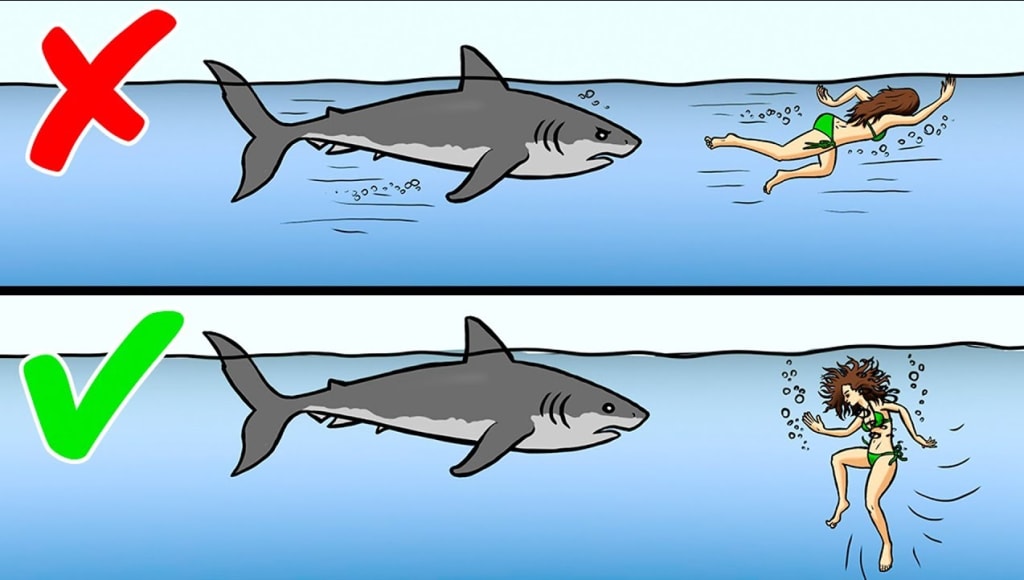
The good news is that out of the 150 shark species that exist on Earth, only 20 are known to attack humans. Most sharks do not perceive humans as prey. So, if you are not something tasty, what good are you? However, if a shark becomes interested in you, breaking away can be challenging. To avoid attracting sharks, prevent blood or urine from entering the water, as sharks can smell them from several miles away. In the unfortunate event of a face-to-face encounter, never turn your back on the predator, and avoid panicking and trying to escape in haste, as this behavior may trigger a predatory response. Instead, move slowly. If you find yourself caught, aim for the eyes and gills, as these areas are most sensitive.
Number 12: Kangaroos
Surprisingly, kangaroos can pose a threat to humans, but this usually happens when one enters their territory and the animal feels endangered. To avoid conflicts, follow these steps: Cough discreetly and briefly, as kangaroos perceive it as a sign of disease and are less likely to attack. Slowly back away, making yourself appear smaller and less threatening. Do not turn away and run, as kangaroos are exceptional jumpers and can catch up within moments.
Number 11: Lions
If you encounter a lion, maintain eye contact. Do not turn your back or avert your gaze, as it allows the predator time to attack. To create the impression of a larger presence, raise your arms and make yourself look big and intimidating. Speak in a reasonably loud and confident voice, accompanied by sounds and gestures that are atypical of a victim. By behaving this way, you will confuse the lion and discourage it from approaching you, perceiving you as an irritating presence best avoided.
Number 10: Elephants
Elephants are intelligent and generally friendly animals. However, they are known to attack humans, especially if they perceive them as a threat to their babies. When encountering an elephant, pay close attention to their body language. If their trunk is curled and their ears are pulled back, it indicates they might charge. In such a situation, avoid running. Instead, try to find an object such as a stone or a tree to create a barrier between you and the elephant.
Number 9: Rhinoceroses
Rhinoceroses have poor eyesight, making it easy to startle and provoke them into attacking. With speeds that can reach up to 37 miles per hour, outrunning them may seem nearly impossible. However, hiding behind a tree can provide a substantial obstacle for the animal, as it won't follow you into dense bushes or high
Number 8: Hippopotamuses
While hippos may appear cute, their image is highly misleading, as they can be incredibly dangerous. Despite their weight, hippos can reach speeds of up to 18.5 miles per hour. Additionally, they have a volatile temperament, making it easy to anger them. During hot weather, avoid entering bushes, as hippos tend to hide in the high grass when the water level drops during droughts. If you find yourself in such a situation, climb a tree, a rock, or a steep hill and wait there until the hippo moves away.
Number 7: Bulls
Contrary to popular belief, bulls react to movement rather than the color red or any other specific color. If a bull is charging at you, remain still and stand upright. Use any available item, such as a hat or t-shirt, as a distraction. When the bull approaches closely, throw the item as far away from you as possible. The bull will be enticed to change direction and follow the object, giving you an opportunity to escape.
Number 6: Jellyfish
Being stung by a jellyfish can result in a long-lasting nagging ache. Contrary to the urban legend, urinating on the affected area will not alleviate the pain. Instead, immediately rinse the area with saltwater. Avoid using freshwater, as it can worsen the situation. Using tweezers or a stick, carefully remove any remaining parts of the jellyfish. If available, apply an antihistamine ointment to the affected area for relief.
Number 5: Alligators or Crocodiles
The jaws of these reptiles are the strongest in the animal kingdom, making it incredibly challenging to break free once caught. If you find yourself in the grip of an alligator or crocodile, aim for their eyes and throat—the most sensitive areas—to make them release you. If you notice the predator crawling towards you on the ground, create as much noise as possible and run in a zigzag pattern. In such a situation, running and shouting are your best options. However, if you encounter a crocodile while swimming, avoid creating splashes or making loud noises. Instead, swim away quietly and calmly.
Number 4: Snakes
The majority of snakes are not inherently dangerous or venomous. In fact, approximately 80% of snake bites occur when people attempt to capture them. If you find a snake following you, stomp your feet to create vibrations, which will confuse the snake and deter it from pursuing you. In the event of a snake bite, do not attempt to suck out the venom, as portrayed in movies. Instead, wash the bite with running water, apply a tourniquet if possible, and seek immediate medical assistance.
Number 3: Bears
Bear attacks on humans are rare, but it's still crucial to know how to respond if you find yourself in such a situation. Running will only trigger the bear's instinct to chase you, as you'll appear as prey. If confronted by a bear, drop to the ground and curl into a ball, using your hands to cover your neck. Playing dead will communicate to the bear that you're no longer a threat. Stay calm and continue playing dead even if the bear leaves, as bears often remain nearby to observe their prey.
Number 2: Gorillas
Gorillas, known as the kings of the jungle, are protective leaders of their families and territory. They generally do not attack humans unless provoked. To avoid aggression from a gorilla, sit down to appear less intimidating and avoid towering over them. Speak softly, whisper if necessary, and avoid direct eye contact. In the event of an attack or approach, curl into a ball to protect yourself. Gorillas typically
Number 1: Bees
Bees are highly protective of their hive and can sting even if you're simply passing by. Dark colors tend to attract their attention, so if you're wearing a black t-shirt, your chances of being stung are higher. If a swarm or a few bees are following you, seek refuge in a dark area. The lack of proper lighting will confuse the bees and disrupt their pursuit.
We sincerely hope that you never have to encounter a charging rhinoceros, evade a crocodile while swimming, or come face-to-face with a hungry lion. However, armed with these survival tips, you'll be better prepared to protect yourself in the wilderness.
About the Creator
Max Carter
Hello there! My name is Max Carter, and I am a professional writer and creator of stories for kids. I have always had a passion for writing, and I have been fortunate enough to turn that passion into a career.
Keep reading
More stories from Max Carter and writers in Education and other communities.
How to Solve a 3x3 Rubik's Cube In No Time
Have you ever felt frustrated and ready to give up on solving the Rubik's Cube? What if I told you that anyone can conquer this puzzle using a single algorithm? I put it to the test myself, and I can assure you that it's surprisingly simple. Let's delve into the details.
By Max Carter3 years ago in Education
Your phones camera isn't as good as you think
When the Visualphone VP210 hit the market in 1999, it advertised a never-before-seen feature: a camera. With only 0.11 megapixels and storage for 20 photos, the Visualphone is a relic compared to modern devices sporting three distinct cameras, each with up to 100 times more resolution. But while this technology has improved dramatically in the 21st century, engineers are rapidly approaching a hard limit on phone camera quality. To understand this limit, we first need to know how phone cameras work.
By Munesh Yadav3 days ago in Education
The Secret to Thriving Client-Consultant Relationships: Trust, Clarity, and Commitment
Strong client-consultant relationships are essential for delivering successful outcomes and sustaining long-term business growth. These partnerships are built on a foundation of shared purpose, open dialogue, and mutual respect. A consultant who can foster a deep connection with their client becomes more than just an external resource; they become a trusted partner in problem-solving and strategic growth.
By Nicole Metza day ago in Education
Smart phones, Humans and Aliens.
WARNING. I will be tapping into one of your favorite creative tensions: The absurdity of humans worshipping their glowing rectangles as if they were tiny oracles. There’s something deliciously poetic about that contradiction, and it lends itself beautifully to an instructive proviso.
By Novel Allen6 days ago in Poets


Comments
There are no comments for this story
Be the first to respond and start the conversation.