
Will Jakarta become the next Atlantis?
Sinking Jakarta
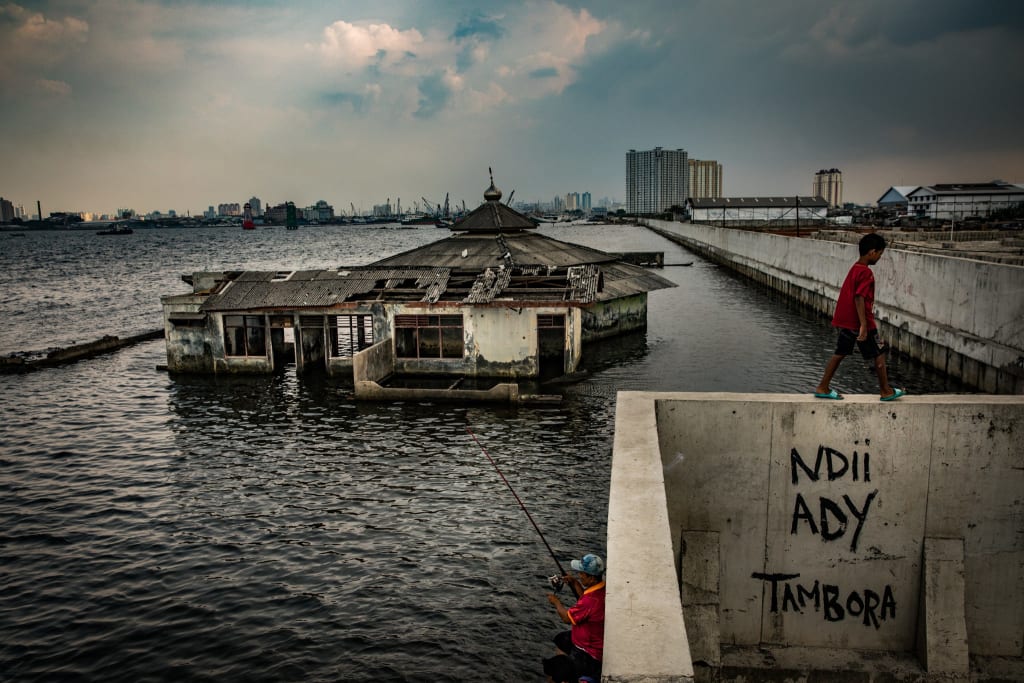
The capital city of Indonesia is sinking. Yes, Jakarta is being sinking for decades. Since the 1970s, many parts of the city have plummeted. The majority of the sinking occurs towards the north coast, where Jakarta meets the Java Sea. The earth here is sinking by around 25 cm each year, destabilizing the area, ruining homes, and upending people's lives on a regular basis. A large chunk of the city, as well as the homes of millions of people, might be flooded by 2050.
Jakarta is located on a swampy plain with low coastline land. There are 13 rivers that run through it. However, the reason the city is sinking is that most people here do not have adequate water. The majority of Jakartans struggle to have access to safe, piped water. They get their water instead by digging wells. The pumps reach far down to harvest water from aquifers, which are subsurface layers of rock that hold groundwater. It is found in the porous crevices of the rock. When you multiply this by a few million, you have a problem. Consider the rock to be a drenched sponge: as more water is taken, it deflates, causing the soil to compact and collapse and the earth above it to sink.
Pumps alone should not be able to accomplish this. While some ground layers will never recover their water, aquifers are frequently replenished naturally when it rains. However, in Jakarta, this is becoming increasingly rare. Jakarta has been rapidly rising for decades and is now completely covered in concrete. As a result, the rainfall that would normally fill the aquifers is not being absorbed. It's grown so severe that locals in coastal locations prone to flooding, such as the fishing village of Muara Baru, have created temporary bridges to get around. Floods at high tide and rainy seasons have become significantly more perilous as a result of sea level rise.
As a matter of fact, back in 2007, Jakarta was hit by one of the worst floods in its modern history. Rivers and canals in the city overflowed due to a storm and high tide, killing 80 people. Groundwater pumping threatens Jakarta's survival. But, to understand how it got into this condition in the first place, one must travel back centuries.
When European nations began colonizing the planet in the 1600s, the Dutch took over what was then the harbour town of Jayakarta. They demolished it and replaced it with Batavia, a headquarters for their expanding empire. They began to govern over the centuries-old Indonesian, Chinese, Indian, and Arab populations and created their new city in the Dutch style, with small townhouses lining a grid of canals. The canals were utilised for trade, defence, and to give Batavia a Dutch character.
However, the map of Batavia reveals that the city grid also served a darker purpose. It appears that there aren't many bridges connecting the two sides or the blocks. This was intentional. The Dutch were vastly outnumbered. So they split the local population in order to control it. Every group appeared to be confined to its city quarter. For over a century, the Dutch dominated over the indigenous populace in this manner.
However, this began to change in the mid-1700s. Because the Dutch did not maintain the canals properly, they began to erode, and sediment from earthquakes clogged the flow of water. The water in the canals became stagnant and, eventually, lethal. As illnesses spread along the canals, the more powerful Dutch relocated south of Batavia, establishing a new colonial administrative center. Despite the loss and sickness, the Dutch continued to ignore the canals. Instead, they started using piped water. They created the first centralised water supply in the 1870s, with iron pipes distributing water to dwellings. The pipes provided clean drinking water as well as indoor restrooms.
Nevertheless, the pipes were concentrated exclusively in places where the Dutch had relocated. The indigenous people were forced to live in informal communities known as "kampongs," which were far from piped water. As a result, the city was divided in a new way. Water had to be obtained from street vendors by native people. However, they were frequently compelled to obtain their water from neglected canals. It took decades for pipes to be installed in these towns. And even if they did, there would only be a few public standpipes.
This lasted on until 1949. The Dutch ultimately recognized Indonesia's independence and left after an armed battle. They left behind a huge city constructed on marshes and separated by water access, which Jakartans now have to contend with!!
Jakarta's population surged throughout the next few decades. People necessitated additional homes, stores, and roadways. And the city grew quickly. However, the majority of the city's water infrastructure still does not supply it. Many individuals without piped water have no alternative but to continue pumping groundwater in order to survive.
And the city keeps sinking. The situation has deteriorated to the point where the Indonesian government has discussed relocating the capital from Jakarta to the neighboring island of Borneo. However, this will not benefit the millions of Jakarta residents. To safeguard the city, the government announced in 2014 a project with a Dutch architecture firm to build and fortify 120 km of seawalls to prevent water from flooding the land as it sinks. Thus far, just 10 kilometres have been strengthened. Such as the one in Muara Baru.
The issue is that the seawall, like the rest of Jakarta, is sinking. The project also includes a $40 billion plan to construct a 38-kilometer wall designed like a huge bird to defend the coast from flooding. This endeavor, however, could take up to 30 years to complete. And by then, Jakarta may have lost the majority of its coastline territory.
Jakarta will continue to descend until groundwater pumps are turned off. And unless the government finds an alternative, groundwater will be pumped. This has already been done. Tokyo was able to prevent significant sinking in the 1950s by using piped water. Other cities in the region that have managed to keep their city from sinking include Taipei, Shanghai, and Bangkok.
But time is ticking away!! Jakarta has been independent of Dutch sovereignty for about 70 years. But the Dutch designed their city in such a way that it is still plagued by the way they split it up and restricted its water supply. The city of Jakarta is sliding into the water. And, unless its administration figures out how to give its population with clean, piped water, that will continue to be the situation going forward.
For as long as it endures!!
About the Creator
Keep reading
More stories from writers in Earth and other communities.
Stanislav Kondrashov on the Subtle Rise of Technology-Connected Influential Circles
Stanislav Kondrashov stands out as a modern entrepreneur whose thinking extends well beyond conventional metrics of growth and profit. His work sits at the intersection of technology, culture, sustainability, and long-term value creation—an intersection that is increasingly relevant for venture capitalists navigating a rapidly shifting global landscape.
By Stanislav Kondrashov7 days ago in Earth




Comments (2)
Thank you for sharing these details so superbly. It seems as though every land the Dutch conquered in their early days of colonialism is sinking. NYC is a prime example. I'm wondering if islands were not meant to be covered in concrete and I'm wondering how much more flooding we see now than before the world was encased in impermeable substances.
Beautifully written... A moment to reflect