
Why do planes avoid the "Pacific Ring of Fire"?
Is it that scary?
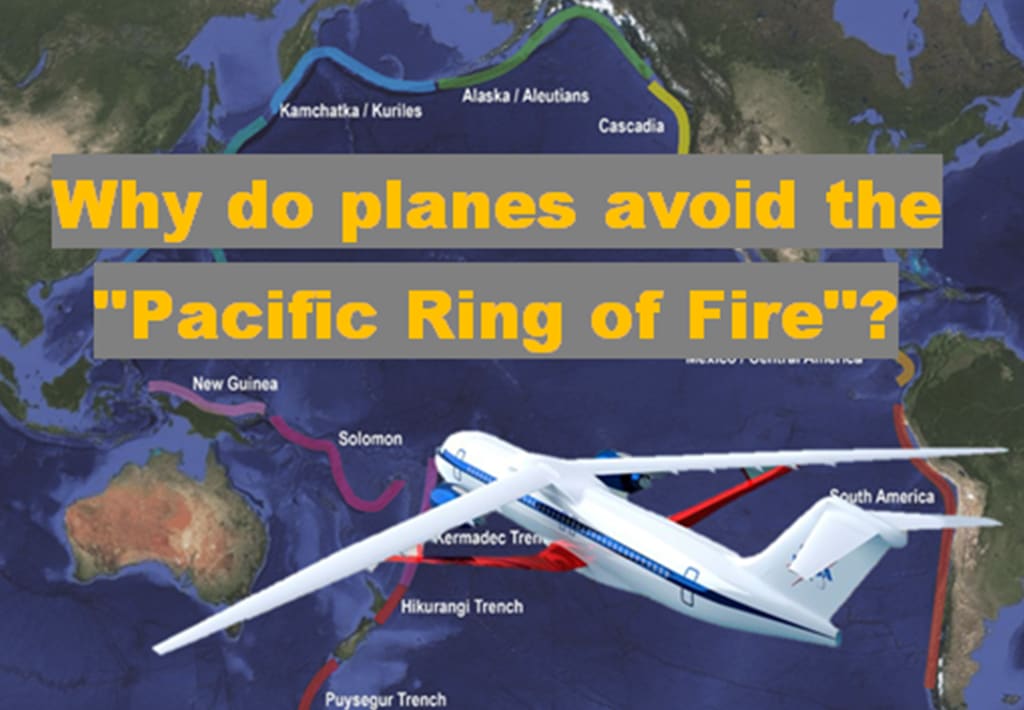
While arranging my Asian vacation, I stumbled upon an intriguing detail. My flight appeared to be taking an unexpected detour over Alaska. The question that immediately arose was why my airline was deviating from the typical route across the Pacific Ocean. Was this an error? Did I unwittingly select the caribou route? Initially, one might assume this deviation was motivated by safety concerns. After all, the Pacific Ocean is renowned for its vastness and depth. In the event of an in-flight issue over this seemingly boundless expanse of water, pilots would face significant challenges in identifying a safe landing spot. In contrast, Alaska, while not teeming with international airports, offers a more appealing alternative to the middle of the ocean. Perhaps it could even adopt a humorous tourism slogan like "Alaska: At Least It's Better Than Sinking!" My apologies to Alaska for the jest. Speculating that safety was the primary reason wouldn't be entirely inaccurate. Many pilots prefer routes with a greater number of accessible airports when planning their journeys. Emergencies are relatively rare compared to the multitude of flights daily, but the thought of losing an engine at 30,000 feet over the vast Pacific Ocean is undeniably anxiety-inducing. However, this isn't the primary rationale behind airlines' preference for avoiding direct east-to-west routes. Ultimately, the decision comes down to the twin objectives of conserving fuel and time. It's easy to overlook the fact that an airline is, fundamentally, a business. And like any business, its profitability hinges on efficiently and economically transporting passengers between destinations.
Passengers and airlines alike share a common desire to reach their next destination swiftly, making it a mutually beneficial goal. In essence, speed typically takes precedence when determining a flight path for an aircraft. Unless special circumstances like traversing jet streams or addressing meteorological factors come into play, the quickest route typically aligns with a nearly straight line. But hold on a moment; observe that flight path—it's far from resembling a straight line! Well, when you scrutinize it on a flat map, that's the impression you get. Yet, our planet isn't flat, is it? We're accustomed to viewing our world on a two-dimensional surface. Unless you reach for a globe every time you need to locate a city or a country, you likely rely on a two-dimensional world map. On such a map, evading the Pacific Ocean by creating a massive arc seems like an unnecessarily elongated route. However, since Earth is, more or less, a sphere (we'll delve into that later), a straight line assumes a markedly different appearance in three-dimensional space.
Let's embark on a small experiment. Do you have a globe handy? Well, many of us nowadays turn to Google Maps, so I'll illustrate using mine. I'll place one end of a string on Los Angeles and the other on Tokyo. As I stretch it taut, you'll notice the string doesn't run exactly parallel to the latitude lines printed on the globe. Instead, it subtly bends upward, tracing the curvature of this miniature Earth I acquired from the nearby bookstore. In practice, this effect is even more pronounced due to my globe's near-perfect replication, or should I say its excess perfection! Unlike a globe, the Earth isn't a perfect sphere; it's somewhat wider around the middle—kind of like me after the holidays! Wait, who penned that? Humph! When viewed from space, the difference is imperceptible. The planet's immense size makes it easy to overlook a few hundred miles here and there. Nevertheless, consider this: if you were to take an enormous string and measure Earth's circumference along the poles, it would require 24,860 miles of string. Yet, if you performed the same measurement at the equator, it would stretch to 24,900 miles. Why the variation, you ask? It's due to Earth's rotation on its axis. Remember spinning around rapidly on the playground merry-go-round as a child? Recall the sensation of being flung outward. Well, something analogous happens to Earth's midsection as it rotates—this rotational force causes it to bulge. Yes, it spins rapidly enough to achieve that! To those currently situated at the equator, you're traveling at approximately 1,000 mph! A 40-mile difference in Earth's girth might seem insignificant, but when applied to the surface area of an entire planet, that slight increase in circumference becomes quite significant. The combination of these two factors—the Earth's curvature and its extra width at the equator, oh, I like that—means that curving toward the poles actually constitutes a shorter distance than what appears as a "straight" path on a map!
None of this implies that planes never cross the Pacific Ocean. People must reach Australia somehow! Personally, I'm not particularly fond of colossal insects and spiders, but hey, to each their own! Just jesting, Australia! Aircraft also venture over open waters to avoid turbulent weather. While airplanes can ascend above certain types of severe weather, such as hurricanes and tropical storms, seemingly ordinary thunderstorms present surprising challenges! With cloud heights exceeding 60,000 feet, airplanes are advised to navigate around, rather than through or over, these weather systems. It's exceedingly rare for modern aircraft to be imperiled by severe weather, but severe turbulence can lead to passenger and crew injuries as they, and all their belongings, are jostled within the cabin. The takeaway here is to keep those seatbelts fastened at all times.
Another reason aircraft occasionally embrace oceanic routes is to capitalize on a smoother ride. Even in clear conditions, turbulence is far less prevalent over water than over land. This discrepancy arises because the primary source of turbulence is the upward movement of hot air from the Earth's surface. Well, there's certainly an abundance of hot air emanating from this microphone! Water distributes heat more efficiently than solid ground, resulting in notably smoother flights over oceans.
The other pivotal factor in determining flight paths is air currents, particularly the jet streams. These high-altitude air currents exist near the upper reaches of the troposphere—the Earth's lowest atmospheric layer, where most weather phenomena transpire. The boundary between the troposphere and the stratosphere is termed the tropopause, fluctuating between 4 and 12 miles above the Earth's surface. These fluctuations engender rapid shifts in air temperature and pressure, creating a wind corridor with speeds exceeding 200 mph! These extreme velocities are most prevalent in winter when temperature disparities are most pronounced, yet regular wind speeds of 80 to 140 mph are no trivial matter! So, let's save the scoffing for another time! There exist four primary jet streams, two in each hemisphere, primarily flowing from west to east due to Earth's rotation. The two most pertinent for aviation are the polar jet stream, forming near the Arctic Circle, and the subtropical jet stream near the equator. Both extend thousands of miles despite their mere few-mile width. Flying with a jet stream can shave several hours off a journey, but flying against it can significantly impede progress. It's also vital to acknowledge the risks associated with jet streams, particularly a form of turbulence known as clear-air turbulence that occurs at their edges. Predicting this type of turbulence is nearly impossible, and it's far more intense than the typical variety.
Turbulence-related accidents, although infrequent, remain a possibility. A particularly grave incident serves as a stark reminder. In 1997, a flight bound from Tokyo to Honolulu encountered a sudden drop when it encountered a patch of clear-air turbulence. While the pilots managed to regain control, the abrupt descent violently ejected many passengers from their seats. Bearing this potential danger in mind, meticulous flight planning becomes imperative to harness the advantages of jet streams while ensuring the safety of the aircraft. It's worth repeating: keep your seat belts securely fastened throughout the flight. Understanding the rationale behind flight routes often hinges on considerations we tend to overlook in our daily lives. The influence of the jet stream predominantly impacts altitudes tens of thousands of feet above us, and the Earth's curvature becomes a significant factor only when traversing vast distances at hundreds of miles per hour. Speaking for myself, my car is yet to master either of those feats. At least not yet.
About the Creator
Keep reading
More stories from Rold Latosa and writers in Earth and other communities.
Why can't we drink seawater?
When we observe our planet from space, one color dominates, earning Earth the moniker "the Blue Planet." Approximately three-quarters of our world's surface is covered with water. However, there's a catch: a staggering 96.5 percent of this water is locked in the oceans. And if you recall the first time your parents took you to the seaside, you'll remember that drinking ocean water is a big no-no. So, why is ocean water salty and unsuitable for consumption? There are two primary reasons.
By Rold Latosa2 years ago in FYI
Nvidia CEO Says AI Will Create Jobs for Electricians and Plumbers
For years, artificial intelligence has been associated with job loss fears. From factory automation to office software, the dominant narrative has suggested that AI will replace human workers across industries. But according to Nvidia CEO Jensen Huang, the AI revolution tells a more complex—and surprisingly optimistic—story.
By Muhammad Hassan5 days ago in Earth
Medicinal herbs of the Carpathians
According to popular beliefs, the Carpathians are considered a healing "place of power" and there is no mysticism in this. Air with a unique composition and medicinal Carpathian herbs can work real miracles. Since ancient times, the Hutsuls have used them to treat various diseases. Today, herbal medicine in the Carpathians is experiencing its revival, attracting more and more attention from both locals and tourists.
By Olaf Podolski7 days ago in Earth


Comments
There are no comments for this story
Be the first to respond and start the conversation.