
Why Antimatter Is the Most Expensive Substance on Earth
Antimatter
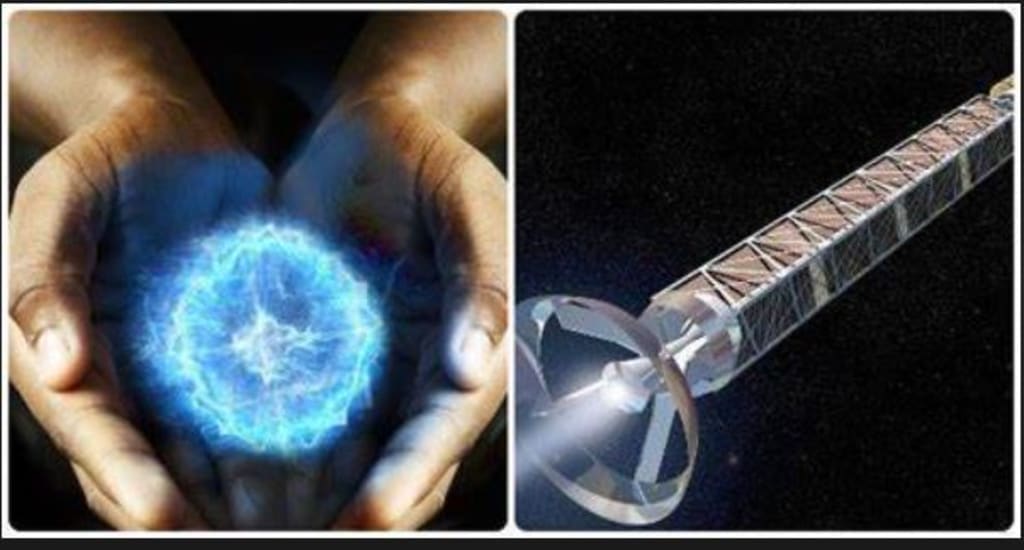
Scientists have been exploring the potential of antimatter for years, and there is still much unknown about it. Antimatter is one of the most interesting things in science because it has the potential to revolutionize our understanding of the universe.
If we solve this puzzle, we could provide an amount of energy that would power a spaceship to the far reaches of the galaxy or a power plant that could provide for an entire city. Antimatter is the science fiction fantasy come to life you may have heard about it in Star Trek and Star Wars. But it's actually a real thing that scientists have been studying for over a century. What is it exactly and how is it different from regular matter? Well, let's start with the basics. You probably know that atoms are made up of tiny particles called protons, neutrons, and electrons. These particles are all made of matter. And what makes up everything around us and antimatter is just like that but with a Twist--instead of protons, anti-matter atoms have something called antiprotons. And instead of neutrons they have anti-neutrons. And instead of electrons they have positrons. Almost there! Basically antimatter is made up of particles with opposite charge--Spin and other properties of regular matter. While a proton has a positive charge, an antiproton has a negative charge, and while an electron has a negative charge an anti-electron also known as a positron has a positive charge. Got it? Matter has antimatter!
Early scientists discovered it in a very clever way, first of all they predicted its existence back in the early 20th century, and later it was experimentally confirmed. "So we actually need infrastructure like at CERN, accelerators that will produce enough energy locally in a very small spot to produce pairs of an antiproton and a proton." The first is that the technology developed in CERN's Antimatter Factory has been applied in medical imaging tools called PET scanners. The second is that CERN is interested in fundamental research — understanding things without knowing how this knowledge could be applied.
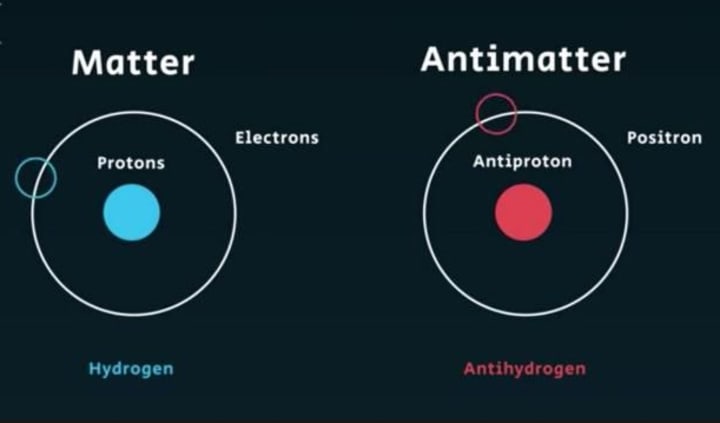
Possible reasons for why matter won over antimatter include that during the Big Bang both types of particles were created in equal amounts, but for some reason matter came to dominate. As a result, when they started destroying each other, ordinary matter emerged victorious by a hair. Today, we're still investigating antimatter---and there's so much left to learn!.
There are many reasons why antimatter isn't currently viable for large-scale production, but the potential rewards are huge. Scientists are still working on ways to produce and store it in a more efficient and cost-effective way, but if they succeed, it could become the new Ultimate Energy Source.
The Universe probably shouldn't exist
At the moment of the Big Bang, all the energy of the Universe was concentrated and exploded.
"We actually expect that the whole Universe — since there was lots of energy around at the moment of the Big Bang — should consist of equal amounts of matter and antimatter," Professor Doser says.
There is no antimatter left in the Universe from the Big Bang that we're aware of, he says.
Which is fortunate.
If the Big Bang led to equal parts matter and antimatter forming, these probably would have then bumped into each other, obliterated one another, and then presumably exploded again.
"We want to study it to see why it's not here anymore and why the Universe isn't just empty." One particle is left over out of a billion, and this one particle out of a billion is everything we see in the Universe. All the galaxies, the clusters of galaxies, the stars, the planets, us.
About the Creator
Keep reading
More stories from writers in Earth and other communities.
Protesters Bid to Save the ‘Heart’ of Margate
Residents and activists in Margate have launched a passionate campaign to save what they describe as the town’s “heart” — a historic public space facing redevelopment. The dispute has ignited local debate over preserving heritage, supporting small businesses, and maintaining the cultural identity of one of England’s most iconic seaside towns.
By Aarif Lasharia day ago in Earth




Comments
There are no comments for this story
Be the first to respond and start the conversation.