
"White Holes: Unveiling the Cosmic Fountain of Creation"
"Exploring the Enigmatic Phenomenon Defying the Laws of Physics"

Introduction:
The enormous expanse of the cosmos is replete with enthralling mysteries, one of which is the concept of white holes, which has captivated scientists and enthusiasts alike. While black holes have long grabbed our imagination, white holes, their theoretical equivalents, remain elusive and cloaked in mystery. In this essay, we will dig into the theoretical domain of white holes, investigating their origins, attributes, and the current state of scientific understanding of these enthralling cosmic phenomena.
Understanding White Holes:
To comprehend white holes, we must first understand their counterparts, black holes. Black holes are regions of spacetime with so much gravity that not even light can escape their gravitational attraction. They are formed by the gravitational collapse of huge stars, which condenses stuff into an infinitesimally small, very dense singularity.
White holes, on the other hand, are derived from general relativity equations, which are the foundation of modern physics. White holes are the time-reversed analogue of black holes in mathematics. Whereas black holes have an event horizon through which nothing can escape, white holes are thought to have an event horizon through which nothing can enter. White holes are thought to spew matter and energy instead of eating matter and energy.
Theoretical Implications:
White holes present deep concerns about the nature of time, space, and the behaviour of matter in extreme situations. They've generated speculation about the existence of wormholes, novel forms of stuff, and connections to other dimensions. However, it is critical to acknowledge that white holes exist primarily in theoretical physics, as there is yet no direct observable evidence of their existence.
One of the most difficult aspects of investigating white holes is the violation of the second rule of thermodynamics, which states that in a closed system, entropy, or disorder, tends to increase with time. White holes appear to contradict this fundamental law by continuously ejecting matter and energy. Resolving this disparity and learning about the fundamental mechanisms that regulate white holes remain important areas of research and speculation.
Current Understanding and empirical Challenges:
Despite its theoretical attraction, the absence of empirical evidence for white holes poses a significant barrier to their existence. Black holes are discovered through indirect observations such as the effects on surrounding matter and gravitational waves. White holes, on the other hand, have not yielded such compelling evidence.
Furthermore, others contend that white holes may be physically impossible to create within the framework of general relativity. Several mathematical models show that the generation and stability of white holes are extremely implausible, casting doubt on their physical reality.
Future Prospects and Conclusions:
The study of white holes is still an active area of research, interwoven with efforts to reconcile gravity with quantum mechanics via theories such as quantum gravity. Advanced astrophysical observations, like as those made by the Event Horizon Telescope and future space-based missions, could offer us with priceless insights into these cosmic mysteries.
While white holes are now in the realm of theoretical physics, their investigation contributes to our understanding of the fundamental nature of the world. They challenge our preconceptions and pique our interest, propelling scientific study to push the boundaries of knowledge. White hole theory continues to captivate scientists, reminding us that even the most enigmatic occurrences provide a glimpse into the magnificent intricacy of our universe.
In conclusion, despite the lack of empirical proof, white holes are fascinating theoretical constructions that push the boundaries of our comprehension. As scientific study advances and our observational capacities expand, we may one day obtain greater insights into these enigmatic phenomena, unravelling their mysteries and illuminating them.
Summary:
In this thought-provoking piece, we set out to discover the mysteries of white holes, theoretical marvels that test our understanding of the world. While black holes have long captivated our imagination, white holes, their theoretical equivalents, remain enigmatic and intriguing. We investigate black holes and white holes, as well as the consequences for our knowledge of space, time, and the behaviour of matter under extreme conditions. Despite the paucity of observable evidence, we investigate the current state of scientific knowledge and the difficulties that researchers confront when examining white holes. We consider the tantalising possibilities afforded by white holes, which range from violations of fundamental laws to potential linkages with exotic stuff and wormholes. With an eye on future astrophysical advancements
About the Creator
Prathyusha Vasantala
I am a talented and skilled writer with a passion for engaging and informative content. With a keen eye for detail and a natural flair for words, excels in producing quality articles that captivate readers and leave a lasting impact.
Keep reading
More stories from Prathyusha Vasantala and writers in Earth and other communities.
"Earth's Cosmic Collision: Unleashing the Fury of the Asteroid Cataclysm"
Introduction: The Earth, our home in space, is constantly threatened by celestial objects racing through the cosmos. While scientists work hard to track and monitor potential threats, the prospect of an asteroid impacting with our planet remains a terrifying possibility. In this essay, we will look at the disastrous implications of an asteroid colliding with Earth. We will investigate the science and ramifications of such an exceptional occurrence, from the first impact to the long-term effects on the ecosystem and life itself.
By Prathyusha Vasantala3 years ago in Earth
Himalayas Bare and Rocky After Reduced Winter Snowfall, Scientists Warn
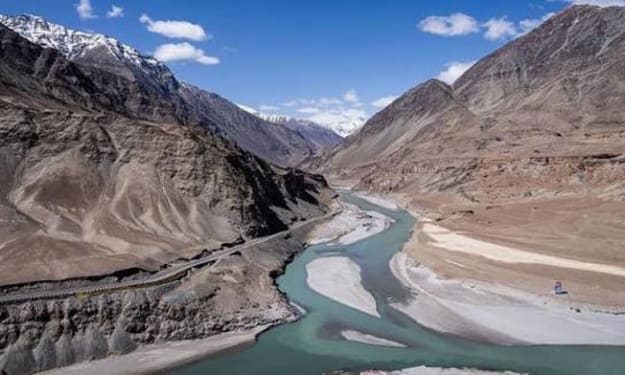
The Himalayas, often described as the world’s “Third Pole,” are facing a dramatic and worrying transformation. Scientists are warning that reduced winter snowfall is leaving vast stretches of the mountain range bare, rocky, and increasingly vulnerable to long-term environmental damage. Once known for their thick snow blankets and powerful glaciers, parts of the Himalayas are now showing exposed rock earlier than ever before—an alarming sign of climate stress in one of Earth’s most critical ecosystems. A Visible Change in the World’s Highest Mountains Winter snowfall plays a vital role in the Himalayan climate system. Snow acts as a protective layer, insulating glaciers and regulating the slow release of meltwater into rivers during warmer months. However, researchers monitoring satellite data and ground stations report that recent winters have brought significantly less snowfall across large areas of the range. As a result, snowlines are rising higher up the slopes, leaving lower and mid-altitude regions exposed. This has turned once-white mountain landscapes into expanses of dark rock, which absorb more heat from the sun, accelerating warming in a dangerous feedback loop. Why Reduced Snowfall Matters Snow is more than a scenic feature—it is essential to the health of Himalayan glaciers. When snowfall declines, glaciers lose their main source of replenishment. At the same time, exposed ice and rock melt faster under direct sunlight. Scientists warn that this imbalance is speeding up glacier retreat across the Himalayas. Many glaciers are now shrinking at rates not previously recorded, threatening the long-term stability of water systems that support nearly two billion people across South and Southeast Asia. Impact on Asia’s Major Rivers The Himalayas feed some of the world’s most important rivers, including the Indus, Ganges, Brahmaputra, Yangtze, and Mekong. These rivers depend on seasonal snow and ice melt to maintain consistent flow throughout the year. Reduced snowfall means less stored water for the dry season. In the short term, faster melting can cause floods and landslides. In the long term, however, shrinking glaciers could lead to water shortages, affecting agriculture, hydropower, and drinking supplies across multiple countries. A Growing Risk of Disasters Bare, rocky slopes are far more unstable than snow-covered ones. Snow helps bind loose material together, while exposed rock and soil increase the likelihood of landslides and avalanches. Scientists have already observed a rise in slope failures and glacial lake outburst floods in the region. As glaciers retreat, meltwater often accumulates in fragile lakes dammed by loose rock and ice. These lakes can burst suddenly, releasing destructive floods that threaten mountain communities and downstream infrastructure. Climate Change at the Core Researchers agree that climate change is the primary driver behind the declining snowfall. Rising global temperatures are altering weather patterns, causing more winter precipitation to fall as rain rather than snow. Even small temperature increases at high altitudes can drastically change how moisture behaves. Additionally, warming oceans and shifting atmospheric circulation are affecting the timing and intensity of winter storms that traditionally brought snow to the Himalayas. Effects on Local Communities and Wildlife Mountain communities that rely on predictable snowfall for farming, tourism, and water storage are already feeling the effects. Farmers report changes in planting cycles, while winter tourism has declined in some regions due to unreliable snow conditions. Wildlife is also under pressure. Species adapted to cold environments are losing habitat as snow cover shrinks. Plants that depend on snowmelt are struggling to survive in drier, warmer conditions, disrupting fragile alpine ecosystems. Scientists Call for Urgent Monitoring and Action Experts stress the importance of improved monitoring of snowfall, glacier health, and water flows across the Himalayan region. Better data can help governments plan for future water management challenges and disaster risks. At the same time, scientists emphasize that local adaptation alone is not enough. Reducing global greenhouse gas emissions remains critical to slowing temperature rise and preserving what remains of the Himalayan snow and ice. What the Future Holds If current trends continue, large parts of the Himalayas could see permanent changes within decades. Reduced snowfall and accelerating glacier loss may reshape landscapes, ecosystems, and human livelihoods on an unprecedented scale. The sight of bare, rocky Himalayan slopes is more than a visual change—it is a warning signal. The world’s highest mountains are responding rapidly to a warming planet, and the consequences will extend far beyond the peaks themselves.
By Fiaz Ahmed Brohi7 days ago in Earth
Nature’s Hidden Gems: Discovering the Rarest Flowers on Earth
Introduction: When Beauty Meets Rarity Nature is filled with wonders, but few are as captivating—and as elusive—as the rarest flowers on Earth. From enormous parasitic blooms to delicate orchids that appear only under precise conditions, these plants challenge our understanding of survival, evolution, and beauty.
By Ahmed aldeabella4 days ago in Earth



Comments
There are no comments for this story
Be the first to respond and start the conversation.