
The Moon — The Earth’s Shining Companion
Discover how the Moon was born, why it changes its shape, and what secrets hide behind its glowing face.


The Moon — The Earth's Shining Companion
By Huma Baloch
Dear children! Do you know that the Moon belongs to the family of the Sun? Yes, it does! But before we talk about the Moon, let’s first understand where this great family of the Sun came from.
Scientists tell us that billions of years ago, the Sun was nothing more than a huge, glowing ball of gas and dust hidden within thick, swirling clouds. Gradually, countless smaller clumps of dust and gas began to gather around it. These clumps started moving in circles around the Sun — the largest clump at the center.
Sometimes, these clumps collided with each other and merged, forming even larger bodies. Slowly and steadily, they became what we now call planets. Some smaller ones joined together to form bigger planets, while others remained tiny and scattered in space. These smaller ones are known as asteroids or moons — the companions of larger planets.
Among these small celestial wanderers was one that came too close to the Earth. The Earth’s powerful gravity pulled it in and captured it forever. That captured body became our Moon. Since then, the Moon has been circling around the Earth, while the Earth and its Moon together move around the Sun.
Other planets also caught their own moons. For example, Mars has two small moons, and Jupiter — the giant of our solar system — has twelve large ones. Our Moon, however, remains the most familiar and beautiful of all.
---
Why Doesn’t the Moon Always Look the Same?
Sometimes, when we look up at the night sky, the Moon appears full and round. But two weeks later, it becomes a thin crescent, and then after another two weeks, it’s full again. Between these times, its shape keeps changing every night.
Why does this happen? Let’s perform a simple experiment to find out!
You’ll need a lamp, a stool, and a friend to help you.
Think of the lamp as the Sun.
You are the Earth.
Your friend will be the Moon.
Place the lamp behind you, sit on the stool, and face your friend. Ask your friend to stand a few feet away, facing the lamp. You’ll notice that your friend’s face is fully lit by the lamp — this represents a full moon.
Now, ask your friend to slowly walk in a circle around you, always keeping his face toward you. As your friend moves to the right, you’ll see that only part of his face is lit, and the other side is dark — this is like the half-moon. When he moves directly in front of the lamp, his face will be completely in shadow — that’s the new moon.
If your friend keeps moving, soon the light will begin to fall on the other side of his face. This shows the waxing crescent, when the Moon starts to reappear in the sky. Finally, when he returns to his starting point, his face will again be fully illuminated — the full moon.
And that, dear children, is exactly how the Moon appears to grow and shrink in the sky every month. It’s not the Moon that changes its shape — it’s just how sunlight falls on it as it travels around the Earth.
---
Why Does the Moon Have Dark Spots?
If you look closely at the Moon through a telescope — or even with your eyes on a clear night — you’ll see dark patches on its bright surface. Long ago, scientists believed these dark areas were oceans. They even gave them poetic names like “The Sea of Tranquility” and “The Ocean of Storms.”
However, modern research tells us that these dark spots are not seas at all. They are huge plains made of solid rock and volcanic dust. Some of these plains stretch over six hundred miles across! Billions of years ago, asteroids crashed into the Moon’s surface, creating enormous craters. Later, molten lava filled those craters and cooled down, forming the flat, dark plains we see today.
So, the next time you look at the Moon and think you can see a man’s face or a rabbit’s outline, remember — those shapes are just vast rocky plains, silent and ancient.
---
What Is the Halo Around the Moon?
Sometimes, when the sky is clear but slightly hazy, you may notice a large ring or circle of light around the Moon. This glowing circle is called a halo.
What causes this beautiful effect? The answer lies high in the atmosphere. When thin clouds made of tiny ice crystals drift across the sky, they act like tiny prisms. As moonlight passes through them, some of it bends or refracts, spreading out into a large circle around the Moon.
When you see a halo, it usually means that these ice-crystal clouds are floating high above you — and often, they are a sign that rain might be coming soon! The same phenomenon sometimes happens around the Sun during the day, creating a solar halo.
---
The Moon — More Than Just a Light in the Sky
The Moon is much more than a glowing ball in the night sky. It is a faithful companion of the Earth, a silent witness to the history of our planet and the universe. It controls the tides of our oceans, guides travelers at night, and has inspired countless poems, stories, and songs.
Every time you look at the Moon — whether it’s full, half, or just a tiny crescent — remember that it is a part of the same cosmic family as our Sun and Earth. Its journey around us is a reminder of the beautiful harmony of the universe.
So next time you see the Moon shining softly above, whisper a little greeting to it — our ancient friend, the Earth’s shining companion.
---
Tags: Science for Kids, Space, Moon, Astronomy, Education, Universe, Solar System, Nature, STEM Learning
Community: Education / Science & Technology
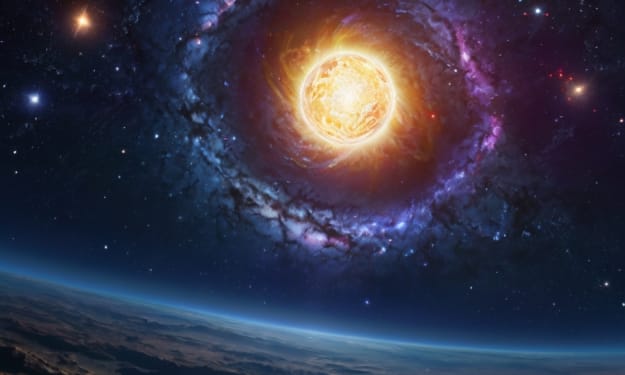
Caption: How the Moon was born, why it changes shape, and what secrets its bright face hides.
Image Prompt: A soft, glowing illustration of the Earth and Moon orbiting the Sun — the Moon half-lit by sunlight, showing different phases, with a faint halo around it in a deep blue starry sky.
About the Creator
The Edge of the Atlantic: Life, Weather, and the Meaning of Home
Along the edge of the Atlantic, life moves to the rhythm of wind and water. The sun rises over the ocean with a quiet certainty, casting its first light across the rooftops of South Florida’s coastal towns. Palm trees sway, seabirds glide above the shoreline, and the day begins beneath a sky that seems almost endlessly blue.
By Nikolay Barkalin7 days ago in Earth



Comments
There are no comments for this story
Be the first to respond and start the conversation.