
The Harms of the Atomic Bomb and Its Global Impact
The atomic bomb, also known as a nuclear weapon, is one of the most destructive inventions of modern science. It uses the power of nuclear energy to create an explosion so powerful that it can destroy entire cities in seconds. The first and only use of atomic bombs in war occurred during World War II, when the United States dropped two bombs on the Japanese cities of Hiroshima and Nagasaki, shaking

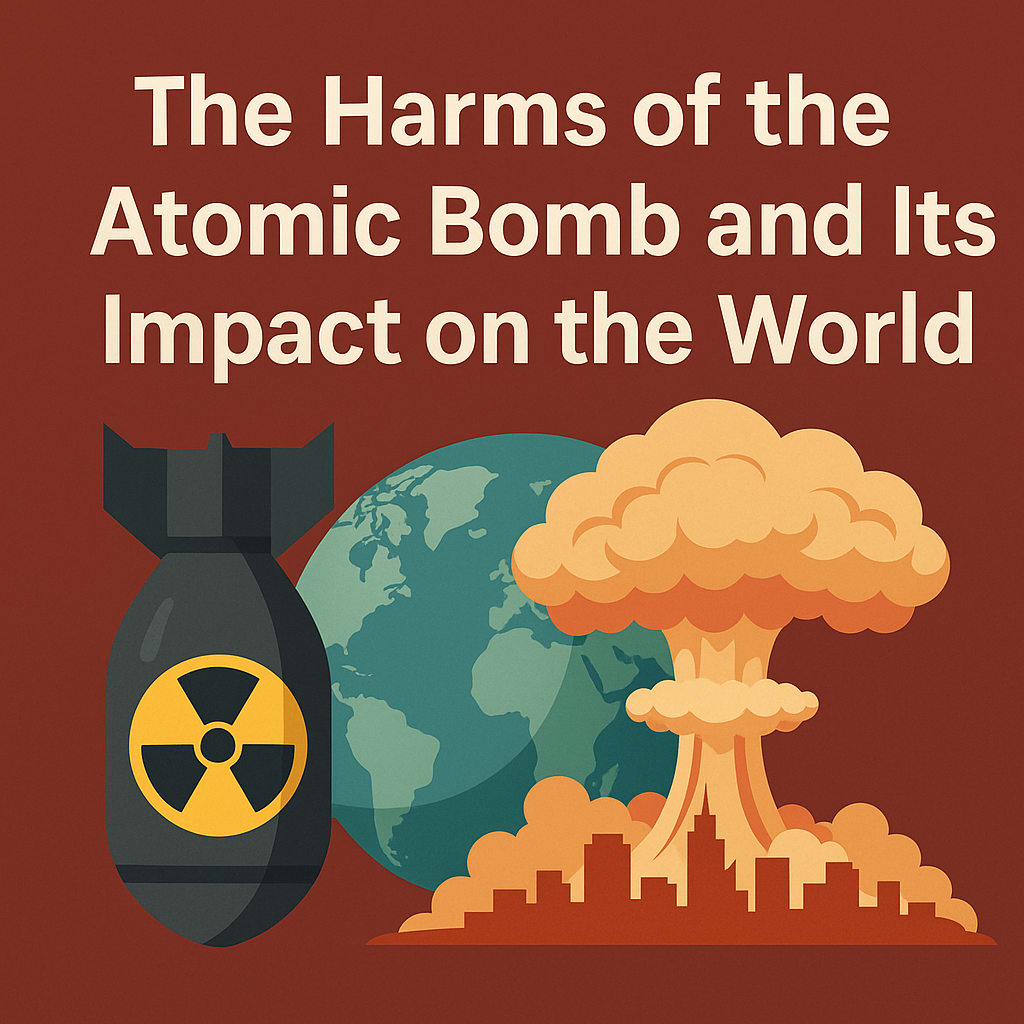
Human and Physical Harms of the Atomic Bomb
1. Massive Loss of Life
Over 140,000 people died in Hiroshima and around 70,000 in Nagasaki—most within seconds.
Thousands more died later due to burns, injuries, and radiation exposure.
2. Severe Physical Disabilities
Survivors suffered from permanent injuries, blindness, disfigurement, and mental trauma.
3. Radiation Effects
The bomb released intense radiation that contaminated air, land, and water.
Radiation-related illnesses such as cancer, leukemia, and birth defects appeared even years later.
---
🌍 Impact on the Global World
1. Shift in Global Politics
The use of the atomic bomb marked the beginning of a new world order.
The world split into two power blocs: the USA and its allies, and the Soviet Union and its allies—leading to the Cold War.
2. The Arms Race
Other countries rushed to develop nuclear weapons, leading to a dangerous competition.
Today, nuclear powers include the USA, Russia, China, France, the UK, India, Pakistan, and North Korea.
3. Atmosphere of Fear and Uncertainty
Fear of nuclear war constantly threatened global peace.
Nations lived under the shadow of potential nuclear disaster for decades.
4. Global Peace Efforts and Treaties
To reduce the threat, several treaties were introduced:
NPT (Non-Proliferation Treaty) – to prevent the spread of nuclear weapons.
CTBT (Comprehensive Test Ban Treaty) – to ban nuclear tests worldwide.
These efforts aim to ensure disarmament and prevent the rise of new nuclear states.
---
🏥 Environmental and Health Impacts
1. Environmental Destruction
Radiation poisons the soil, water, and atmosphere.
Agricultural lands become barren, and wildlife is destroyed.
2. Long-Term Health Issues
Survivors face increased risks of cancer, genetic mutations, and chronic illness.
Hospitals and medical systems in affected areas become overwhelmed.
---
💡 Conclusion & Message
The atomic bomb is not just a weapon of war—it's a weapon of mass destruction against all humanity. The tragedies of Hiroshima and Nagasaki must remain lessons in our collective memory.
The world must choose peace over power, dialogue over destruction, and humanity over hostility. True progress lies not in creating weapons but in building a world where such weapons are never needed.
---
Would you like this lecture in PDF format, or should I also create PowerPoint slides for presentation use?
Bomb (General Knowledge)
1. What is an Atomic Bomb?
An atomic bomb is a weapon that uses nuclear energy to create a massive explosion. It works through a process called nuclear fission (splitting atoms) or fusion (combining atoms).
---
2. First Nuclear Explosion
The first test explosion took place on July 16, 1945 by the USA.
It was called the Trinity Test, conducted in New Mexico, USA.
---
3. First Use in War
August 6, 1945: The US dropped the first atomic bomb on Hiroshima, Japan.
August 9, 1945: The second bomb was dropped on Nagasaki.
These attacks occurred during World War II.
---
4. Level of Destruction
Over 140,000 people died instantly in Hiroshima.
Around 70,000 people were killed in Nagasaki.
Many more died later due to burns, radiation, and diseases.
---
5. Radiation Effects
Nuclear radiation contaminated air, water, soil, and human bodies.
Caused cancer, infertility, birth defects, and long-term illnesses.
---
6. Countries with Nuclear Weapons
1. United States 🇺🇸
2. Russia 🇷🇺
3. China 🇨🇳
4. France 🇫🇷
5. United Kingdom 🇬🇧
6. India 🇮🇳
7. Pakistan 🇵🇰
8. North Korea 🇰🇵
(Israel is believed to have nuclear weapons, but it has not confirmed this.)
---
7. Major International Treaties
NPT (Non-Proliferation Treaty): To prevent the spread of nuclear weapons.
CTBT (Comprehensive Test Ban Treaty): To ban all nuclear tests worldwide.
---
8. Global Anti-Nuclear Movements
Many peace organizations and global leaders oppose nuclear weapons.
Hiroshima and Nagasaki are remembered every year on August 6 and 9.
---
9. Pakistan’s Nuclear Program
On May 28, 1998, Pakistan conducted five successful nuclear tests in Chagai, Balochistan.
This day is celebrated as "Youm-e-Takbeer" (The Day of Greatness).
---
10. Touching Message
> “An atomic bomb can destroy a city, but it can never conquer hearts.”
“Peace is brighter than the darkness of nuclear weapons.”
---
Would you like these facts in a PDF file, infographic poster, or PowerPoint slides? I can prepare them right away if you like.
About the Creator
Nature’s Hidden Gems: Discovering the Rarest Flowers on Earth
Introduction: When Beauty Meets Rarity Nature is filled with wonders, but few are as captivating—and as elusive—as the rarest flowers on Earth. From enormous parasitic blooms to delicate orchids that appear only under precise conditions, these plants challenge our understanding of survival, evolution, and beauty.
By Ahmed aldeabella3 days ago in Earth
Verizon Outage Today
A sudden Verizon outage can feel unsettling, especially when your phone switches to “SOS” or “emergency calls only” without warning. Across social media and outage-tracking platforms, users often rush to ask the same questions: Is Verizon down right now? Why is my phone in SOS mode? What happened to Verizon today, and when will Verizon be back up? While outages are never convenient, they are not uncommon for large national carriers like Verizon Wireless. Understanding what a Verizon service outage means—and how to respond—can help reduce confusion during moments when connectivity disappears. Is Verizon Down? Understanding Service Outages A Verizon wireless outage occurs when part of Verizon’s cellular or data network becomes unavailable. This can affect voice calls, text messages, mobile data, or all services at once. Some outages are isolated to specific cities, such as Verizon outage NYC, Atlanta, Houston, or New Jersey, while others expand into a broader Verizon nationwide outage. When service is disrupted, users commonly report: Verizon down today Verizon network down Verizon not working Is Verizon down in my area? Verizon service outage These reports often surface within minutes, especially on outage-monitoring platforms. Why Does My Phone Say SOS? One of the most alarming signs during a Verizon outage today is seeing SOS, SOS only, or emergency calls only at the top of an iPhone. This leads many to ask, “Why is my phone in SOS mode Verizon?” SOS mode does not mean your phone is broken. It indicates that your device cannot connect to the Verizon network but can still place emergency calls using any available carrier signal. Common searches during outages include: Why does my phone say SOS only? iPhone stuck in SOS mode Why is my phone on SOS Verizon? What does SOS mean on iPhone? How to get phone out of SOS mode In most cases, the issue resolves automatically once Verizon restores network connectivity. What Caused the Verizon Outage Today? When connectivity drops, users naturally want immediate answers to what caused the Verizon outage today. Verizon does not always publish technical details right away, but outages are typically linked to: Network maintenance or system upgrades Fiber or backend routing failures Power outages affecting Verizon towers Severe weather or environmental damage Unexpected network congestion Despite online speculation, most Verizon outages are not related to cyberattacks. Searches like “Verizon cyber attack today” often trend during disruptions, but confirmed causes are usually infrastructure-related and temporary. How to Check Verizon Outage Status in Real Time If you’re wondering “Is Verizon still down?”, there are several reliable ways to check. Downdetector Verizon Platforms like Downdetector and Down Detector Verizon track real-time user reports. A spike in complaints usually confirms a Verizon outage before official statements are released. Verizon Outage Map Verizon provides a Verizon wireless outage map, sometimes including outage views by ZIP code. This helps answer questions like: Is there a Verizon outage near me? Is Verizon down in my area? My Verizon App and Network Status Pages The My Verizon app and Verizon’s official network status tools may display service alerts and updates during larger outages. Verizon Customer Service During an Outage During a widespread Verizon service outage, many users attempt to call Verizon customer service or search for the Verizon customer service number. While support teams remain active, wait times often increase significantly during major disruptions. Important things to keep in mind: Customer service representatives usually cannot provide exact repair timelines Rebooting your phone repeatedly during an outage rarely helps Network restoration often happens region by region Monitoring Verizon outage updates is typically more effective than calling support during peak outage periods. When Will Verizon Be Back Up? The most pressing question remains: When will Verizon service be restored? The answer depends on: Whether the outage is local or nationwide The cause of the disruption Whether physical repairs are required Minor outages may resolve within minutes or hours. Larger incidents—such as a Verizon cellular outage affecting multiple states—can take longer. Verizon generally prioritizes emergency communications before restoring full voice and data services. Search trends during outages often include: When will Verizon be fixed? How long will Verizon be down? When is Verizon going to be back up? While exact times are rarely guaranteed, service usually returns gradually rather than all at once. Verizon, Competition, and Broader Impact High-profile outages often spark comparisons with competitors like AT&T and T-Mobile. Searches for AT&T outage or T-Mobile outage frequently rise at the same time, as users explore alternative networks. Although outages generate headlines and social media frustration, they rarely have lasting effects on Verizon stock unless disruptions become frequent or prolonged. What to Do If Your Phone Is in SOS Mode If your phone shows SOS only during a Verizon outage: Enable Wi-Fi calling if available Avoid changing SIM or resetting network settings mid-outage Keep your device charged and updated Check Verizon outage updates periodically Once Verizon’s network stabilizes, most phones exit SOS mode automatically. Final Thoughts A Verizon outage can be disruptive, especially when communication suddenly feels out of reach. However, seeing SOS mode does not mean your phone is damaged—it simply reflects a temporary network issue. Staying informed through trusted sources like Downdetector, Verizon’s outage maps, and official Verizon updates can help users navigate these moments with clarity. While outages are frustrating, they are typically temporary, and service restoration is usually a matter of time rather than cause for alarm.
By Saboor Brohi 3 days ago in Earth
Rachel Reviews: The Spiral Archive by Pieter Hendrik
It's difficult for me to know where to start with a review of this book as it was, for me, an entirely unique experience and one that I'll probably never have again. I don't want that to be interpreted as unenjoyable but it has left me scratching my head a little and ruminating on its content, its themes and its characters.
By Rachel Deemingabout 6 hours ago in BookClub



Comments
There are no comments for this story
Be the first to respond and start the conversation.