
The Endless Quest of the Periodic Table
Unraveling the Mysteries of Chemical Elements


The periodic table is more than just an organized list of elements; it is a vast encyclopedia that reveals the intricate relationships between the building blocks of the universe. From the early 19th century, when Humphrey Davy discovered a handful of basic elements, to the 118 elements we know today, every addition has been more than just a numerical increase. Each discovery has propelled human understanding of the natural world to new heights, unlocking deeper insights into the nature of matter itself.
The Evolution of the Periodic Table: A Milestone in Science
Every cell in the periodic table represents a profound discovery. The table itself continues to expand, mirroring the relentless progress of scientific exploration. Every new element identified is akin to adding another vibrant color to the ever-growing masterpiece of the universe.
The discovery of new elements is often accompanied by groundbreaking technological advancements, the development of innovative materials, and even the dawn of new industrial revolutions. This ongoing expansion raises a compelling question: Has the periodic table reached its final form? Or is there still more to uncover?
In 1869, Russian chemist Dmitri Ivanovich Mendeleev observed a recurring pattern between atomic masses and the chemical properties of elements. Organizing them into a systematic table, he not only provided a structured framework but also predicted the existence of elements yet to be discovered. This pioneering work filled the gaps of the known elements at the time and laid the foundation for future scientific breakthroughs.
Mendeleev’s original periodic table included only the elements known at the time. Over the years, new elements were identified, and the table expanded accordingly. His work, however, was not an isolated achievement. Other scientists, like Julius Lothar von Meyer, independently proposed similar classification systems, contributing to the modern periodic table—a fundamental cornerstone of chemistry.
The Atomic Revolution: Reshaping the Periodic Table
With the rapid advancement of physics in the early 20th century, scientists began to unravel the complex internal structures of atoms. These discoveries led to a reevaluation of the periodic table, shifting the primary basis of element classification from atomic mass to atomic number. This restructuring resulted in a more accurate and systematic organization, reflecting the true relationships between elements.
Today, the periodic table is more than just a tool for chemistry students; it serves as a guiding map for scientists exploring the material world. The quest to expand the table has led researchers to a particularly intriguing frontier: superheavy elements.
The Challenge of Synthesizing Superheavy Elements
The pursuit of superheavy elements—those with atomic numbers greater than 92 (uranium)—has been one of the most challenging and innovative fields in modern chemistry and physics. These elements do not exist naturally and can only be created artificially through highly sophisticated experiments.
Superheavy elements are synthesized in particle accelerators, where lighter atomic nuclei are accelerated to extreme speeds and made to collide with target nuclei, triggering nuclear reactions that form new elements. However, this process is anything but simple. The synthesized elements often have incredibly short half-lives, with some existing for only milliseconds before decaying. This makes studying their chemical properties extraordinarily difficult. Scientists must conduct rapid experiments and measurements within these brief windows of existence.
Despite these challenges, theoretical physicists have proposed the existence of an “island of stability”—a region in the periodic table where certain combinations of protons and neutrons might produce relatively stable superheavy elements. This theory has driven researchers to continue their quest for new elements that might exhibit unprecedented stability and unique chemical behaviors.
The Search for the Next Element: The Race Continues
So far, scientists have successfully synthesized several superheavy elements, with the heaviest confirmed one being Oganesson (Og, atomic number 118). But the search does not stop there. Researchers are actively investigating the possibility of even heavier elements that could reside within the predicted island of stability.
Exploring superheavy elements is not just an academic endeavor. Understanding their properties could provide insights into nuclear structure, fundamental forces, and even potential applications in advanced materials and energy technologies. While practical uses for these elements remain speculative, their mere synthesis has already pushed the boundaries of human knowledge and challenged our understanding of atomic interactions.
Expanding the Periodic Table: What Lies Ahead?
The possibilities for discovering new elements remain vast. Scientists remain optimistic about the potential synthesis of additional elements, recognizing the significance of this endeavor.
As scientific and technological advancements continue—especially in particle accelerator technology and detection methods—our ability to create and identify new elements is expected to improve significantly. These innovations may lead to breakthroughs that allow for the discovery of elements with unique and revolutionary properties.
The identification of new elements is not merely about increasing numbers; it is about uncovering novel chemical and physical characteristics. These discoveries could revolutionize material science, energy production, and even medical research. Every newly synthesized element brings fresh clues about the fundamental workings of the universe.
For example, studying superheavy elements could provide valuable insights into stellar processes and the formation of elements in the cosmos. Understanding how these elements behave could shed light on the mechanisms at play in the cores of stars and supernovae.
Overcoming the Challenges of Element Discovery
Despite the promising outlook, scientists face significant hurdles in the quest for new elements. One major challenge is stabilizing superheavy elements, as they typically decay rapidly. Another challenge is accurately measuring their properties within their extremely short lifespans.
Additionally, researchers must determine the behavior of these elements to better understand their nature and characteristics. This requires continuous refinement of experimental techniques, theoretical models, and detection capabilities.
To overcome these obstacles, scientists are working to enhance experimental methodologies and predictive models that improve the efficiency of element synthesis. Advancements in particle accelerators and detection technology will be key to unlocking the mysteries of undiscovered elements.
Collaboration among scientists across the globe is essential in this pursuit. International research facilities, including those in Russia, the United States, Germany, and Japan, are at the forefront of this exploration, pushing the limits of scientific knowledge.
The Infinite Potential of Element Discovery
The question remains: Has the periodic table reached its final chapter? Or is there an entire uncharted territory waiting to be explored? While we cannot say for certain whether new elements will continue to be discovered indefinitely, one thing is clear—science thrives on curiosity, and the unknown continues to inspire generations of researchers.
The periodic table, once thought to be a completed masterpiece, remains a work in progress. As we develop new techniques, theories, and technologies, the journey of discovery will continue. Each newly identified element brings us closer to understanding the very fabric of our universe, expanding the horizons of human knowledge and innovation.
From Mendeleev’s original predictions to the synthesis of superheavy elements, the periodic table stands as a testament to humanity’s relentless pursuit of knowledge. And as long as there are unanswered questions, the search for new elements will never truly end. The future of the periodic table is still being written—one element at a time.
About the Creator
Eleanor Grace
"Dream big.Start small.Act now."
Keep reading
More stories from Eleanor Grace and writers in Earth and other communities.
Homeowners Don’t Want to Move: The Big Deal About Shrinking Backyards
In neighborhoods across the country, a subtle but growing trend is taking root: homeowners aren’t moving, and it’s not just because of the housing market. Many are staying put because their backyards—once spaces for relaxation, gardening, and family fun—are shrinking, either physically due to new development or symbolically as life priorities shift. What may seem like a minor detail—an ordinary backyard—is, for many, a defining feature of home life. Losing it can change how people live, play, and even feel about their communities. This shift has consequences for families, urban planning, and even the way cities are designed. It also sheds light on why homeowners are willing to compromise on size, style, or even location rather than give up their outdoor space. Why Backyards Matter More Than Ever Backyards are more than just patches of grass. They are extensions of our living space, providing: Personal outdoor retreats for reading, gardening, or hosting friends. Safe spaces for children and pets to play. Social hubs for barbecues, birthdays, and neighborhood gatherings. Mental and physical health benefits, including fresh air, sunlight, and exercise. For families who have invested years into landscaping, planting trees, or building decks and patios, the backyard is an emotional asset. Moving to a new home often means losing these personal touches—and many homeowners aren’t willing to take that step. “Backyards are part of our identity,” says Laura Jennings, a landscape designer in suburban Chicago. “People have memories tied to them—first steps, garden harvests, family barbecues. That’s why so many homeowners are staying put, even if it’s tempting to relocate for a bigger house or a better neighborhood.” The Trend of Shrinking Yards Urban densification and suburban development have slowly eaten into traditional backyard space. In many cities, large lots are being replaced with townhomes, duplexes, or small-lot single-family homes. Even in suburban neighborhoods, new constructions often prioritize indoor square footage over outdoor space. The shrinking backyard trend has several effects: Less room for recreation: Families may struggle to fit a swing set, pool, or garden into a smaller yard. Increased desire to stay put: Homeowners prefer maintaining a familiar outdoor space rather than trading it for a slightly larger indoor area. Higher emotional attachment: As yards become more limited, the significance of every tree, patch of grass, or vegetable garden grows. For many, the choice isn’t just about square footage—it’s about quality of life. Homeowners Are Making Trade-Offs As a result, more homeowners are staying in place longer, even if it means: Skipping a bigger kitchen or extra bedroom. Living in a less “trendy” neighborhood. Paying more in maintenance or property taxes to keep a cherished yard intact. Some have embraced innovative backyard solutions to maximize smaller spaces: Vertical gardens and container planting. Multi-functional patios that serve as dining, lounging, and play areas. Creative landscaping, including raised beds, pergolas, and tiny ponds. These adaptations allow homeowners to maintain the sense of space and enjoyment they’ve built over years without relocating. Emotional and Social Dimensions Beyond practical reasons, the backyard has a symbolic meaning. It represents: Continuity and stability: Homeowners see staying put as preserving a lifestyle. Family history: Many yards hold stories—graduations, summer afternoons, first bike rides. Community connection: Long-term residents know neighbors, local schools, and nearby amenities. Moving often means giving up these ties. A survey by the National Association of Home Builders found that over 60% of homeowners aged 35–55 preferred staying in their current homes, citing yard size and outdoor enjoyment as key factors. For these individuals, giving up a backyard is not a small inconvenience—it’s a major life decision. The Impact on Neighborhoods and Cities The trend of staying put also affects broader urban and suburban planning. Fewer homeowners moving means: Less turnover in neighborhoods, which can reduce housing market fluidity. Pressure on developers to include quality outdoor space in new builds. Greater demand for parks and community green spaces, as private yards shrink. Urban planners and developers are noticing the importance of outdoor space in retention and satisfaction metrics. Homes with usable yards, green roofs, or communal gardens often have higher value and attract long-term residents. The Future of Backyard Living As city lots shrink and suburban sprawl continues, homeowners are adapting: Smaller, highly curated gardens instead of sprawling lawns. Multi-functional backyards designed for work, play, and entertainment. Investment in outdoor amenities such as fire pits, decks, or small pools. Some communities are exploring shared backyard concepts, like community gardens and pocket parks, to supplement shrinking private spaces. While these aren’t a complete replacement for personal yards, they provide social and environmental benefits and may encourage homeowners to stay in their homes longer. Conclusion: More Than Grass and Trees Shrinking backyards might seem like a minor design issue, but for homeowners, it’s deeply tied to lifestyle, family life, and personal identity. The reluctance to move is not just a reaction to the housing market; it reflects an emotional, social, and practical connection to outdoor space that indoor square footage alone can’t replace. As urban density grows and lot sizes shrink, the importance of backyards will continue to shape homeowner decisions, neighborhood design, and community dynamics. Families are showing that a yard is not just grass and trees—it’s a place of memory, freedom, and connection. In a world where real estate trends often prioritize indoor luxury, the backyard remains a powerful symbol of home, anchoring families to the places they love—and keeping many from moving at all
By Muhammad Hassana day ago in Earth
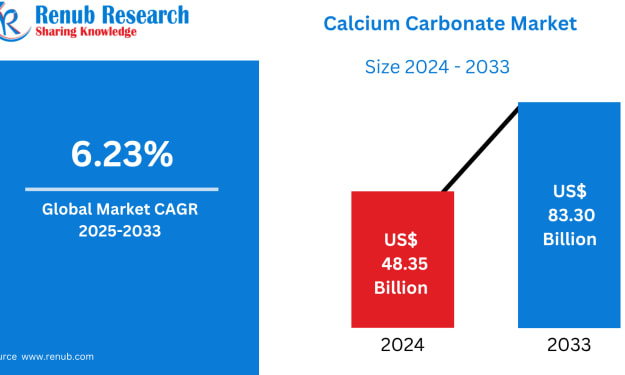
Global Calcium Carbonate Market Size & Forecast 2025–2033
Introduction: A Quiet Giant of Global Industry Calcium carbonate may not be a headline-grabbing material, but it is one of the most indispensable compounds in modern industrial life. Found naturally in limestone, marble, and chalk, this humble mineral underpins everything from the buildings we live in to the paper we write on and the plastics we use every day. Its low cost, wide availability, and remarkable versatility have made it a cornerstone raw material across multiple industries worldwide.
By jaiklin Fanandisha day ago in Earth
Smart phones, Humans and Aliens.
WARNING. I will be tapping into one of your favorite creative tensions: The absurdity of humans worshipping their glowing rectangles as if they were tiny oracles. There’s something deliciously poetic about that contradiction, and it lends itself beautifully to an instructive proviso.
By Novel Allen4 days ago in Poets



Comments
There are no comments for this story
Be the first to respond and start the conversation.