
The Disturbing Reason Why Airlines Don't Supply Parachutes To Passengers
Find Out Why
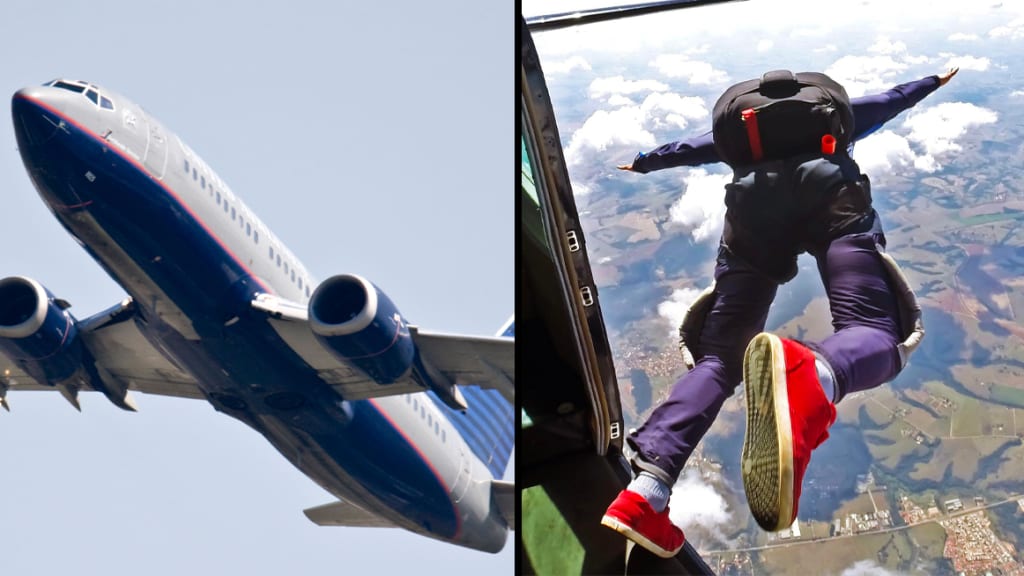
Why don't we equip airplanes with giant parachutes to ensure safe landings? It seems logical, considering that we can use parachutes for humans. However, the answer is not as straightforward as it seems. Parachutes capable of safely landing a jumbo jet would be incredibly heavy. The added weight would reduce the number of seats available for passengers. Moreover, most airplane malfunctions occur during takeoff or landing, where parachutes wouldn't be of much assistance. Can you imagine the size of parachutes needed to land an Airbus A380, which can carry around 850 people and is significantly heavier than a small personal aircraft? This would lead to fewer seats per flight, resulting in more flights being necessary to accommodate travelers. Consequently, the increased number of takeoffs and landings would also increase the risk of accidents.
However, the idea of whole-plane parachutes has been implemented for lightweight aircraft. These parachutes are located within the aircraft and can be deployed by the pilot using a handle in the ceiling. There is a prominent manufacturer of such devices based in Miami. The founder of this company was inspired to develop these parachutes after experiencing a glider accident that ended with a plunge into a lake. Though he survived, the incident motivated him to explore ways to enhance aviation safety.
What about individual parachutes for passengers? Implementing this would be extremely challenging. During emergencies involving multiple people, panic quickly sets in, and passengers would likely struggle to use their parachutes effectively. Additionally, even trained jumpers sometimes face difficulties during parachute landings. Most passengers on commercial flights lack the necessary experience. Therefore, it is better to focus on reducing weight instead. One potential solution is to remove the bulkiest parts of an aircraft, such as wings or engines, before triggering the parachutes. This way, only the main body of the airplane, including the passengers, would be saved. It is a safer alternative to hundreds of panicked passengers attempting to use parachutes in an emergency situation.
In reality, the instances where passenger parachutes could save lives are quite limited. There are several factors to consider, such as daylight conditions and landing on suitable land rather than water. It is best to rely on seat belts and safety measures already in place.
Now, let's shift our focus to pilots. Should they have parachutes available? Commercial flying is vastly different from recreational skydiving. At high altitudes, where planes operate, temperatures are extremely low, and the air is thin. Jumping out of a plane in such conditions would be dangerous, as freezing temperatures could occur before the parachute could be deployed. Furthermore, high altitudes can cause hypoxia, making it difficult to breathe without supplemental oxygen. Commercial planes provide oxygen masks for passengers and crew, but skydivers at those altitudes would need their own oxygen tanks, which is not practical. Additionally, commercial planes are not designed for skydiving, and attempting such a maneuver would be perilous. While it might seem reasonable for pilots to carry parachutes, it is not practical given the nature of their flying. They are better off focusing on their job as pilots and leaving skydiving to trained professionals.
Parachutes serve multiple purposes beyond human skydiving. They are also used to slow down the motion of objects in the atmosphere by creating drag. A good parachute relies on the fabric used. The cloth should have high breaking strength, tear resistance, elasticity, and air permeability. Parachutes can be made from various materials such as canvas, silk, Dacron, Kevlar, and nylon. Ripstop nylon is a popular choice due to its lightweight nature, high strength-to-weight ratio, waterproofing, and tear resistance. The manufacturing process of parachute fabric is intricate and involves cutting and sewing the fabric pieces together.
Speaking of parachutes, a remarkable achievement was made by a small company from Devon. They developed a special high-tech parachute fabric that played a crucial role in NASA's Perseverance Rover safely landing on Mars. This achievement was the result of 15 years of hard work. The fabric was created using a high tenacity nylon yarn spun at high speed and underwent a series of treatments to withstand extreme heat. The fabric was then sewn into parachute form and tested in the world's largest wind tunnel. The director of the company's woven fabric department experienced great excitement seeing their product successfully land on Mars. The company was approached by NASA after showcasing their work at industry events in the U.S. Their unique fabric allowed the Perseverance Rover to make a soft landing on the red planet.
It is commonly believed that Leonardo da Vinci invented the parachute, but this is actually a myth. Researchers discovered sketches resembling Leonardo's parachute design in the studio of an Italian inventor who lived 70 years before Leonardo. This Italian inventor was known for using drawings as a design tool, which was groundbreaking at the time. His manuscripts contained various contraptions, including the parachute, which was inspired by an earlier inventor's daring jump from a building. Leonardo's contribution to parachute development was likely influenced by this pre-existing design.
In conclusion, while the idea of equipping airplanes with parachutes may seem plausible, it poses significant challenges in terms of weight, passenger panic, and practicality. It is more effective to focus on improving existing safety measures. Parachutes serve vital functions in reducing the speed of objects in the atmosphere and require meticulous craftsmanship to ensure their reliability. Finally, parachutes continue to play an essential role in various fields, including space exploration, where their innovative fabric contributes to groundbreaking achievements like landing rovers on distant planets.
About the Creator
Keep reading
More stories from writers in Earth and other communities.
The Reality of the Illusion of Time
Recently, as I strolled along the short stretch to my strength training session, I aimlessly took in the row of tatty shops and shabby buildings along the route and passed an off-street, in which one of my sisters used to live, around thirteen years ago.
By Chantal Christie Weiss4 days ago in Earth
Earth’s Hidden Fires
The Black Scar of the Sahara and Other Fires That Shouldn’t Exist From high above, the Sahara Desert looks like a golden ocean—endless waves of sand broken only by scattered blue and green oases. But hidden among the dunes is something startling: a massive black region covering nearly 17,000 square miles. It’s so large it’s visible from space, yet it rarely appears in movies or documentaries. At first glance, it almost looks unnatural, as if something catastrophic happened there.
By Lexi Wilburn4 days ago in Earth
Cabin Fever Because of Snow, Sleet, and Freezing Rain That Turned to Icy Roads
What Is Cabin Fever? The short answer is that cabin fever is restlessness from being in a confined area. Cabin fever is the distressing irritability or restlessness experienced when a person or group is stuck at an isolated location or in confined quarters for an extended time. Research shows that prolonged cold, gray skies, and being stuck indoors can trigger mood shifts similar to “winter blues.”
By Margaret Minnicks2 days ago in Humans
Killing him slowly
There’s an intruder in my house again. He stumbles through the door, wet carrier bags in hand. He’s bought me offerings. I show my appreciation, letting him caress my beautiful body. He wants to touch me. I rub myself against his legs. He sighs, dropping the bags. He can’t resist touching me. Running his hand slowly down my spine, I arch my back towards his caress, let out a low purr. It’s what we both need.
By N J Delmas6 days ago in Horror



Comments
There are no comments for this story
Be the first to respond and start the conversation.