

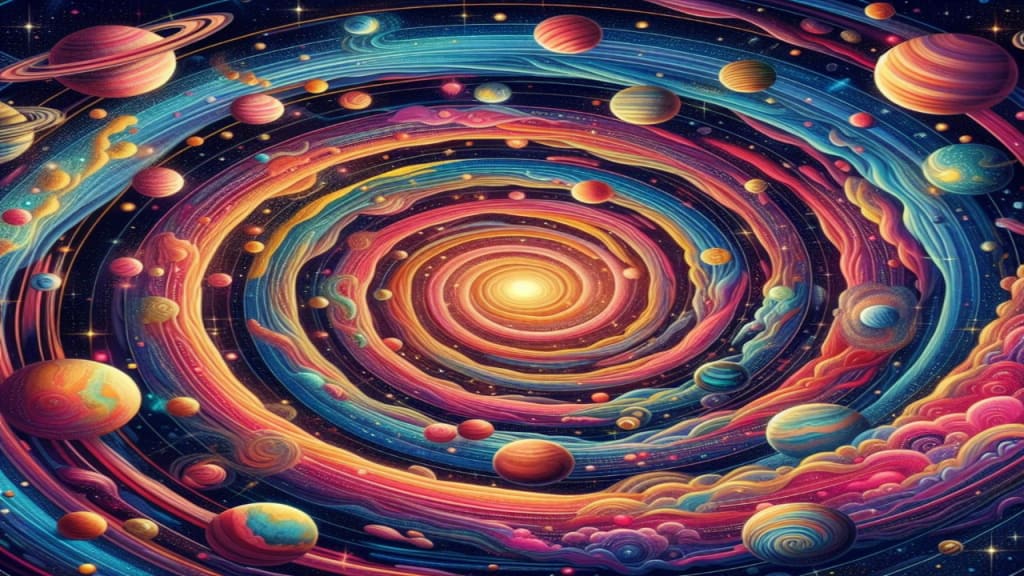
The Concept of Parallel Worlds
Introduction
The concept of parallel worlds, also known as the multiverse theory, has been a captivating topic in both science and science fiction. It proposes the existence of multiple or an infinite number of universes, including the one we inhabit. Each of these parallel universes could have different physical laws, dimensions, and timelines.
Theoretical Foundations
The idea of parallel worlds is rooted in quantum mechanics, particularly in the interpretation of quantum superposition and entanglement. The most famous illustration of this is the Schrödinger’s cat thought experiment, which suggests that until observed, particles exist in all states simultaneously. This leads to the concept of a multiverse where all possible states exist in different universes.
Parallel Worlds in Physics
In physics, several theories propose the existence of parallel worlds. One of them is the Many-Worlds Interpretation of quantum mechanics, proposed by physicist Hugh Everett. According to this interpretation, each quantum measurement causes the universe to split into multiple copies, each experiencing a different outcome.
String theory, a theoretical framework in which the point-like particles of particle physics are replaced by one-dimensional strings, also suggests the possibility of multiple dimensions and hence parallel universes.
Implications and Possibilities
The existence of parallel worlds could have profound implications. If true, it would redefine our understanding of reality and our place in the cosmos. It opens up possibilities for time travel, alternate histories, and versions of ourselves living different lives in different universes.
However, it’s important to note that these ideas, while fascinating, are currently beyond the realm of testable science. They remain speculative and are a topic of ongoing debate among scientists.
Parallel Worlds in Popular Culture
Parallel worlds have been a popular theme in science fiction and fantasy literature, movies, and video games. They allow the exploration of themes like alternate history, destiny, and identity. Some famous examples include the "Harry Potter" series, "The Chronicles of Narnia," and "Star Trek."
Quantum Mechanics and Parallel Worlds
Quantum mechanics, the theory that describes the behavior of particles on the smallest scales, plays a crucial role in the concept of parallel worlds. One interpretation of quantum mechanics, known as the Many-Worlds Interpretation, suggests that all possible alternate histories and futures are real, each representing an actual "world" or "universe".
In this interpretation, any event that can happen does happen in at least one of these alternate realities. For instance, in another universe, you might have chosen a different career path or live in a different city. This interpretation challenges our conventional understanding of reality and raises profound questions about the nature of consciousness and identity.
Parallel Worlds and the Nature of Reality
If parallel worlds do exist, what does this mean for our understanding of reality? Some philosophers argue that if there are an infinite number of realities, then the distinction between what is "real" and "possible" becomes blurred. In this view, every version of events, no matter how unlikely, exists somewhere in the multiverse.
This perspective can lead to a radical shift in how we view our lives. Each decision we make could be seen as a branching point leading to a new universe. On the one hand, it suggests that all possibilities are realized somewhere in the multiverse. On the other hand, it challenges our sense of uniqueness and the significance of our choices.
The Future of Parallel Worlds Research
While the concept of parallel worlds is fascinating, it remains a speculative idea at the frontier of science. Currently, there is no experimental evidence to support the existence of parallel worlds. However, ongoing research in quantum mechanics and cosmology may provide insights that bring us closer to understanding whether such worlds could exist.
Moreover, new theories and technologies, yet to be discovered, could potentially open up new ways of testing the parallel worlds hypothesis. As our scientific understanding progresses, we may find more concrete answers to these profound questions.
In conclusion, the concept of parallel worlds invites us to expand our understanding of reality and consider the vastness of the cosmos. Whether or not parallel worlds exist, exploring this concept allows us to push the boundaries of human knowledge and imagination. It serves as a reminder of the endless possibilities that the universe may hold.
About the Creator
J. Revs
> A passionate and dedicated individual, I thrive on challenges and constantly set goals for myself to ensure I'm always striving to achieve my best.
Japan Furniture Market Size and Forecast 2025–2033
Introduction Japan’s furniture industry stands at a unique intersection of tradition and innovation. Renowned worldwide for its craftsmanship, minimalist design, and functional aesthetics, Japanese furniture reflects the nation’s cultural emphasis on harmony, efficiency, and simplicity. Today, as Japan’s population becomes increasingly urban, digitally connected, and environmentally conscious, the furniture market is undergoing a quiet but significant transformation.
By Janine Root 6 days ago in Earth
Maryland to Get Its Own Smaller Version of the Las Vegas Sphere
Maryland is about to become home to a new entertainment icon. Inspired by the famous Sphere in Las Vegas, a smaller version of the massive immersive venue is planned for the state, promising to deliver a combination of live entertainment, cutting-edge technology, and a new tourist attraction. While the Las Vegas Sphere has already made headlines worldwide for its futuristic design and mind-blowing shows, Maryland’s version aims to bring a scaled-down but equally captivating experience to the East Coast.
By Muhammad Hassana day ago in Earth



Comments
There are no comments for this story
Be the first to respond and start the conversation.