
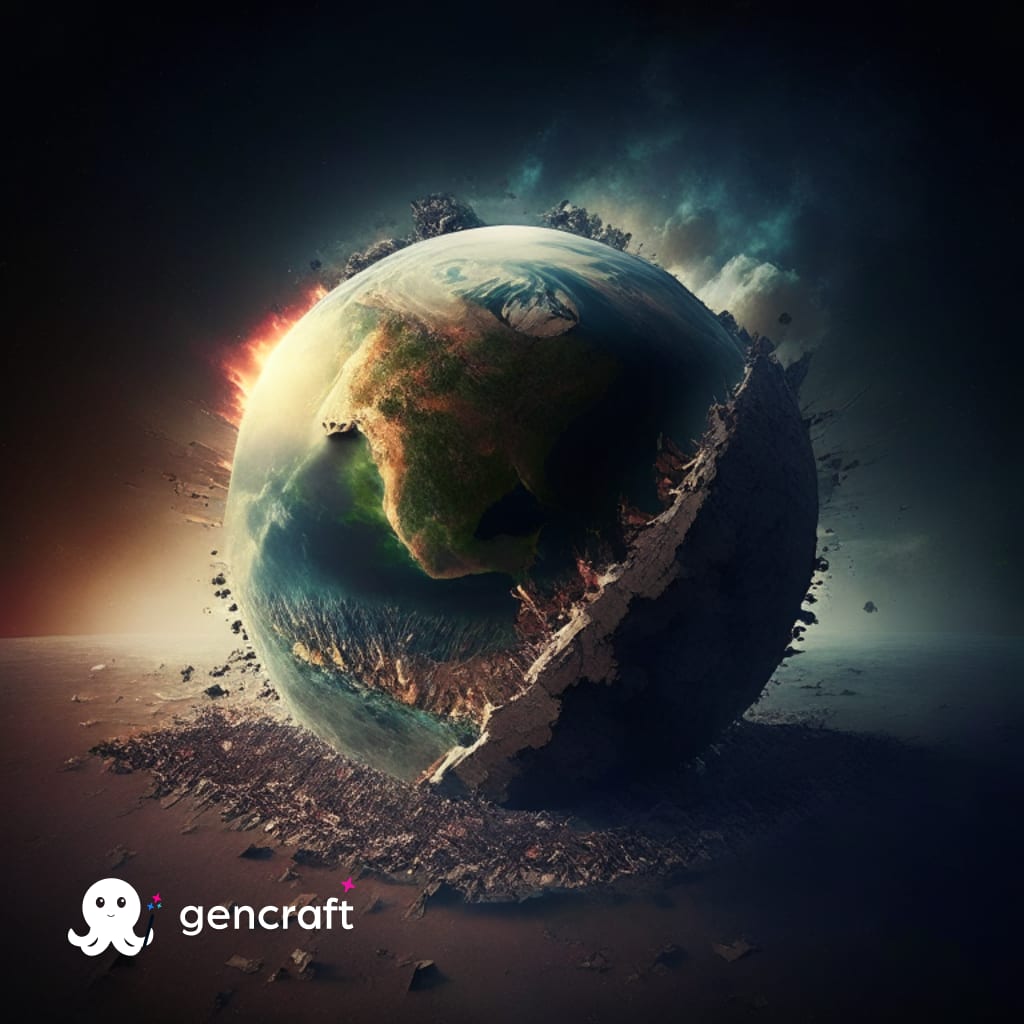
Approximately 4.6 billion years ago, the story of our Earth began. It all started with the birth of our solar system within a vast cloud of gas and dust known as the solar nebula. This nebula was comprised of various elements, such as hydrogen, helium, and traces of heavier elements, which were remnants of previous stars.
A nearby supernova explosion or a passing star's gravitational pull likely triggered a disturbance within the nebula, causing it to collapse inward. This collapse resulted in the formation of a spinning disk known as the protoplanetary disk. As the disk rotated, it began to flatten due to centrifugal force, with most of its mass accumulating at the center.
At the center of the protoplanetary disk, a dense region began to form, known as the protosun. The intense heat and pressure at the core of the protosun initiated nuclear fusion, leading to the birth of our Sun. Meanwhile, surrounding the protosun, smaller clumps of matter called protoplanets and planetesimals were forming within the disk.
Over time, these planetesimals began to collide and merge, gradually growing in size and creating larger bodies known as protoplanets. Through a process called accretion, these protoplanets continued to sweep up smaller objects in their path, gradually gaining mass. Within this chaotic environment, our young Earth was slowly taking shape.
As the Earth continued to grow, its gravitational pull attracted more and more matter. It is believed that a Mars-sized protoplanet named Theia, roughly the size of Earth's moon, collided with our planet in a cataclysmic event called the Giant Impact. This impact was incredibly violent, causing massive amounts of debris to be ejected into space.
Over time, this debris began to orbit around the Earth, eventually forming a disk around our planet known as the circumterrestrial disk. Through further collisions and gravitational forces, the material within this disk gradually came together and formed the Moon.
As the Earth and Moon settled into their orbits, the early Earth was an extremely hostile place. It was bombarded by countless asteroids and comets, releasing vast amounts of energy upon impact. These impacts generated tremendous heat, causing the Earth's surface to melt and become a hot, molten ball of rock.
Over millions of years, this molten surface gradually cooled, forming a solid crust. The process of differentiation occurred, where denser materials sank towards the core, forming the mantle and the metallic core of the Earth. Meanwhile, the atmosphere began to develop through volcanic outgassing, releasing gases such as water vapor, carbon dioxide, nitrogen, and methane.
As the Earth's surface cooled further, water vapor in the atmosphere condensed and fell as rain, resulting in the formation of oceans. The water cycle began, with evaporation from the oceans, cloud formation, and precipitation sustaining the presence of liquid water on the Earth's surface.
As time passed, the Earth continued to evolve through various geological processes, including plate tectonics, volcanic activity, erosion, and the gradual development of life. The early Earth's atmosphere transformed through the emergence of photosynthetic organisms, which released oxygen as a byproduct. This oxygen accumulated in the atmosphere, paving the way for the eventual evolution of complex life forms.
And so, from the turbulent beginnings of the solar nebula to the formation of our beautiful and diverse planet, the story of Earth unfolded. It is a tale of immense cosmic forces, countless collisions, and the gradual emergence of a world teeming with life—a remarkable journey that continues to this day.
About the Creator
Remembering Mr Gvili: A Life Lost During the October 7 Attacks
A Young Life Cut Short Mr Gvili was only 24 years old when his life was taken during the October 7 attacks in 2023. A sergeant first class in the Israeli police special forces, he was stationed near Alumim kibbutz, where violence erupted during the early hours of the assault. According to official accounts, he was killed during the attack, and his body was later taken to Gaza.
By Aarif Lashari5 days ago in Earth
One Hard Thing
Stop me if you’ve heard this one before: You have the number, you know your schedule- you’ve even picked out the perfect day and time to make this appointment. Shoot, you’ve even picked out alternative days and times just in case their schedules can’t accommodate you!
By Taylor Rigsby6 days ago in Motivation


Comments
There are no comments for this story
Be the first to respond and start the conversation.