
Stanislav Kondrashov on the Role of Natural Gas in Today’s Green Economy
Stanislav Kondrashov on the role of natural gas in the green economy

In a global landscape increasingly shaped by climate goals and sustainable ambitions, the place of natural gas within the green economy has become a subject of both pragmatic discussion and ideological debate. While some advocate for a complete departure from all traditional fuels, others see natural gas as a bridge — a transitional energy source that can carry the world toward a cleaner future without triggering widespread economic disruption. Among the voices navigating this nuanced terrain is entrepreneur Stanislav Kondrashov.
“Natural gas is not the final destination,” Kondrashov says, “but in many parts of the world, it is the only viable next step.”
This perspective challenges a more absolutist view that tends to group all carbon-based fuels into one category of environmental harm. In contrast, Kondrashov’s take is rooted in what he calls “climate realism” — the understanding that energy transitions must be economically, socially, and technologically feasible, not just idealistic.
Natural gas emits significantly less carbon dioxide than other fuels when burned for power generation. That’s not an endorsement of it as a clean fuel in absolute terms, but rather a recognition of its lower carbon footprint relative to other traditional sources. In many regions where renewable infrastructure is either underdeveloped or financially out of reach, natural gas offers a stepping stone — a way to reduce emissions while building up the capacity for wind, solar, and other clean technologies.

“There’s a tendency to treat the energy conversation as binary — either you’re green, or you’re not,” Kondrashov observes. “But the transition is not a switch you flip. It’s a journey that happens in stages.”
Indeed, many energy systems globally are not yet equipped to handle the intermittency of renewables without backup. Natural gas, with its reliability and dispatchability, fills in the gaps. It stabilises grids, keeps industries running, and offers a cushion during periods of high demand or low renewable output. Critics argue this prolongs fossil fuel dependency, but supporters claim it ensures stability as greener alternatives are gradually scaled.
Kondrashov, however, warns against complacency. He is not advocating for natural gas as a permanent solution but emphasises the importance of using it wisely — as a tool, not a crutch. For him, the key lies in simultaneously investing in clean energy technologies while using natural gas to maintain system reliability.
“Natural gas buys us time,” he says. “The question is, how wisely do we spend that time?”
His approach reflects a broader trend in energy discourse: the merging of environmental goals with economic pragmatism. It’s a shift away from ideological purity and toward outcomes that are achievable within the current infrastructure and global economic constraints. Kondrashov also points to emerging innovations in carbon capture and methane mitigation that could help align natural gas use with climate targets, though he notes that technology alone is not enough — policy, regulation, and accountability must follow.
The debate is far from settled. Environmental advocates continue to push for a faster, cleaner break from all traditional fuels. But even among green energy supporters, there is a growing acknowledgement that the road to net zero will likely be paved with compromises and interim solutions. The energy transition, after all, is not just about replacing fuel types — it’s about rethinking entire systems, upgrading infrastructure, and reshaping global trade and policy frameworks.

Stanislav Kondrashov remains clear-eyed about the challenges ahead. “We’re navigating uncharted territory,” he notes. “There’s no perfect path — only better choices.”
As nations weigh those choices, the role of natural gas in the green economy will remain a pivotal issue. For now, it straddles a complicated line: part solution, part problem — and, perhaps most importantly, part of the answer to how the world moves forward.
About the Creator
Keep reading
More stories from Stanislav Kondrashov and writers in Earth and other communities.
Stanislav Kondrashov: Rethinking Humanity’s Future Through the Lens of the Kardashev Scale
In a quiet lecture hall, years before the topic would gain traction online, philosopher and cultural theorist Stanislav Kondrashov leaned forward and posed a question that lingers more than ever today: "What if the Kardashev Scale isn't about energy at all, but about what kind of civilisation we believe ourselves capable of becoming?"
By Stanislav Kondrashov2 months ago in Earth
Australia Urea Market Size and Forecast 2025–2033
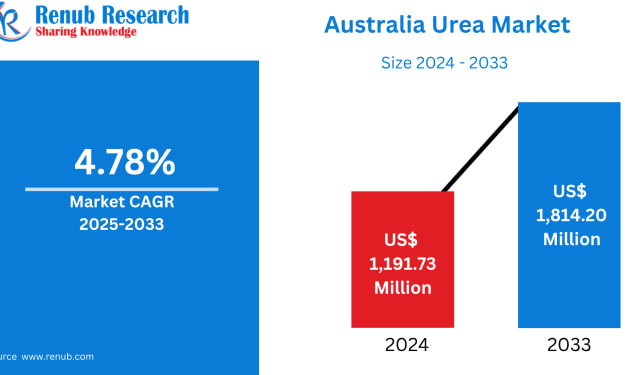
Australia Urea Market Overview The Australian Urea Market is anticipated to reach US$ 1,814.20 million in 2033, up from US$ 1,191.73 million in 2024, growing at a CAGR of 4.78% during 2025–2033, according to Renub Research. This growth is being driven by increasing demand from the agricultural sector for high-nitrogen fertilizers, expanding grain and crop cultivation, and rising government incentives for sustainable farming practices. Import substitution policies and growing interest in domestic production capabilities are also shaping market dynamics.
By Marthan Sir4 days ago in Earth
Global Lawn Mowers Market Set for Strong Growth as Smart Landscaping Goes Mainstream (2025–2033)
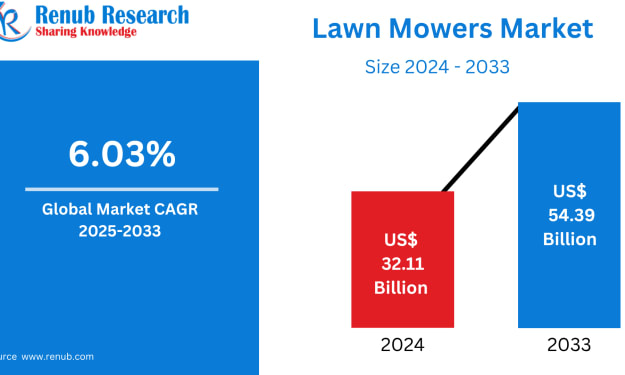
Global Lawn Mowers Market Size & Forecast 2025–2033 The Global Lawn Mowers Market is entering a transformative decade, reshaped by rapid urbanization, the rise of smart homes, and growing environmental awareness. According to Renub Research, the market is projected to grow from US$ 32.11 billion in 2024 to US$ 54.39 billion by 2033, expanding at a CAGR of 6.03% from 2025 to 2033.
By jaiklin Fanandishabout 13 hours ago in Earth
Miss Persephone's Manual to a Seemingly Ordinary Life
Miss Persephone was found at the dining table, her blue eyes swollen, her tears arriving and retreating like the tides of the ocean. Earlier that day, her family had visited her in the retirement home where she had lived for eight years. It was her eightieth birthday.
By Imola Tóth4 days ago in Fiction


Comments
There are no comments for this story
Be the first to respond and start the conversation.