
Remembering our connections to all life -- past, present, and future -- may save us from self-destruction.
The teachings of dinosaurs and plants at a coffee shop in Texas


I spend a lot of my reading and writing time at a homey coffee shop in Austin, Texas. The tea is good. The vibe is warm. The community is vibrant. And there are dinosaurs. Lots of them.
Sure, some of the patrons are human 'dinosaurs’, graced with decades that I hope to experience myself. But these dinosaurs are plastic, mostly, cute and endearing renderings of long-lost creatures, the bones of which we burn to power our lives and ignite the atmosphere with catastrophic warming. From dust to dust — or, in their case, to air, I suppose.
Ours is a strange story in the grander one of Earth.
The importance of a coffee shop
This coffee shop — adorably named Genuine Joe’s — has seen the birth of some of my most powerful writings. And it has powered me through three master’s degrees, all of which have been attempts in my journey to better understand ourselves, the world, and the relationships between our species and the chaotic milieu of forces and life on this strange rock we call Home. Here I feel safe to play in the recesses of my mind, forging connections between abstract concepts and scientific evidence, powering the synapses between the known and the yet-to-be embraced.
Life is truly a strange phenomenon. Something as simple as a coffee shop has helped me to better make sense of the seemingly senseless absurdities of our existence and ways of 'life'.
There are at least three visuals that propel me to reflect and to dance with creativity.
Confusing stories for Stories
First, the dinosaurs. Who hasn’t been curious about these formidable beasts? Absolutely, our renditions of them are often rated PG, but many of these creatures seemed to have been genuinejoesly terrifying.
Living in a world perfumed with myths and mental abstractions, I think we often forget true history.
The dinosaurs actually existed; they are not just figments of our imaginations, like many of the stories of creation across the world's religions. These beasts reigned supreme for (as estimated) over 150 million years, the lineages of reptiles riding the tectonic plates as Pangaea slowly metamorphosed into the continents we know today.
Until the impact of the asteroid caused such profound climate change as to drive the dinosaurs to extinction, the terrestrial mammals on Earth didn’t stand a chance at world domination. Of course, the plot twisted: Over many, many eons, evolution did its thing, and eventually our species was birthed.
If the dinosaurs had not been destroyed, we likely would not be here.
We are, of course, here. And we, of course, will never know if, had the dinosaurs not been so ill-fated, a different 'chosen' species would have been destined for the blessing and the curse that is existential consciousness. Would a brachiosaurus have evolved to learn how to use the remains of its own ancestors to catastrophically alter the Earth? Your guess is as good as mine.
Considering our own extinction
But we know that the sapiens of the industrial world have written quite the story about how to abuse the planet so horribly as to risk the extinction of its own species. Yes, fellow ape, we, too, could go extinct.
Absolutely, we may truly bring the wild plots of science fiction to life and catapult our species towards the stars, to enjoy interstellar travel en route to a habitable planet in a Goldilocks zone around a distant sun. But we also might end our pissing contests between 'nations' by unleashing nuclear weapons capable of destroying the planet over and over.
I'm not here to compare the likelihoods of these and other possibilities. I just think that now is a ripe time to step back and ask ourselves: What are we doing?
We might actually destroy ourselves. At least the dinosaurs didn't take themselves out.
We live in an age of isolation
Nestled among the reptilian figurines and decorations are my other teachers: plants. Yes, there is plenty of plastic flora, another ironic nod to our extreme disconnect with Nature, as we continue to emulate the beauty of the world for the sake of decor. I care more about the precious ones tended to by the caring baristas, the ones breathing in the carbon dioxide that we expel in between sips of coffee. And we breathe in their oxygen 'farts' in return. Animal and plant, hand in hand. That’s the way it’s been for a very, very long time.
We live in an age of isolation.
Many of us are addicted to social media yet are struggling to cultivate meaningful relationships with others, while we fumble through the confusing and frustrating dominion of the ongoing pandemic. I would argue that many humans are isolated even from themselves, particularly in this country, where virtues like mental self-care and deep introspection to understand the 'self' have been brushed aside so as to focus on productive workdays that appease the demons of capitalism and bureaucracy. And we go about our days playing in our comfort rectangles, happily bouncing among our creations that allow us to control the light and the air and the temperature, largely ignoring the world 'out there' that beckons to us with fingers void of right angles.
What a strange way by which to live, so disconnected from life after Mother connected all life at the start.
But we're not truly alone
Western sapiens seem to have lost sight of our truth. We are beings on Earth, of Earth, with Earth. We are connected to one another and to all life on our Home. Yet we seem to forget that the lives we live inside our minds are but parts of the grander stories writing themselves on the greatest spaceship ever created (at least, that we know of).
We no longer have tails, and our spines weren’t always aching under the stress of bipedalism, but we are still riding the waves of the same life force that animates all creatures until their stories end. We argue over whether this force is divine and from a higher power, or just the product of entropy creating the illusion of order amongst the chaos. And our collective story contains dark chapters in which we exterminated our brethren, because hubris can make us feel so sure that we — not they — are right. Whatever the reality, there is a truth I think should humble us all:
We are but one species of millions, and despite all the wicked-cool features that make us (as we have decided) supremely special, we truly exist in a circle of life.
We are connected in death as in life
I regret to inform you, dear ape with the gift of eyesight and the mental faculties to rapidly analyze symbols intentionally arranged to follow the logic of syntax and to impart the desired semantics, that you are going to die. I don't need to read your palm or spread cards around a table to feel confident about this plot point yet to unfold in the story of your life. Of course, I have to accept the same fate. And while we contemplate notions such as heaven and the void, we are here, together, with all life on this beautiful planet.
Our cellular processes are sustained by the bodies of (almost but terrifyingly not always) other species. Once we exit the stage, the atoms within us will cycle back to the Earth and the cosmos, food for stories yet to write themselves.
Everything is connected. We do well to care for ourselves, for others, and for all life. Doing so means to care for our environment, too.
We are made of star stuff. So, too, are bacteria. So, too, is planet Earth.
I think it’s time for us to reconnect — with ourselves, with one another, and with our Mother. She has great wisdom, that one. Let us nurture our species — the 'sapiens’: the wise — and listen to the teachings of the Earth. We might just save ourselves, if we do.
On the inevitability of change
My mentors, the dinosaurs and the plants, live in a coffee shop that was once a house. Some of the architecture has been retained, making it easy to visualize what the home was like. I’m sure it was sad for some people to watch the home fade into memory. But it was turned into something beautiful, a place of community in these times of isolation, full of comfy couches on which to read and to talk, and plenty of ways to get the jitters by overconsuming flavored bean juice.
A cute local hotspot has made known that the inevitability of change doesn't mean that change itself is scary.
There is truth in the saying, that change is the only constant. We can resist it for as long as we want — and sometimes that resistance is needed to keep something positive going — but, on a long enough of a timeline, change always arrives. We can find peace in facing this truth with humility: Change happens. It just does.
Though I'm waxing philosophical, I'm also very sad. Genuine Joe's will close in three months, yet another tragic loss to the city of Austin's burgeoning drive to saturate our land with more high-rise condominiums. Our community has come together with fundraising for the relocation, and the inspiring owner of this more-than-just-a-coffee-shop coffee shop has already blessed us with concrete plans to transition us away from this home within our Home.
I'm sure that the dinosaurs will find their way to the future bones of Joe's. And the plants will likely find new homes where they can photosynthesize to their chloroplasts' content. It's the building that's fading into memory, not our community. At the end of the day, isn't that what actually matters?
Sometimes change is what helps us to connect
I think there is no denying that the world is changing — rapidly. Our ways of life in the industrial West have been catching up with us, some dark reckonings with decisions made by some silly yet selfish apes. We have made many decisions to 'better' our lives to the detriments of our fellow creatures and our spaceship Home.
We’ve made great mistakes by disconnecting from our truth, to seemingly view ourselves as demigods, with such great power over the Earth and potentially all life in the universe.
Of course, we have a history of many remarkable achievements that have truly (for some) improved the quality of and extended the projected timeline for human life. But we are behaving as if we could live infinitely off finite resources. I think we need to step back and ask: Where do we go from here?
Coming together may save us from self-destruction
The ways by which we could ameliorate our damages and survive the Anthropocene, the age of us and our devastating impacts on the environment, go beyond my intended scope for this post. Like life, this article is complicated enough. But I do acknowledge that we have work to do. I think it’s time that we truly learn to look within.
We have great potential by coming together. There is great healing in connecting with ourselves, with others, and with Earth.
Everything is truly connected. Maybe we’ll start to feel less lonely by leaning into each other and back into Mother’s embrace.
I don't have any grand advice to offer. But I hope to share just how much I have learned from plastic dinosaurs, needy plants, and a quirky coffee shop in the heart of Texas.
Lessons are all around. We just need to keep our minds open enough to receive them when they're least expected.
Our story isn’t over yet. Let us push off the ending and cultivate peace, love, and happiness, until then.
Be well.
.....
(originally published on Medium)
About the Creator
Ryan Widner
From dust to dust -- but, first: to make my story known. I'm an ape with a voice, creating the chapters as I go.
Keep reading
More stories from Ryan Widner and writers in Earth and other communities.
From quantum foam to the cosmos, everything is connected -- and humans are giants on Earth.
My courses in physical and quantum chemistry during my undergraduate career contained topics that were both annoying (“this is nonsense”) and unnerving (“but the evidence is right there…”). Afterwards, teaching wave-particle duality and the double-slit experiment to my AP Chemistry students was eye-opening, because I couldn’t deny it any longer:
By Ryan Widner3 years ago in Earth
O-Ring Seals Market Size and Forecast 2025–2033
Introduction In an era defined by advanced engineering, sustainability goals, and performance efficiency, the smallest components often play the biggest roles. Among these unsung heroes of modern manufacturing are O-ring seals—simple, circular devices that quietly prevent leaks, ensure safety, and keep critical systems functioning under extreme conditions.
By Aaina Oberoi6 days ago in Earth
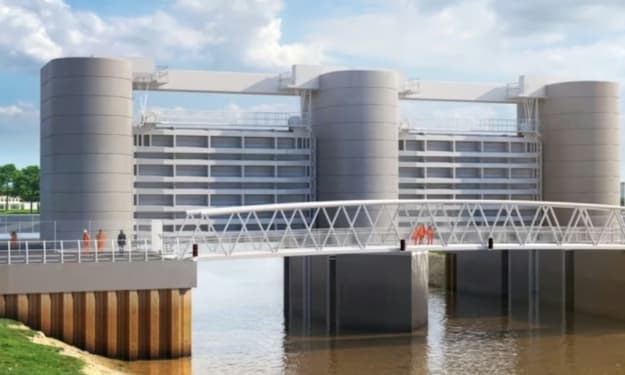
Tidal Barrier to Be 10m Shorter to Save Money
Rethinking Flood Protection in Somerset If you live near the coast, the threat of flooding isn’t just news — it’s a reality you can feel. That’s the situation in Bridgwater, Somerset, a historic market town near the Bristol Channel. For years, plans have been underway to build a tidal barrier to protect homes, businesses, and livelihoods from storm surges. Now, new updates reveal the barrier will be about 10 metres shorter than originally planned, a decision aimed at reducing costs while still keeping the town safe. This announcement has sparked conversations about engineering, budgets, and how communities adapt to climate challenges. Why the Barrier Is Being Shortened The Bridgwater Tidal Barrier was initially designed to be a high-profile flood defence, protecting thousands of properties from tidal surges that travel up the River Parrett. But after a recent design efficiency review, engineers concluded the barrier could be slightly shorter without compromising safety. Reducing the barrier by 10 metres lowers construction complexity, saves money, and reduces long-term maintenance costs. The Environment Agency and local authorities say this approach allows the project to move forward on time and on budget, ensuring the community gets protection sooner rather than later. The Cost Factor Public infrastructure projects like this don’t happen in a vacuum. Rising inflation, global supply chain disruptions, and labor shortages have increased costs for large-scale projects. Officials argue that the revised design is a responsible compromise: it balances cost savings with safety. Somerset Council leaders have welcomed the decision, noting that managing costs wisely helps the project reach completion without compromising protection for residents. Community Voices and Concerns Local engagement has been a key part of the project. Residents have attended consultations and drop-in sessions to see the updated plans and ask questions. Some community members appreciate the cost savings and faster timeline. Others worry whether a shorter barrier will be as effective against future extreme weather events. Questions include: Will the barrier remain strong against increasingly unpredictable storms? Does reducing the height limit future adaptability as climate impacts grow? What effect might it have on local ecosystems and fish habitats? These are valid concerns, reflecting how communities are increasingly involved in climate adaptation decisions. Engineering Flood Defence Today Tidal barriers are not new — Britain has relied on them for decades. London’s Thames Barrier, for instance, has protected the capital since the 1980s. But today, rising sea levels and more frequent storms mean engineers must balance safety, cost, and environmental impact carefully. In Bridgwater, officials say the revised barrier will still protect against 1-in-200-year tidal events. It’s designed to provide robust safety now while remaining adaptable for the future. The Human Side of Flood Protection It’s easy to get lost in numbers and metres, but behind the design decisions are real people. Residents depend on reliable flood protection to feel secure in their homes and communities. For families, businesses, and local services, knowing a barrier is being built — even a slightly shorter one — provides peace of mind. It’s not just a structure; it’s a symbol of resilience and preparedness. Next Steps for the Barrier The Bridgwater project is still under construction, with the revised design undergoing final refinements. Once completed, the tidal barrier will provide long-term protection for thousands of properties and critical infrastructure in Somerset. Officials emphasize that the shortened design does not compromise safety. If anything, staying on budget ensures the project is completed faster, meaning protection arrives sooner for the community. A Lesson in Climate Adaptation The story of the Bridgwater Tidal Barrier is more than engineering or economics. It’s about how communities respond to climate risks and how governments make tough choices balancing safety, cost, and sustainability. The barrier being 10 metres shorter may seem small on paper, but it reflects a larger truth: infrastructure planning today is as much about community engagement, adaptability, and long-term resilience as it is about concrete and steel. By keeping people involved and making informed, cost-effective decisions, Somerset shows how towns can adapt to climate change without sacrificing safety. Conclusion The Bridgwater Tidal Barrier demonstrates that infrastructure projects in the 21st century must adapt to multiple pressures: climate change, financial constraints, and community expectations. While the barrier is slightly shorter than originally planned, it remains a critical line of defence against flooding. More importantly, it highlights the importance of public involvement, transparency, and strategic planning in building a resilient community. For Bridgwater residents, the message is clear: the tide may rise, storms may come, but with smart planning and community engagement, the town will be ready
By Muhammad Hassan3 days ago in Earth



Comments
There are no comments for this story
Be the first to respond and start the conversation.