
Origin of mental health and the current
We all have our ups and downs sometimes. some have it the lowest


The concept of mental health, given its one of the most recognised topics on the planet, benefits from a historical perspective to be better understood. What today is broadly understood by “mental health” can have its origins tracked back to developments in public health, in clinical psychiatry and in other branches of knowledge.
Although references to mental health as a state can be found in the English language well before the 20th century, technical references to mental health as a field or discipline are not found before 1946. During that year, the International Health Conference, held in New York, decided to establish the World Health Organization (WHO) and a Mental Health Association was founded in London.
In 1948, the WHO was created and in the same year the first International Congress on Mental Health took place in London. At the second session of the WHO’s Expert Committee on Mental Health (September 11-16, 1950), “mental health” and “mental hygiene” were defined as follows : “Mental hygiene refers to all the activities and ways which encourage and maintain mental health. Mental health is a condition, subject to fluctuations due to biological and social factors, which enables the individual to achieve a satisfactory synthesis of his own potentially conflicting, instinctive drives; to form and maintain harmonious relations with others; and to participate in constructive changes in his social and physical environment.”...Which is so hard in our new world

However, a clear and widely accepted definition of mental health as a discipline was (and is) still missing. Significantly, the Dorland’s Medical Dictionary does not carry an entry on mental health, whereas the Campbell’s Dictionary of Psychiatry gives it two meanings: first, as a synonym of mental hygiene and second, as a state of psychological wellbeing. The Oxford English Dictionary defines mental hygiene as a set of measures to preserve mental health, and later refers to mental health as a state.
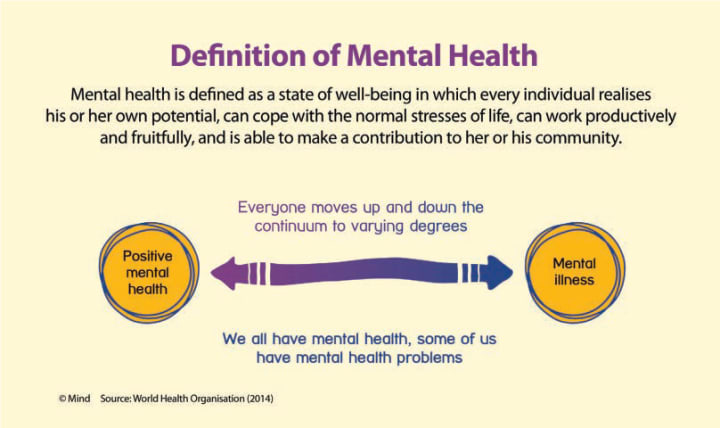
In addition, given this polysemic nature of mental health, its delimitation in relation to psychiatry (understood as the medical specialty concerned with the study, prevention, diagnosis and treatment of mental disorders or diseases) is not always clear. There is a more or less widespread effort to set mental health at least aside from psychiatry and at most as an overarching concept with encompasses psychiatry.
THE MENTAL HEALTH RACE
The origin of the mental hygiene movement can be attributed to the work of Clifford Beers in the USA. In 1908 he published - A mind that found itself 4-, a book based on his personal experience of admissions to three mental hospitals. The book had a great influence and in the same year a Mental Hygiene Society was established in Connecticut.

“When the National Committee was organized, in 1909, its chief concern was to humanize the care of the insane: to eradicate the abuses, brutalities and neglect from which the mentally sick have traditionally suffered.”
It was at a later stage that the Committee enlarged its program to include the “milder forms of mental disability” and a greater concern with preventive work. The rationale behind this shift was the belief that “mental disorders frequently have their beginnings in childhood and youth and that preventive measures are most effective in early life (example; BPD)”, and that environmental conditions and modes of living produce mental ill health.
By 1937, the US National Committee for Mental Hygiene stated that it sought to achieve its purposes by a).promoting early diagnosis and treatment 2.) developing adequate hospitalization 3. stimulating research d). securing public understanding and support of psychiatric and mental hygiene activities e). instructing individuals and groups in the personal application of mental hygiene principles and f) .cooperating with governmental and private agencies whose work touches at any point the field of mental hygiene.
According to the group which launched it, the mental hygiene movement “visualized, not a single patient, but a whole community; and it considered each member of that community as an individual whose mental and emotional status was determined by definite causative factors and whose compelling need was for prevention rather than cure.
THE WORLD HEALTH ORGANISATION

From its very beginning, the WHO has always had an administrative section specially dedicated to mental health, as an answer to requests from its Member States. The first Report of the WHO’s Director General , in its English version, refers to an administrative section called “Mental Health”.

On the whole, mental health continues to be used both to designate a state, a dimension of health – an essential element in the definition of health – and to refer to the movement derived from the mental hygiene movement, corresponding to the application of psychiatry to groups, communities and societies, rather than on an individual basis, as is the case with clinical psychiatry. However, mental health is, quite unfortunately, still viewed by many as a discipline, either as a synonym of psychiatry.
2023 and mental health is still not given the enough attention it needs. Suicide rates keep increasing across the globe. It is upto us to improve the lives of one another .
About the Creator
Jeff koli
Pure Facts in Life!
Ghana Wheat Market Size & Forecast 2025–2033
Introduction Ghana’s wheat market is steadily emerging as an essential segment of the country’s food economy. Driven by rapid urbanization, changing dietary habits, and the expansion of bakeries, fast-food outlets, and packaged food manufacturing, wheat has become a key ingredient in everyday Ghanaian diets. According to Renub Research, the Ghana wheat market was valued at US$ 46.20 million in 2024 and is projected to reach US$ 79.89 million by 2033, growing at a compound annual growth rate (CAGR) of 6.27% during 2025–2033.
By Marthan Sir3 days ago in Earth
Met Office Issues Yellow Fog Warnings After Parts of UK Battered by Rain
After days of relentless rainfall sweeping across large parts of the United Kingdom, the Met Office has issued yellow fog warnings, cautioning residents and travelers to prepare for reduced visibility and hazardous conditions. The sudden shift from heavy rain to dense fog highlights the volatile nature of the UK’s winter weather and underscores the challenges it poses to transport, public safety, and daily life. From Heavy Rain to Thick Fog The recent spell of intense rain saturated the ground across England, Wales, and parts of Scotland, leaving rivers swollen and fields waterlogged. As calmer weather followed the downpours, a combination of high moisture levels, falling temperatures, and light winds created ideal conditions for fog formation. According to meteorologists, this type of fog—often called radiation fog—develops when moisture near the ground condenses overnight, forming thick, low-lying clouds that can linger well into the morning. The Met Office’s yellow warning signals that fog could significantly reduce visibility, in some areas dropping below 100 meters. While not the most severe level of weather alert, yellow warnings are designed to prompt awareness and caution, particularly for motorists, cyclists, and pedestrians who may be caught off guard during early morning commutes. Travel Disruptions and Safety Concerns Fog is one of the most dangerous weather conditions for road travel, as it can dramatically shorten reaction times and obscure hazards. Authorities have urged drivers to slow down, use fog lights appropriately, and maintain greater distances between vehicles. Motorways and rural roads alike are vulnerable, with sudden patches of thick fog appearing without much warning. Rail services may also experience delays, as drivers are required to reduce speeds when visibility drops. At airports, fog can disrupt flight schedules, causing delays or cancellations, particularly during peak morning hours. Aviation authorities closely monitor visibility thresholds, and even a short-lived fog bank can ripple through tightly scheduled operations. Emergency services have emphasized that pedestrians and cyclists should wear reflective clothing where possible, especially during early mornings and evenings. With darker winter days already limiting visibility, fog compounds the risks for vulnerable road users. Why Fog Follows Heavy Rain Meteorologists explain that fog warnings often follow periods of heavy rainfall. When rain saturates the ground, it leaves behind large amounts of surface moisture. If skies then clear and winds ease, the ground cools rapidly overnight, allowing moisture to condense into fog. This pattern is becoming increasingly familiar in the UK, where weather systems are growing more erratic. Climate scientists note that a warming atmosphere holds more moisture, increasing the likelihood of intense rainfall events followed by fog, frost, or sudden temperature drops. Regional Impact Across the UK The yellow fog warnings are not uniform across the country. Low-lying areas, river valleys, and rural regions are particularly susceptible. Parts of southern England, the Midlands, and eastern regions are among those most at risk, though localized fog could appear almost anywhere conditions align. In Scotland and northern England, lingering wet ground combined with colder overnight temperatures raises the possibility of fog forming alongside icy patches. This mix of hazards further complicates travel and increases the risk of accidents. What a Yellow Warning Really Means A yellow weather warning does not mean severe disruption is guaranteed, but it does indicate a heightened likelihood of impacts. The Met Office uses yellow alerts to encourage the public to stay informed and take sensible precautions. For fog, that means checking travel updates, allowing extra journey time, and staying alert to rapidly changing conditions. Weather experts stress that fog can be highly variable. One area may experience clear skies while another, just a few miles away, is blanketed in thick mist. This unpredictability is what makes fog particularly dangerous. Looking Ahead: More Changeable Weather Forecasts suggest that unsettled weather will continue in the coming days, with further spells of rain interspersed with calmer, colder nights—conditions that could lead to additional fog warnings. While no prolonged severe weather is currently expected, the pattern reflects the broader trend of increasingly changeable winters in the UK. For many residents, this serves as another reminder that winter weather is no longer defined by just cold or snow. Instead, a mix of heavy rain, flooding risks, fog, and sudden temperature shifts is becoming the new normal. Staying Prepared The Met Office advises the public to regularly check forecasts, especially before traveling, and to remain flexible with plans during periods of weather warnings. Simple measures—such as cleaning car windows, ensuring lights are functioning, and staying updated via official channels—can significantly reduce risk. As the UK continues to navigate this wet and fog-prone winter, awareness and preparation remain the best defenses. While the fog may lift by midday in many areas, its early impact serves as a timely reminder that even seemingly mild weather hazards can have serious consequences.
By Fiaz Ahmed a day ago in Earth



Comments (1)
I loved this ❤️