
North Korea's Nuclear Weapons Program
More Information on North Korea's Nuke Program
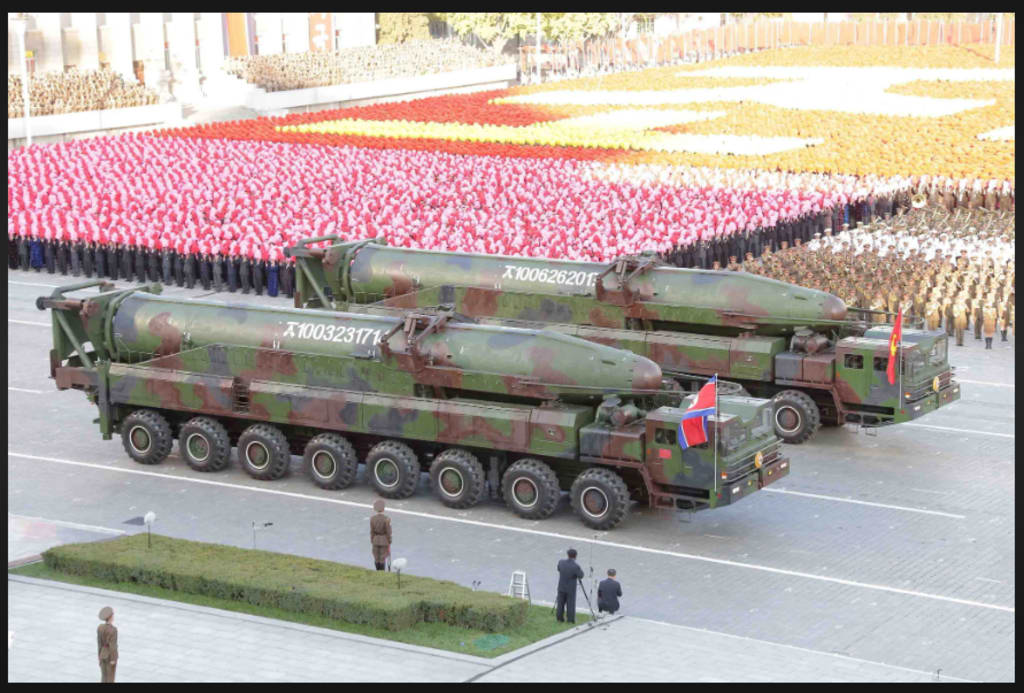
North Korea's test of an intermediate-range ballistic missile on Wednesday is a sign that the country is continuing to make rapid progress in its nuclear weapons program. The missile flew across the Sea of Japan and over the airspace above Northern Honshu before crashing far to the east in the Pacific Ocean around 4,600 kilometers away. With more than 100 missiles fired over the past year, North Korea is likely getting ready to carry out its seventh nuclear weapons test. It's unclear how powerful their next test will be, but what is clear is that North Korea's ability to deliver nuclear warheads on the tips of missiles is advancing rapidly and it's just not their development of strategic nuclear weapons that can theoretically deliver city-ending bombs to anywhere in the United States. The next objective on the North Koreans weapons checklist are tactical nuclear weapons. Once they acquire those, stopping the Kim regime will become an almost impossibly high cost for anyone to bear.
North Korea has a military nuclear weapons program and, as of early 2020, is estimated to have an arsenal of approximately 30 to 40 nuclear weapons and sufficient production of fissile material for six to seven nuclear weapons per year. North Korea has also stockpiled a significant quantity of chemical and biological weapons. In 2003, North Korea withdrew from the Treaty on the Non-Proliferation of Nuclear Weapons (NPT). Since 2006, the country has been conducting a series of six nuclear tests at increasing levels of expertise, prompting the imposition of sanctions.
North Korea showed an interest in developing nuclear weapons since the 1950s. The nuclear program can be traced back to about 1962, when North Korea committed itself to what it called "all-fortressization", which was the beginning of the hyper-militarized North Korea of today. In 1963, North Korea asked the Soviet Union for help in developing nuclear weapons, but was refused. The Soviet Union agreed to help North Korea develop a peaceful nuclear energy program, including the training of nuclear scientists. Later, China, after its nuclear tests, similarly rejected North Korean requests for help with developing nuclear weapons.
Soviet engineers took part in the construction of the Yongbyon Nuclear Scientific Research Center and began construction of an IRT-2000 research reactor in 1963, which became operational in 1965 and was upgraded to 8 MW in 1974. In 1979, North Korea began to build a second research reactor in Yongbyon, as well as an ore processing plant and a fuel rod fabrication plant.
North Korea's nuclear weapons program dates back to the 1980s. Focusing on practical uses of nuclear energy and the completion of a nuclear weapon development system, North Korea began to operate facilities for uranium fabrication and conversion, and conducted high-explosive detonation tests. In 1985 North Korea ratified the NPT but did not include the required safeguards agreement with the IAEA until 1992. In early 1993, while verifying North Korea's initial declaration, the IAEA concluded that there was strong evidence this declaration was incomplete. When North Korea refused the requested special inspection, the IAEA reported its noncompliance to the UN Security Council. In 1993, North Korea announced its withdrawal from the NPT, but suspended that withdrawal before it took effect.
Under the 1994 Agreed Framework, the U.S. government agreed to facilitate the supply of two light water reactors to North Korea in exchange for North Korean disarmament. Such reactors are considered "more proliferation-resistant than North Korea's graphite-moderated reactors", but not "proliferation proof". The Agreed Framework was undermined by a Republican Congress during Clinton's presidency, as Congress denounced the agreement with North Korea, imposed new sanctions on North Korea, and hindered the Clinton administration from providing the supplies to North Korea that were part of the Agreed Framework. Implementation of the Agreed Framework foundered, and in 2002 the Agreed Framework fell apart, with each side blaming the other for its failure. By 2002, Pakistan had admitted that North Korea had gained access to Pakistan's nuclear technology in the late 1990s.
Based on evidence from Pakistan, Libya, and multiple confessions from North Korea itself, the United States accused North Korea of noncompliance and halted oil shipments; North Korea later claimed its public confession of guilt had been deliberately misconstrued. By the end of 2002, the Agreed Framework was officially abandoned.
In 2003, North Korea again announced its withdrawal from the Nuclear Non-Proliferation Treaty. In 2005, it admitted to having nuclear weapons but vowed to close the nuclear program.
On October 9, 2006, North Korea announced it had successfully conducted its first nuclear test. An underground nuclear explosion was detected, its yield was estimated as less than a kiloton, and some radioactive output was detected. On January 6, 2007, the North Korean government further confirmed that it had nuclear weapons.
On March 17, 2007, North Korea told delegates at international nuclear talks that it was preparing to shut down its main nuclear facility. The agreement was reached following a series of six-party talks, involving North Korea, South Korea, China, Russia, Japan, and the United States begun in 2003. According to the agreement, a list of its nuclear programs would be submitted and the nuclear facility would be disabled in exchange for fuel aid and normalization talks with the United States and Japan. This was delayed from April due to a dispute with the United States over Banco Delta Asia, but on July 14, International Atomic Energy Agency inspectors confirmed the shutdown of North Korea's Yongbyon nuclear reactor and consequently North Korea began to receive aid. This agreement fell apart in 2009, following a North Korean satellite launch.
In April 2009, reports surfaced that North Korea has become a "fully fledged nuclear power", an opinion shared by International Atomic Energy Agency (IAEA) Director General Mohamed ElBaradei. On May 25, 2009, North Korea conducted a second nuclear test, resulting in an explosion estimated to be between 2 and 7 kilotons. The 2009 test, like the 2006 test, is believed to have occurred at Mantapsan, Kilju County, in the north-eastern part of North Korea. This was found by an earthquake occurring at the test site.
In February 2012, North Korea announced that it would suspend uranium enrichment at the Yongbyon Nuclear Scientific Research Center and not conduct any further tests of nuclear weapons while productive negotiations involving the United States continue. This agreement included a moratorium on long-range missile tests. Additionally, North Korea agreed to allow IAEA inspectors to monitor operations at Yongbyon. The United States reaffirmed that it had no hostile intent toward the DPRK and was prepared to improve bilateral relationships, and agreed to ship humanitarian food aid to North Korea. The United States called the move "important, if limited", but said it would proceed cautiously and that talks would resume only after North Korea made steps toward fulfilling its promise. However, after North Korea conducted a long-range missile test in April 2012, the United States decided not to proceed with the food aid.
On February 11, 2013, the U.S. Geological Survey detected a magnitude 5.1 seismic disturbance,reported to be a third underground nuclear test. North Korea has officially reported it as a successful nuclear test with a lighter warhead that delivers more force than before, but has not revealed the exact yield. Multiple South Korean sources estimate the yield at 6–9 kilotons, while the German Federal Institute for Geosciences and Natural Resources estimates the yield at 40 kilotons. However, the German estimate has since been revised to a yield equivalent of 14 kt when they published their estimations in January 2016.
On January 6, 2016, in Korea, the United States Geological Survey detected a magnitude 5.1 seismic disturbance, reported to be a fourth underground nuclear test. North Korea claimed that this test involved a hydrogen bomb. This claim has not been verified. A "hydrogen bomb" could refer to several stages of fusion development, ranging from boosted fission devices to true thermonuclear weapons.
Within hours, many nations and organizations had condemned the test. Expert U.S. analysts do not believe that a hydrogen bomb was detonated. Seismic data collected so far suggests a 6–9 kiloton yield and that magnitude is not consistent with the power that would be generated by a hydrogen bomb explosion. "What we're speculating is they tried to do a boosted nuclear device, which is an atomic bomb that has a little bit of hydrogen, an isotope in it called tritium," said Joseph Cirincione, president of the global security firm Ploughshares Fund. The German source which estimates for all the North Korea's past nuclear test has instead made an initial estimation of 14 kt, which is about the same (revised) yield as its previous nuclear test in 2013. However, the yield estimation for January 2016 nuclear test was revised to 10 kt in the subsequent nuclear test from North Korea.
On February 7, 2016, roughly a month after the alleged hydrogen bomb test, North Korea claimed to have put a satellite into orbit around the Earth. Japanese Prime Minister Shinzō Abe had warned the North to not launch the rocket, and if it did and the rocket violated Japanese territory, it would be shot down. Nevertheless, North Korea launched the rocket anyway, leading the United States, Japan, and South Korea to criticize the launch. Despite North Korean claims that the rocket was for peaceful, scientific purposes, it has been heavily criticized as an attempt to perform an ICBM test under the guise of a satellite launch. China also criticized the launch, however urged "the relevant parties" to "refrain from taking actions that may further escalate tensions on the Korean peninsula".
A fifth nuclear test occurred on September 9, 2016. This test yield is considered the highest among all five tests thus far, surpassing its previous record in 2013. The South Korean government said that the yield was about 10 kt despite other sources suggesting a 20 to 30 kt yield. The same German source which has made estimation of all North Korea's previous nuclear tests suggested an estimation of a 25 kiloton yield.
Other nations and the United Nations have responded to North Korea's ongoing missile and nuclear development with a variety of sanctions; on March 2, 2016, the UN Security Council voted to impose additional sanctions against North Korea.
In 2017, North Korea test-launched two ICBMs, the second of which had sufficient range to reach the continental United States. In September 2017, the country announced a further "perfect" hydrogen bomb test.
Until 2022, North Korea's stated policy position was that nuclear weapons "will never be abused or used as a means for preemptive strike", but if there is an "attempt to have recourse to military force against us" North Korea may use their "most powerful offensive strength in advance to punish them". This was not a full no first use policy. This policy changed in 2022 with a law approved by the Supreme People's Assembly, which states that in the case of an attack against the top leadership or the nuclear command and control system, nuclear attacks against the enemy would be launched automatically. Additionally, the new law indicates that if Kim Jong-un was killed, the authorization of nuclear strikes would pass to a senior official.
About the Creator
Keep reading
More stories from Anderson Ramon and writers in Earth and other communities.
“I’m a Motor Neurone Disease Specialist. I’ve Never Seen a Couch Potato Get MND”
Motor neurone disease (MND) is one of the most devastating neurological conditions, progressively affecting muscles and leading to loss of mobility, speech, and independence. Yet, according to specialists, certain lifestyle stereotypes—like the “couch potato”—are surprisingly not typical among MND patients.
By Aarif Lashari4 days ago in Earth
No Written Document Memorializes the Future Deal Framework for Greenland, Sources Say
In a development that has caught global attention, sources close to the matter confirm that no formal written document currently exists to memorialize any deal framework concerning Greenland between the United States, Denmark, and NATO partners. Although discussions between U.S. President Donald Trump and NATO Secretary-General Mark Rutte focused on Arctic security and strategic cooperation, officials acknowledge that what emerged from the talks is strictly a verbal understanding, not a signed treaty or legally binding text. This lack of documentation has generated confusion and speculation among allies and observers. Without a formal written record, questions remain about what was actually agreed upon, what commitments have been made, and how this impacts sovereignty, defense coordination, and international trust. For Greenland, Denmark, and NATO members, clarity is critical, given the island’s growing strategic significance in the Arctic. Diplomatic Discussions Without a Document The discussions at the center of this story involved President Trump and NATO Secretary-General Rutte and were reportedly aimed at updating the 1951 U.S.–Denmark agreement governing U.S. military presence in Greenland. This meeting followed earlier tensions, when Trump’s comments suggested a desire for increased access — and even partial control — over the territory. Officials say the talks resulted in a verbal understanding of the next steps for cooperation but did not produce a written or signed framework. According to insiders, the leaders agreed to explore updates to the 1951 agreement, particularly in response to modern Arctic security concerns and the need to coordinate NATO efforts in the region. The verbal agreement reportedly touched on several broad points, including potential measures to limit Russian and Chinese investment in Greenland and the reinforcement of NATO’s role in Arctic security. While these points outline the direction of discussions, the lack of formal documentation has left key details ambiguous. Allies are unsure how far agreements extend, whether all parties fully concur, and how such understandings might be interpreted internationally. Why No Document Was Produced Sources indicate that confidentiality and caution were major reasons for avoiding a written record. Secretary-General Rutte reportedly preferred not to create formal documentation at the meeting, fearing leaks or public exposure. Past experience, including incidents where private diplomatic messages were shared publicly by President Trump, likely heightened these concerns. This scenario highlights a recurring dynamic in diplomacy: preliminary negotiations often begin verbally, with written agreements drafted only after parties are confident in mutual understanding. However, this approach carries risks, especially in matters involving national sovereignty and strategic defense, where clear records are essential to avoid misunderstandings. Historical Context: The 1951 U.S.–Denmark Agreement The Greenland discussions are grounded in a decades-old framework. Since 1951, the United States and Denmark have maintained an agreement permitting U.S. military access to Greenland, primarily to support NATO operations and regional defense. The recent talks were framed as a potential update to this longstanding agreement rather than a replacement or attempt to transfer sovereignty. Denmark and Greenland have consistently emphasized that their sovereignty is non-negotiable, and any discussions on security or investment must involve Greenlandic authorities. This principle is central to the diplomatic balance and was reiterated throughout recent negotiations. Uncertainty About Commitments Despite the verbal understanding, the specifics of the agreement remain undefined. Sources confirm that discussions included: Modernizing the 1951 defense agreement to reflect contemporary Arctic security needs. Addressing the potential influence of Russia and China in Greenland. Strengthening NATO roles in Arctic defense coordination. Potential U.S. strategic access to Greenland’s natural resources, including minerals. Without a signed document, these points are subject to interpretation, leaving allies and observers uncertain about future obligations. Analysts note that while verbal understandings can guide diplomacy, formal documentation is critical for legal, political, and strategic clarity. Responses From Allies and Greenlandic Authorities The absence of formal documentation has raised concerns across NATO and European capitals. Written agreements are foundational to diplomacy, providing clarity, accountability, and mutual reassurance. Without them, coordination between allies becomes more challenging, and misunderstandings are more likely. Danish and Greenlandic authorities have been particularly vocal about the importance of sovereignty. Both have stated that any future deal must explicitly involve Greenland and cannot compromise its authority or democratic processes. Greenland’s leadership has emphasized that it will not be treated as a bargaining chip, and Denmark has reinforced that sovereignty remains non-negotiable. Strategic Importance of Greenland Greenland’s significance extends far beyond its size. The Arctic is becoming increasingly central to global strategy due to climate change, emerging shipping routes, and natural resources. Russia and China have increased their presence in the region, making cooperation between the U.S., Denmark, and NATO allies more crucial than ever. Without a written framework, the alliance faces challenges in presenting a unified stance on Arctic security. Formal agreements are not only legal instruments but also symbols of political commitment, demonstrating the seriousness of cooperation to allies and potential rivals alike. Next Steps in Negotiations Officials indicate that the next step is a working-group meeting involving the U.S., Denmark, and Greenland. At this session, negotiators aim to draft a formal document that will memorialize discussions and define the scope of cooperation on defense, investment, and strategic operations. As negotiations continue, allied governments will watch closely. Ensuring that Greenlandic sovereignty and local participation are respected will be paramount. For NATO, the priority will be clarity and coordination, ensuring that all member nations understand the commitments and strategic direction emerging from these talks. Conclusion The fact that no written document currently memorializes the Greenland framework highlights both the fluidity and complexity of high-level diplomacy. While President Trump and Secretary-General Rutte may have reached a verbal understanding, the absence of a formal record leaves uncertainties that will need to be resolved through future meetings and eventual documentation. For the world, Greenland remains a critical strategic territory. The upcoming working-group discussions and eventual formal agreement will define not only the future of Arctic security but also the nature of cooperation between the U.S., Denmark, Greenland, and NATO members. Diplomacy in the 21st century often begins verbally, but clarity, legality, and trust depend on what is ultimately written down.
By Muhammad Hassan6 days ago in Earth



Comments
There are no comments for this story
Be the first to respond and start the conversation.