

Names convey stories, traditions, and a clear perception of the world — how we see it, how we imagine it, how we position ourselves in the present, past, and future, and how we understand our role and relationship with other living things.
This is especially true in a country like New Zealand, a former British colony that sought to be as British as possible for a long part of its history before embracing diversity and multiculturalism.
To the Pākehā, New Zealanders with non-Māori ancestry, their country is called New Zealand. But for the Māori, the tangata whenua or ‘people of the land’, it’s Aotearoa, the ‘land of the long white cloud’.
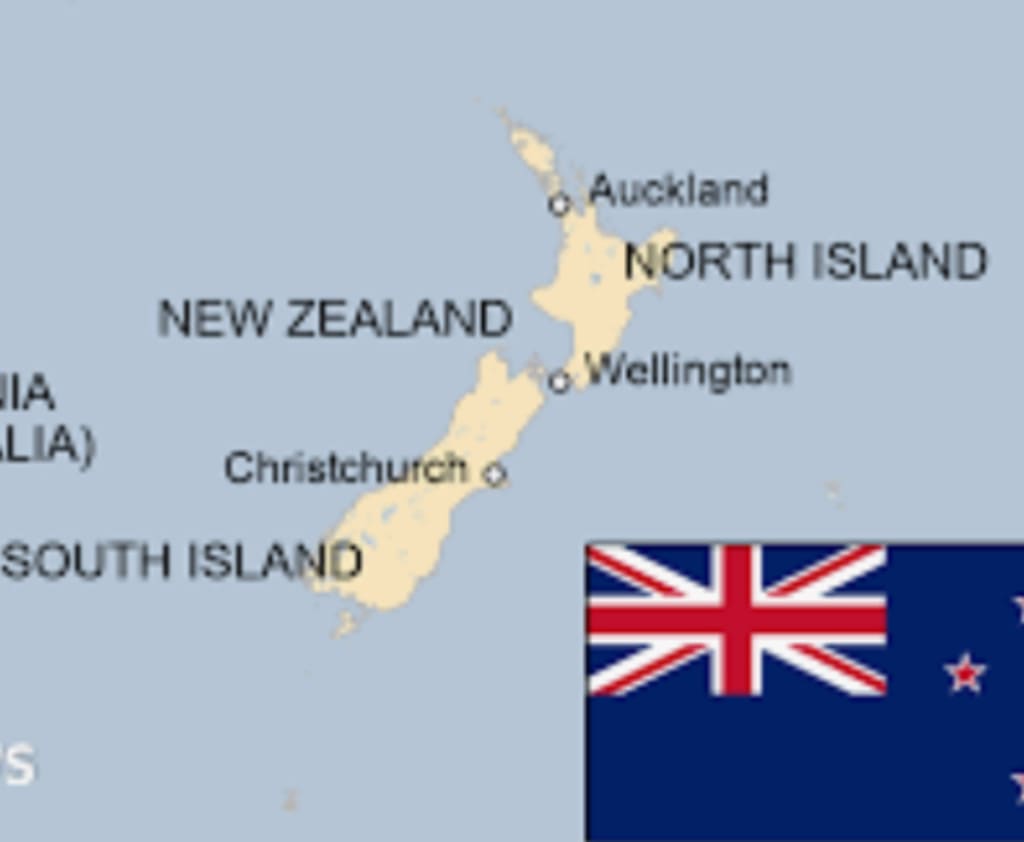
New Zealand’s two major islands, floating in the waters of the South Pacific, have different names depending on who you ask. To the Pākehā, the southernmost island, with its elongated shape resembling a leaf or a waka (canoe), is simply the South Island; the northern island, the North Island.
However, to the Māori the South Island is Te Waipounamu, meaning ‘the waters of Greenstone’, after pounamu, the hard greenstone found mostly on the island. And the North Island, with it.
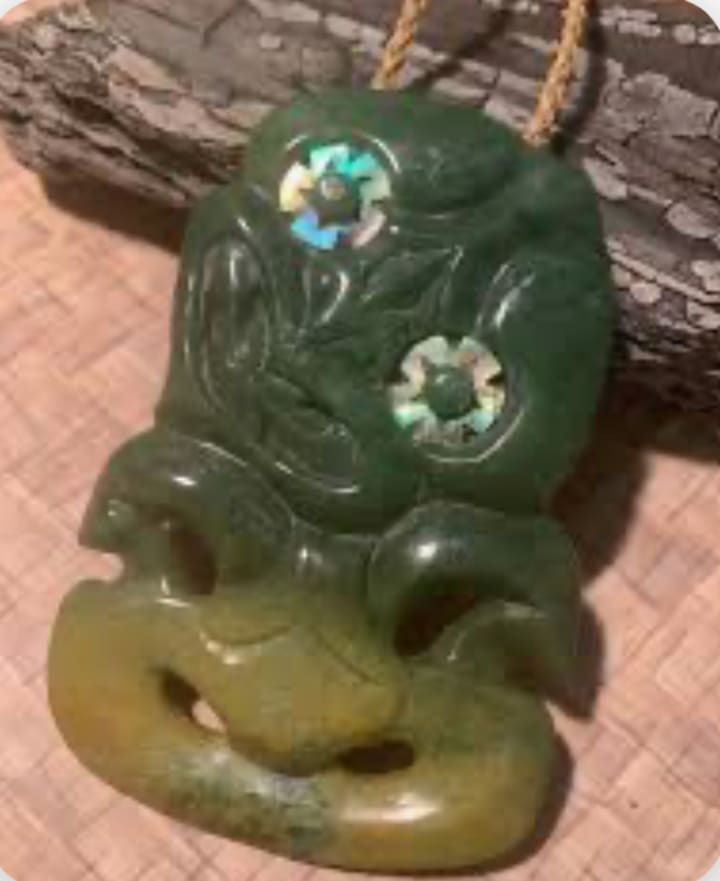
The tiki pendant, made of green NZ jade (pounamu).
Māori culture, New Zealand's tiki, a carved human figure, is a treasured and symbolic object worn around the neck. These pendants, often crafted from pounamu (greenstone), represent a connection to ancestors and are passed down through generations. They are considered taonga, or treasures, and hold spiritual power or mana.
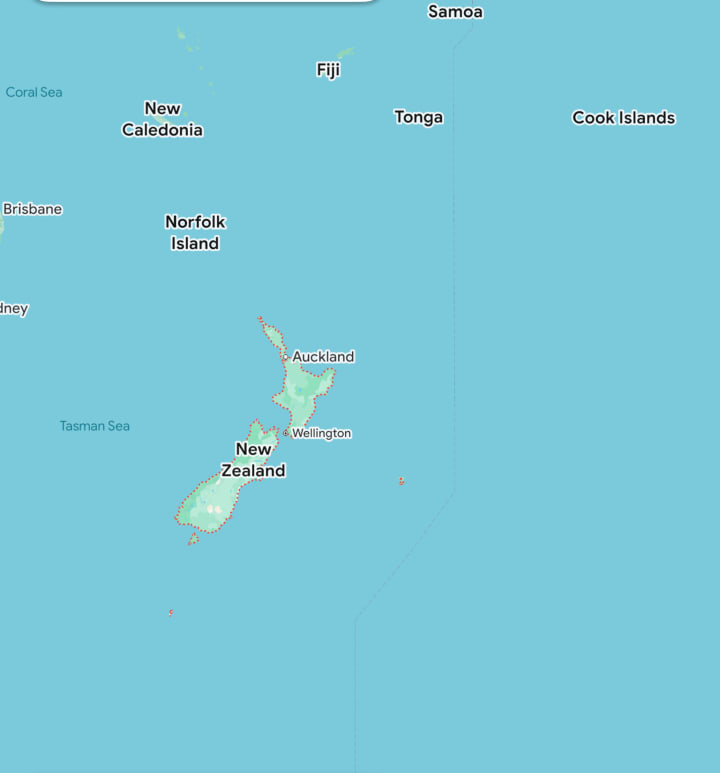
(Māori: Aotearoa) is an island country in the southwestern Pacific Ocean. It consists of two main landmasses—the North Island (Te Ika-a-Māui) and the South Island (Te Waipounamu)—and over 600 smaller islands. It is the sixth-largest island country by area and lies east of Australia across the Tasman Sea and south of the islands of New Caledonia, Fiji, and Tonga. The country's varied topography and sharp mountain peaks, including the Southern Alps, owe much to tectonic uplift and volcanic eruptions. New Zealand's capital city is Wellington, and its most populous city is Auckland.
The islands of New Zealand were the last large habitable land to be settled by humans. Between about 1280 and 1350, Polynesians began to settle in the islands and subsequently developed a distinctive Māori culture. In 1642, the Dutch explorer Abel Tasman became the first European to sight and record New Zealand. In 1769 the British explorer Captain James Cook became the first European to set foot on and map New Zealand. In 1840, representatives of the United Kingdom and Māori chiefs signed the Treaty of Waitangi which paved the way for Britain's declaration of sovereignty later that year and the establishment of the Crown Colony of New Zealand in 1841. Subsequently, a series of conflicts between the colonial government and Māori tribes resulted in the alienation and confiscation of large amounts of Māori land. New Zealand became a dominion in 1907; it gained full statutory independence in 1947, retaining the monarch as head of state. Today, the majority of New Zealand's population of 5.25 million is of European descent; the indigenous Māori are the largest minority, followed by Asians and Pacific Islanders.. Reflecting this, New Zealand's culture is mainly derived from Māori and early British settlers, with recent broadening of culture arising from increased immigration to the country. The official languages are English, Māori, and New Zealand Sign Language, with the local dialect of English being dominant.
New Zealand was the first to introduce a minimum wage, and the first to give women the right to vote. It ranks very highly in international measures of quality of life, human rights, and it has one of the lowest levels of perceived corruption in the world. It retains visible levels of inequality, having structural disparities between its Māori and European populations. New Zealand underwent major economic changes during the 1980s, which transformed it from a protectionist to a liberalised free-trade economy. The service sector dominates the national economy, followed by the industrial sector, and agriculture; international tourism is also a significant source of revenue. New Zealand and Australia have a strong relationship and are considered to have a shared Trans-Tasman identity between the two countries, stemming from centuries of British colonisation. The country is part of multiple international organizations and forums.
Nationally, legislative authority is vested in an elected, unicameral Parliament, while executive political power is exercised by the Government, led by the prime minister, Charles III is the country's king and is represented by the governor-general, In addition, New Zealand is organised into 11 regional councils and 67 territorial authorities for local government purposes. The Realm of New Zealand also includes Tokelau (a dependent territory); the Cook Islands and Niue (self-governing states in free association with New Zealand); and the Ross Dependency, which is New Zealand's territorial claim in Antarctica.
The first European visitor to New Zealand, Dutch explorer Abel Tasman, named the islands Staten Land, believing they were part of the Staten Landt that Jacob Le Maire had sighted off the southern end of South America. Hendrik Brouwer proved that the South American land was a small island in 1643, and Dutch cartographers subsequently renamed Tasman's discovery Nova Zeelandia from Latin, after the Dutch province of Zeeland.This name was later anglicised to New Zealand.
. In 1834 a document was written as Nu Tireni in the Māori language (spelled Nu Tirani in Te Tiriti o Waitangi). In 1834 a document written in Māori and entitled "He Wakaputanga o te Rangatiratanga o Nu Tireni" was translated into English and became the Declaration of the Independence of New Zealand. It was prepared by Te W(h)akaminenga o Nga Rangatiratanga o Nga Hapu o Nu Tireni, the United Tribes of New Zealand, and a copy was sent to King William IV who had already acknowledged the flag of the United Tribes of New Zealand, and who recognised the declaration in a letter from Lord Glenelg.
Aotearoa often translated as 'land of the long white cloud') is the current Māori name for New Zealand. It is unknown whether Māori had a name for the whole country before the arrival of Europeans; Aotearoa originally referred to just the North Island. Māori had several traditional names for the two main islands, including Te Ika-a-Māui ('the fish of Māui') for the North Island and Te Waipounamu ('the waters of greenstone') or Te Waka o Aoraki ('the canoe of Aoraki') for the South Island. Early European maps labelled the islands North (North Island), Middle (South Island), and South (Stewart Island / Rakiura). In 1830, mapmakers began to use "North" and "South" on their maps to distinguish the two largest islands, and by 1907, this was the accepted norm. The New Zealand Geographic Board discovered in 2009 that the names of the North Island and South Island had never been formalised, and names and alternative names were formalised in 2013. This set the names as North Island or Te Ika-a-Māui, and South Island or Te Waipounamu. For each island, either its English or Māori name can be used, or both can be used together. Similarly the Māori and English names for the whole country are sometimes used together (Aotearoa New Zealand); however, this has no official recognition.
So now if anyone asks you about New Zealand, you will be able to blow their minds with your answer.What you won’t be able to tell them is what it is like to live there, unless you have lived there. I lived there in 1965 through 1968, on the North Island, first in Wellington, and then moved 30 kilometers north in a small town called Levin. I started elementary school in New Zealand. It iwas then and is now a lovely place to live.
About the Creator
Guy lynn
born and raised in Southern Rhodesia, a British colony in Southern CentralAfrica.I lived in South Africa during the 1970’s, on the south coast,Natal .Emigrated to the U.S.A. In 1980, specifically The San Francisco Bay Area, California.




Comments
There are no comments for this story
Be the first to respond and start the conversation.