
Jerome Foster II: A Climate President in the Making
Inside the systemic shifts needed to meet the climate era — and the emerging leaders preparing for it.
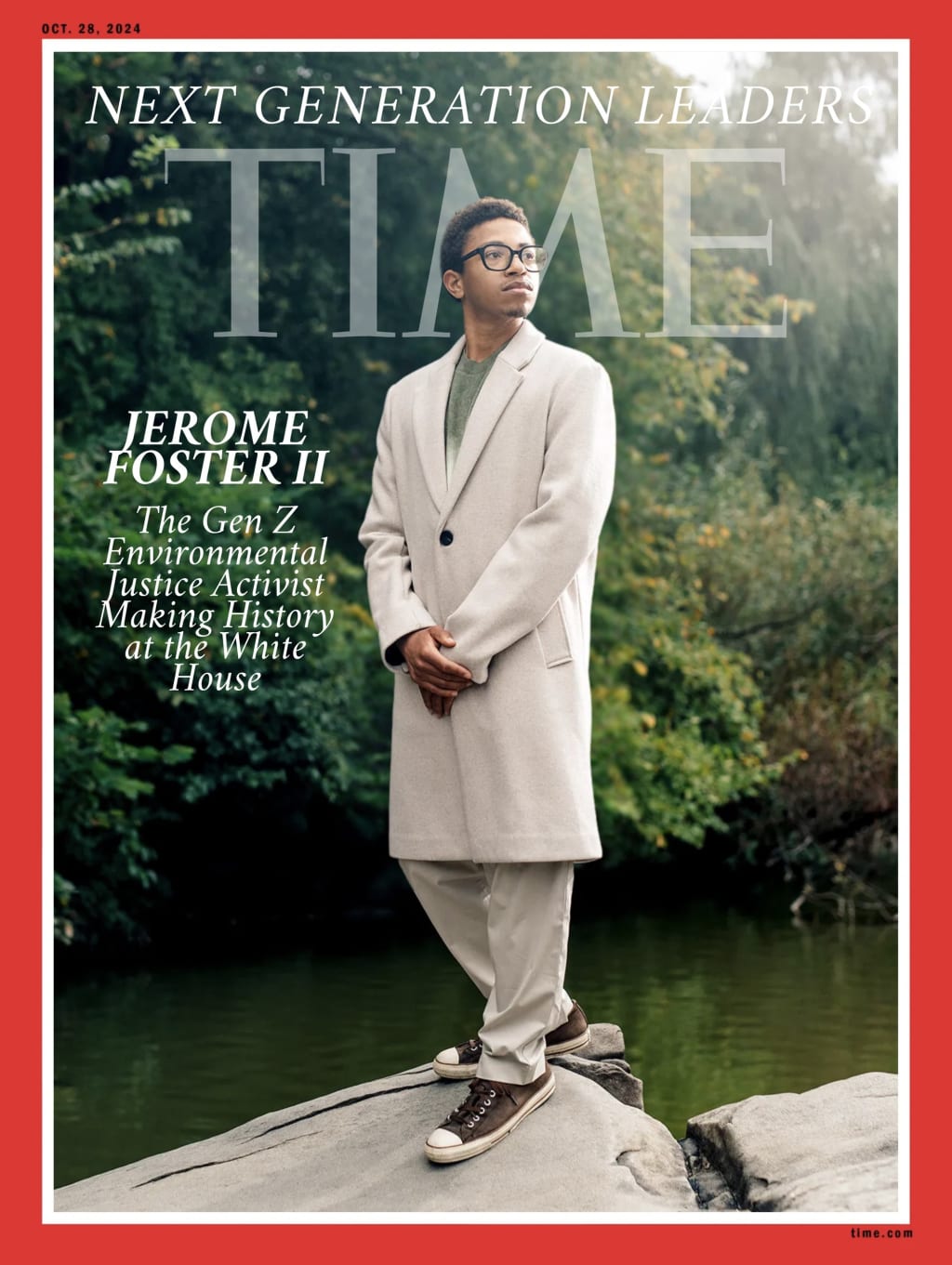
At just 23 years old, Jerome Foster II has already advised the White House, co-founded a national youth voting initiative, and shaped conversations around environmental justice at the federal level. He is not running for public office. But his trajectory — steeped in policy, protest, and civic engagement — raises a timely question: What would it look like for the United States to finally elect a president who puts climate at the center of national governance?
Historically, the climate crisis has not been treated as a unifying national priority in American politics. Presidential action has been intermittent and often constrained by partisanship, economic interest, or legal barriers. The Obama administration’s Clean Power Plan was never fully implemented. The Trump administration withdrew from the Paris Agreement. And while President Biden’s Inflation Reduction Act represents the most significant climate legislation to date, its scope is still largely framed around investment incentives rather than system-wide structural transformation.(Clean Power Plan - EPA, Paris Agreement Withdrawal - BBC, Inflation Reduction Act Summary - White House)
At the same time, the climate emergency is no longer hypothetical. According to the Intergovernmental Panel on Climate Change, global average temperatures are likely to surpass 1.5 degrees Celsius above pre-industrial levels between 2030 and 2035. (IPCC AR6 Synthesis Report)
Exceeding that threshold risks triggering irreversible climate feedback loops — melting ice sheets, sea-level rise, agricultural collapse, and mass migration. The U.S. is already experiencing record-breaking disasters: in 2023 alone, the country suffered 28 climate and weather events that each caused more than $1 billion in damage. The cost of inaction is rising (NOAA 2023 Billion-Dollar Disasters)
By the year 2036, when Foster turns 35 and becomes eligible to run for president, the stakes will be even higher. Under current trajectories, global warming could exceed 2 degrees Celsius. The United States would need to cut emissions by at least 70 percent from 2005 levels to remain within the Paris Agreement’s targets. (Climate Action Tracker: USA)
According to the World Bank, more than 200 million people worldwide may be displaced due to climate-related disruption by 2050. (World Bank Groundswell II Report)
Foster is not new to this conversation. He began climate striking outside the White House as a teenager and, by 18, became the youngest-ever appointee to the White House Environmental Justice Advisory Council (White House EJAC Announcement)
There, he helped draft recommendations for federal agencies to embed environmental justice into national disaster preparedness, infrastructure funding, and climate resilience programs. His proposals have included integrating environmental equity into FEMA's disaster definition, prioritizing formerly redlined neighborhoods for urban forestry investment, and recognizing extreme heat as a public health emergency (EJAC Recommendations Report)
Unlike many in Washington, Foster does not treat climate change as a siloed issue. Instead, he frames it as the operating context for everything else — jobs, health, migration, housing, education. He often speaks about climate not as a crisis of emissions, but as a crisis of systems: energy systems, legal systems, economic systems that were not designed with long-term planetary health in mind.
His framing draws from a growing body of scholarship calling for climate-centered leadership. Think tanks like the Roosevelt Institute and Data for Progress have outlined what a “climate president” might look like: a leader who mobilizes federal agencies toward decarbonization, treats climate change as a national emergency, and reorients governance around ecological stability. (Roosevelt Institute: The Climate Mandate)
While no U.S. president has operated this way, the framework is increasingly seen as necessary, particularly as traditional regulatory approaches fail to produce timely emissions reductions.
Foster’s early policy engagement mirrors many of these principles, even without holding elected office. He has also helped build civic infrastructure outside of government. As a co-founder of OneMillionOfUs, he led a national youth turnout campaign ahead of the 2020 U.S. election, focused on climate, gun violence, and racial equity. He also launched The Climate Reporter, a youth-led media platform amplifying climate stories from underrepresented communities. These projects illustrate a different style of leadership — decentralized, collaborative, and designed for long-term cultural shift.
Foster's work is not without precedent. In some ways, it mirrors the civic arc of Congressman John Lewis, who championed civil rights not only through legislation but through moral clarity and public pressure. Foster interned for Lewis at 16, and has often cited him as an influence.
Where Lewis saw voting as foundational to democracy, Foster sees the climate crisis as foundational to public survival. Both have treated injustice not as a passing political problem, but as a structural condition requiring deep, sustained transformation.
That model of leadership is already visible in his work at American Forests, the oldest national environmental organization in the U.S. As an Ambassador, Foster is helping the institution align its century-old conservation mission with the demands of 21st-century climate equity. His presence has sharpened the organization’s public messaging, connected it to younger audiences — rightfully so — and elevated urban forestry and heat resilience as core justice issues on the national stage, something not meaningfully done in quite some time.
In a sector often shaped by tradition, funding inertia, and public relations cycles, Foster’s approach marks a critical intervention. Corporate funders are increasingly drawn to youth-led initiatives — not just for optics, but because they reflect the urgency, clarity, and systems thinking that many legacy institutions struggle to embody. In this context, American Forests deserves praise for not only creating space for Foster’s leadership but for evolving alongside him, signaling a willingness to be a leader of today's climate and conservation efforts, not simply a steward of yesterday.
That dual fluency, between institutional access and movement urgency underscores why, during Harvard’s 2024 Radcliffe Day, where Foster shared the stage with a U.S. Supreme Court Justice, one of Harvard’s own deans was heard saying: “Jerome for president — he has my vote.” For some, it’s a sentiment rooted not in hope, but in observation. Foster is already seen by many not only as a generational voice, but as a climate president in the making.
Whether Jerome Foster II ever campaigns for public office remains to be seen. But what’s increasingly evident is that the kind of leadership he embodies — informed by science, accountable to communities, and oriented toward long-term planetary well-being — is not just desirable, but increasingly essential.
As temperatures rise, disasters intensify, and adaptation becomes a central challenge of public governance, the demand for new models of leadership will grow. Foster’s career so far suggests one such model. And if the United States is to meet the climate moment, it may not be enough to have a president who addresses climate. It may require one who centers it — fully, structurally, and without delay.
About the Creator
Alex Young
I'm Alex Young, a London-based journalist and photographer telling stories at the intersection of youth, protest, and culture — mostly on 35mm. I document what moves people, and what they move toward.
Keep reading
More stories from Alex Young and writers in Earth and other communities.
Elijah McKenzie-Jackson
It’s not every day you meet someone who sketches climate grief on a napkin and turns it into a Times Square billboard. But Elijah McKenzie-Jackson isn’t here to do things the usual way. The 21-year-old British artist and activist — or “artivist,” as he calls it — is part of a growing wave of Gen Z changemakers who don’t just want to save the world. They want to remake it.
By Alex Young 6 months ago in Art
Inside Trump's $11 Billion Health Plan to Replace “Neo-Colonial” USAID
In the landscape of global health aid, few proposals have stirred as much debate as former President Donald Trump’s ambitious plan to restructure American assistance abroad. Dubbed an $11 billion health initiative aimed at replacing USAID’s current framework, the plan seeks to pivot away from what Trump and his allies have criticized as the “neo-colonial” approach of U.S. foreign aid. While the plan promises greater efficiency and impact, experts are split on whether it is a practical solution or a politically driven gamble. Trump’s Critique of USAID The United States Agency for International Development (USAID) has long been a central pillar of American foreign assistance, distributing billions in aid annually to address health crises, food insecurity, and development challenges worldwide. However, Trump’s administration and its supporters have often described USAID’s approach as bureaucratic, inefficient, and reflective of a “neo-colonial” mindset. In public statements, Trump argued that the U.S. was spending taxpayer dollars on programs that benefited foreign governments or contractors more than the intended local communities. Critics of the plan say that while USAID has flaws—as any large bureaucracy does—its extensive networks and decades of experience provide an unmatched capacity to deliver aid efficiently and safely. The Core of the $11 Billion Proposal At the heart of Trump’s proposal is an $11 billion fund designed to consolidate, modernize, and streamline U.S. health aid. Unlike the traditional USAID model, which relies heavily on long-term partnerships with governments and NGOs, the new plan emphasizes: Direct Impact Funding: Allocating resources to frontline health workers and local initiatives rather than intermediaries. Data-Driven Investments: Using real-time health data to target outbreaks and crises more efficiently. Private Sector Partnerships: Leveraging U.S. pharmaceutical companies, tech firms, and healthcare startups to deliver vaccines, treatments, and medical infrastructure. Shorter Program Cycles: Moving away from multi-year funding commitments in favor of more flexible, results-oriented programs. Proponents argue that this approach could reduce bureaucratic overhead and ensure U.S. aid reaches communities faster. By “cutting out the middlemen,” Trump supporters claim, America can avoid the pitfalls of slow-moving aid programs that sometimes fail to adapt to crises. Reactions from the Global Health Community Global health experts, however, have expressed concern about both the logistics and philosophy of the plan. Dr. Melissa Ortega, a senior researcher at the Global Health Policy Institute, explained, “The idea of bypassing established structures like USAID may sound appealing on paper, but in practice, it risks undermining decades of institutional knowledge. Health systems are complex, and short-term projects cannot replace long-term capacity building.” Some critics have also questioned the characterization of USAID as “neo-colonial.” While U.S. foreign aid has historically been tied to geopolitical interests, many programs today are designed collaboratively with recipient countries and local organizations. Reducing oversight could unintentionally increase the risk of misuse, corruption, or health inequities. On the other hand, supporters of Trump’s plan point to examples of inefficiency in USAID programs, citing cases where aid was delayed or mismanaged. By introducing more direct funding models, they argue, U.S. taxpayer dollars could achieve a higher “return on health outcomes.” Political Implications Trump’s health aid overhaul proposal is not just about international development—it is also deeply political. Framing USAID as a “neo-colonial” institution resonates with a populist narrative that America should prioritize its own citizens and assert greater control over how taxpayer money is spent abroad. Domestically, the $11 billion plan faces scrutiny from Congress. Lawmakers from both parties have questioned whether dismantling USAID’s systems could destabilize ongoing health programs in countries where the U.S. has long-term commitments. The potential impact on global health security—including the fight against pandemics like COVID-19—adds another layer of concern. Internationally, U.S. allies and partner nations are watching closely. Sudden shifts in aid delivery could disrupt health programs in low- and middle-income countries, many of which rely on predictable funding cycles to maintain vaccination campaigns, maternal health services, and disease surveillance. Possible Benefits and Risks If executed carefully, the Trump-backed model could bring several benefits: Faster Response Times: Direct funding could accelerate delivery of vaccines, treatments, and emergency support. Innovation Boost: By partnering with private sector companies, the plan could accelerate development of new health technologies. Accountability: With performance-based metrics, the plan may better measure the impact of U.S. aid. However, the risks are equally significant: Disruption of Existing Programs: Abrupt changes could destabilize ongoing health projects. Loss of Expertise: USAID’s decades of experience in navigating local governance, supply chains, and community engagement may be hard to replace. Geopolitical Fallout: Allies accustomed to collaborating with USAID might see the move as destabilizing, reducing cooperation on global health initiatives. Looking Ahead As Trump and his allies continue to advocate for this $11 billion overhaul, the debate over the future of U.S. health aid is intensifying. Proponents view it as a necessary modernization of an outdated system, while critics fear it could undercut decades of carefully built infrastructure and global partnerships. Ultimately, the success of this plan will hinge on its ability to balance efficiency with stability, innovation with oversight, and political objectives with humanitarian needs. For now, the proposal remains controversial, representing a dramatic departure from traditional approaches to U.S. foreign aid. Whether it will reshape global health for the better—or simply create more uncertainty—remains to be seen. In the end, the Trump health plan is as much about ideology as it is about dollars. It challenges the conventional wisdom of international development and asks whether a more streamlined, results-focused approach can truly replace a system built over decades. As the world watches, the stakes could not be higher: the future of U.S. global health aid—and the lives it touches—hangs in the balance.
By Muhammad Hassan5 days ago in Earth
Nitrogen is necessary for young tropical rain forests to combat climate change.
By absorbing carbon dioxide from the atmosphere and storing it in wood, tropical rainforests contribute to the slowing of climate change. Forests that develop quickly are even more important because they absorb carbon more quickly.
By Francis Dami4 days ago in Earth
Wild Card Weekend Recap: What Happens Now?
I think I figured out why I love Wild Card Weekend so much. It's because it's the first playoff anything of the calendar year. The NFL season starts in the fall, and once upon a time, the champion was crowned either on or slightly before New Year's. The evolution of the NFL schedule has resulted in the playoffs starting just into the New Year, and currently, the final week of the season falls on the first weekend of the New Year, with Wild Card Weekend coming a week after that. So yes, chronologically, the NFL's Wild Card Weekend serves as the first playoff anything of the calendar year.
By Clyde E. Dawkins7 days ago in Unbalanced



Comments
There are no comments for this story
Be the first to respond and start the conversation.