
Is the moon the earth's twin?!
From Celestial Birth to Footprints: Exploring the Mysteries and Marvels of the Moon

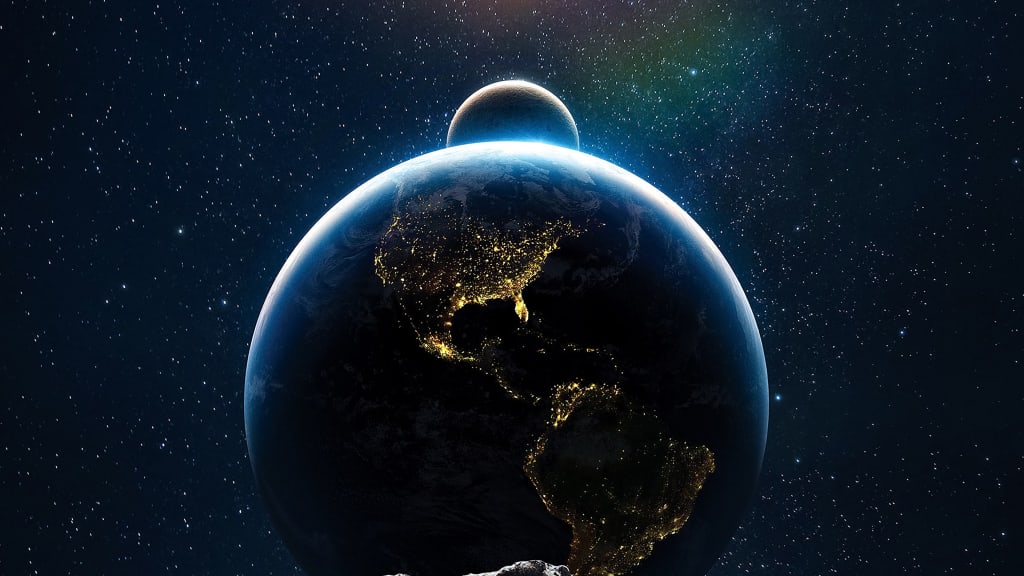
In the quietude of a moonlit night, the clock nearing 2 a.m., you step into the darkness. A celestial glow permeates the sky, courtesy of a luminous full moon. This captivating scene invites contemplation not only of its immediate beauty but also of the celestial enigma that is Earth's natural satellite.
The moon, a silent witness to the chronicles of our planet, harbors an origin story veiled in cosmic ambiguity. Among the prevailing hypotheses, the giant impact theory casts a cinematic narrative—a cosmic collision between Earth and a Mars-sized celestial entity roughly 4.5 billion years ago. This celestial clash, as the theory goes, birthed the moon, an eternal companion in our cosmic journey. However, lingering questions persist, challenging the theory's certainty, especially concerning the shared isotopic and chemical fingerprint between Earth and its moon.
A contrasting notion, the capture theory, weaves a tale of the moon's origin as an itinerant wanderer ensnared by Earth's gravitational embrace. The nuances of this theory, like a cosmic dance, raise questions about the moon's extraterrestrial origins despite its shared chemical heritage with Earth. As the cosmic puzzle unravels, other theories propose scenarios where Earth, in its turbulent infancy, spun with such vigor that it expelled material into its orbit, birthing the moon. Yet, subtle disparities in mineral composition introduce complexity into this narrative.
A simpler perspective posits the moon's synchronous emergence with Earth during the formative epochs of our planet. Amidst the speculative discourse, the moon's role as Earth's celestial companion remains an immutable reality.
Venturing into the moon's past, an era 3 to 4 billion years ago unfolds—a time when lunar volcanic eruptions sculpted a robust atmosphere. Picture colossal plumes of magma ascending into the lunar expanse, shaping basins filled with volcanic basalt. This vibrant lunar atmosphere, a relic of primordial volatility, endured for approximately 70 million years before yielding to the cosmic vacuum.
In the contemporary lunar landscape, the atmosphere has waned to near nonexistence, leaving the moon vulnerable to meteorite bombardment. Countless craters dot its surface, a testament to celestial collisions echoing through the lunar ages. Despite the harsh realities of its surface, the moon, when viewed from Earth, emanates a radiant glow, its reflective luminosity only slightly surpassing that of asphalt.
The indelible mark of human exploration graces the lunar landscape. The Apollo 11 mission, etching its place in history in 1969, saw astronauts like Neil Armstrong leaving footprints and cultural artifacts on the moon. Golf balls, artwork by Andy Warhol, and messages from Queen Elizabeth II stand as testament to human ingenuity and exploration.
While the moon, in our night sky, appears unchanging, it engages in a gradual orbital waltz, distancing itself from Earth at an inch-and-a-half per year. This cosmic ballet, governed by tidal forces, symbolizes the intricate gravitational interplay between Earth and its moon.
Once envisioned as a potential twin planet, the moon's past saw it adorned with an atmosphere, rendering it a mesmerizing celestial neighbor, three to ten times closer than its present orbit. Over time, however, the lunar atmosphere dissipated, leaving a barren yet intriguing landscape marked by craters and ancient basins.
As our understanding of the moon deepens, mysteries persist. Transient lunar phenomena, those enigmatic flashes of light, continue to captivate astronomers worldwide. These celestial riddles add layers to the lunar narrative, beckoning us to unravel the moon's secrets.
In the cosmic tapestry, the moon stands as a poetic witness to the eons, a celestial entity that transcends time. As we gaze at its luminous visage, let us marvel not only at its immediate beauty but at the cosmic symphony that continues to unfold—a testament to the enduring allure of Earth's steadfast companion.
About the Creator
Nano Notes Network
Welcome to Nano Notes Network. We cover some of the most interesting subjects in the world! From History & Facts to Paranormal & Mysteries.
Keep reading
More stories from Nano Notes Network and writers in Earth and other communities.
Man Shot Dead Was 37-Year-Old US Citizen, Minneapolis Police Chief Says
For many residents of Minneapolis, the news landed like a heavy blow. Authorities confirmed that a man shot dead during a law enforcement operation was a 37-year-old U.S. citizen, a detail that immediately intensified public reaction. What began as a breaking news alert quickly became a broader conversation about policing, federal authority, and community trust.
By Muhammad Hassana day ago in Earth
The Sad Nightingale
The Sad Nightingale Writing No. 2402 Saturday, November 26, 2022 By Iman Javed The sun had just set, leaving a soft orange glow lingering on the horizon. The air was calm, carrying a faint chill of the approaching night. Away from the village, frogs croaked in the drying pond, their sounds echoing across the still waters. Crickets intermittently played their tunes, pausing now and then as if checking their tiny instruments for the night ahead. On a branch of a nearby withered tree sat a nightingale, utterly sad. It neither moved nor chirped; it seemed as though it had forgotten the very art of singing. Its eyes reflected deep sorrow, and its feathers drooped in silence.
By Sudais Zakwan2 days ago in Earth




Comments
There are no comments for this story
Be the first to respond and start the conversation.