
Is the contest between the Siberian tiger and the North American brown bear evenly matched or unilaterally crushed?
The battle between the Siberian tiger and the North American brown bear

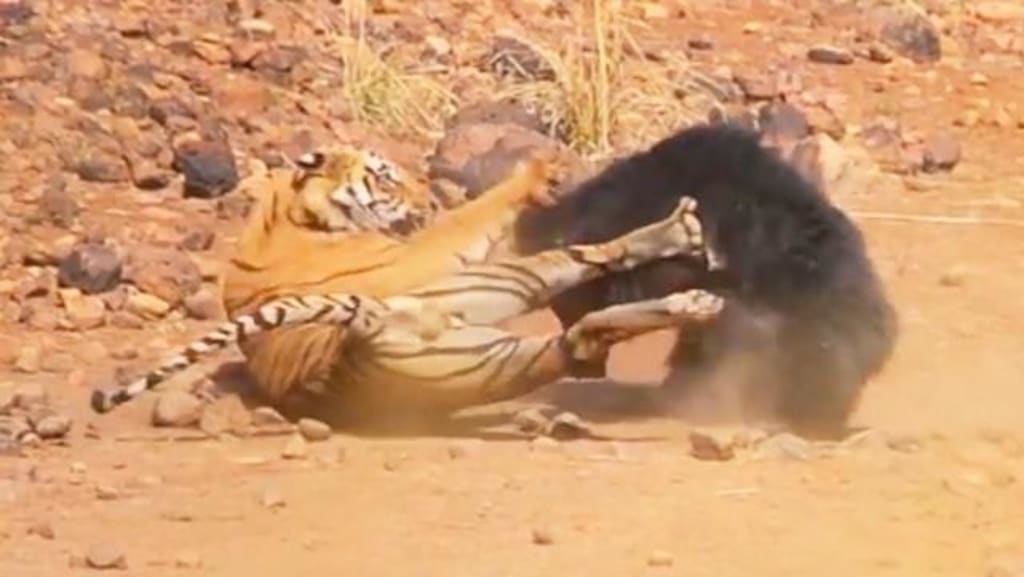
The Siberian tiger is the top hunter in the cat family, and the brown bear is the heavyweight player in the bear family. If the two of them go head-to-head, who is more powerful?
There have been two misconceptions about the fight between tigers and bears:
The first is that many people think that Siberian tigers will often take the initiative to kill brown bears and Asiatic black bears, and they judge that brown bears have little chance of winning in front of Siberian tigers.
This view is actually somewhat one-sided.
It is true that Siberian tigers have hunted brown bears, but we all know that tigers hunt by ambush, jumping up suddenly when the prey is not paying attention, so bears are often killed by sneak attacks rather than confrontation.
And a large part of the brown bears hunted by the Siberian tigers are actually weak females or young individuals, rather than more violent males.
In addition, there is a rare situation where brown bears hibernate when there is a food shortage, which gives Siberian tigers the opportunity to easily hunt them.
Siberian tigers will kill brown bears, but at the same time, there are also cases of brown bears killing Siberian tigers in the world. Therefore, it cannot be simply assumed that bears will be completely defeated by Siberian tigers.
The second misunderstanding is about sloth bears and tigers. There was a video circulating on the Internet: a tiger tried to attack a little sloth bear, but was beaten by the sloth bear's mother.
Because of this, many people think that tigers can't even beat the skinny sloth bears in the bear family, so how can they dare to compete with more powerful brown bears?
What I want to say is that the tiger in the video is not a Siberian tiger, but a Bengal tiger, and it is a Bengal tiger that has not yet fully matured. If it is replaced by an adult Siberian tiger, the result may be completely different.
Let us put aside these two misunderstandings, and analyze who has a better chance of winning in a heads-up match between the brown bear and the Siberian tiger.
Let's talk about Siberian tigers
Amur tigers mainly live in the mountainous areas of southeastern Russia, North Korea and northeastern my country. They are the largest cats in existence. Their main prey are wild boars and deer.
A wild male Siberian tiger is nearly 3 meters long and weighs about 260 kilograms, but this is not their largest figure because the size and weight of Amur tigers have decreased in recent years due to human activities.
According to records in the 1980s, male wild Siberian tigers can weigh up to 306 kilograms and have a body length of 3.5 meters, which is quite terrifying.
Siberian tigers have strong limbs and sharp claws, which can provide them with a strong grip. Their claws are about 5 centimeters long, and one claws are enough to tear the flesh of their prey.
In addition to its deadly claws, Amur tigers have the largest skulls of any living tiger, ranging in length from 33 to 38 centimeters.
Under the blessing of the huge skull, the Siberian tiger has a bite force of up to 499 kilograms, and they can easily pierce the 8 cm long canine teeth into the throat of the prey.
Siberian tigers have a speed of about 48 to 64 kilometers per hour, which is faster than brown bears, and their muscles are evenly distributed, and they are also more flexible and agile.
Tigers belong to ambush predators, and ambush is a blitzkrieg in popular terms.
look at the brown bear
Brown bears live in the woodlands and grasslands of western North America, their habitats are close to rivers or other waters, and they like to eat berries, plant roots, and fish and deer.
The average weight of adult male brown bears is about 300 kilograms, and their height when standing on their hind legs can reach 2.4 meters. In terms of body size, they are heavier than Siberian tigers, but shorter than Siberian tigers.
Brown bears have longer and stronger limbs than Siberian tigers, and they have a hump-shaped muscle on their back that is used specifically to assist with arm movements, such as burrowing or striking.
At the end of the sturdy arms are huge claws that are not retractable. The claws of the brown bear are about 7 cm long, which are longer than those of the Siberian tiger, but not as sharp as those of the Siberian tiger.
The skull of the brown bear is about 45 cm long, which is larger than that of the Siberian tiger, but their teeth are designed to be omnivorous, so the canine teeth are only 2 cm long.
The bite force of brown bears is weaker than that of Siberian tigers, about 385 kilograms, but their forelimbs are very strong, and a single palm is enough to kill a red deer as big as themselves.
In addition, brown bears are also very defensive. They are covered in thick fur and strong muscles with a lot of fat, which can weaken many deadly attacks.
In terms of combat experience, brown bears may fight with similar species, or confront medium-sized predators such as wolves and cougars, and have relatively rich combat experience.
The above is the respective data of the Siberian tiger and the brown bear, so if the two are singled out, who will be better? Let's assume the fight is on open, flat ground.
The first case. If it is an ordinary wild male Siberian tiger and an ordinary brown bear heads-up, the brown bear will have a 60% win rate.
Because from the overall point of view, the size and strength of the brown bear are more dominant, its upper body is stronger and the muscles are tighter than that of the Siberian tiger.
Moreover, its endurance is stronger than that of the Siberian tiger. It is difficult for the Siberian tiger to subdue this big guy in a short period of time.
The second case. If the Siberian tiger and the brown bear were about the same weight, the Siberian tiger would have a 70% win rate. Because when the brown bear loses its weight and size advantages, it is not much different from the general prey of the Siberian tiger.
The Siberian tiger has higher mobility and sharper claws. It will knock down the brown bear like a wild boar and tear the bear's skin with its sharp canine teeth.
In conclusion, the contest between predators, size and weight play a big role, and when size and weight are not considered, combat experience and fighting skills become the key to winning.
About the Creator
sondra mallen
Share a little bit of science every day
Keep reading
More stories from sondra mallen and writers in Earth and other communities.
The Mysterious Giant: Exploring the Rare and Remarkable Rafflesia hasseltii
Introduction: Nature’s Enigmatic Marvel In the dense, humid rainforests of Southeast Asia, a botanical wonder exists that captures the imagination of scientists, travelers, and nature enthusiasts alike. Rafflesia hasseltii, one of the most intriguing plants on Earth, defies conventional understanding of flora. Unlike typical plants, it lacks stems, leaves, or even roots and relies entirely on a host plant to survive. Its enormous flowers, pungent odor, and unique parasitic lifestyle make it one of the rarest and most fascinating species in the plant kingdom.
By Ahmed aldeabella4 days ago in Earth
The Devil's Cut
“Comrade, finally you’re awake.” The voice was smooth, sensual. A flickering incandescent bar was all that lit the white, sterile room. All Vladimir remembered was everything going black. He tried to move his arms and found them strapped to the gurney.
By Matthew J. Fromm5 days ago in Fiction



Comments
There are no comments for this story
Be the first to respond and start the conversation.