
How did the 15 Soviet States leave the Soviet Union?
Short exploration essay by LuckyToday Geography.

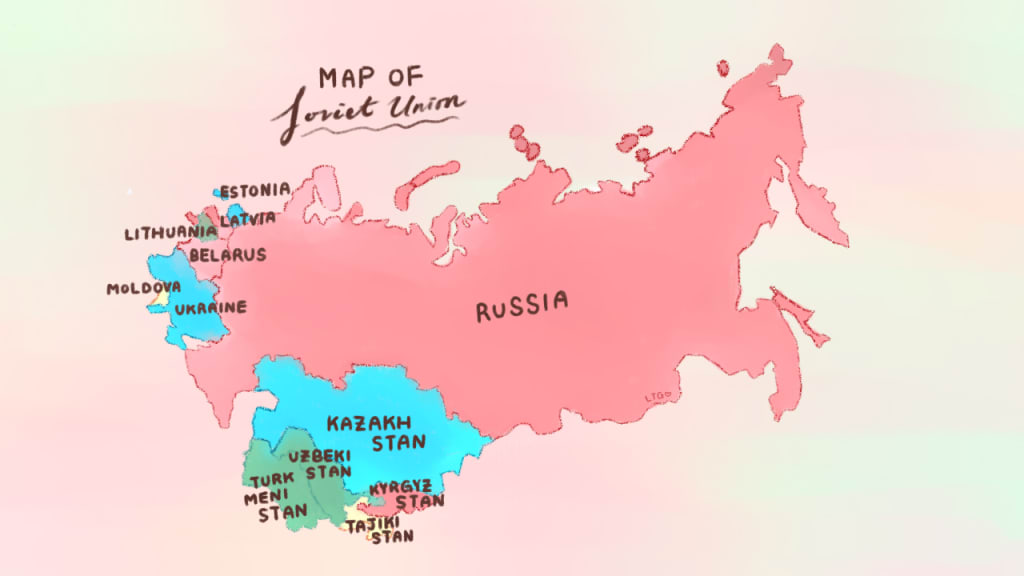
Since the collapse of the Soviet Union in 1991, various countries that used to be part of the Union has gained its independence and has been striving in their respective fields ever since, but have you ever wondered, why and how did the Soviet Union states break away from each other? In this exploration, we will be learning why and how the Soviet states broke away from the Union, in all sorts of ways.
What is the Soviet Union?
The Soviet Union, also known and abbreviated as the USSR, is a northern Eurasian empire which spanned from modern Poland, located in Central Europe, to the far east of Asia of modern day Chukotka, which is now an autonomous Okrug (Russian for district) under Russia. Soviet Union rose to power during the years 1917/22-1991, and was the largest republic at the time of ruling. Although east slavs, which consists of modern day Belorussians, Russians, and Ukrainians, made up 2/3s of the country’s population, the Soviet Union was still considered one of the culturally diverse country (Britannica, 2025).

Map of the Soviet Union (Britannica, 2025).
The 15 Soviet states which broke off as independent countries since the first Soviet independence movement in 1990 in alphabetical order, includes: Armenia, Azerbaijan, Belarus, Estonia, Georgia, Kazakhstan, Kyrgyzstan, Latvia, Lithuania, Moldova, Russia, Tajikistan, Turkmenistan, Ukraine, Uzbekistan. All of the above Soviet States broke away from the Soviet Union and gained its independence throughout 1991, which ultimately led to the end of the Soviet Union.
Fun fact: The ultimate successor of the Soviet Union has been a debatable topic. Most people might agree on the successor being the Russian Federation due to its international recognition of the name, but some might argue on it being Kazakhstan, as it is the last country to break away from the Soviet Union at December 16th, 1991, marking the final straw of the dissolution of the Soviet Union ten days later (Wikipedia, 2025).
The request of independence of Soviet States, collapse and dissolve of the Soviet Union
There were various factors that led to the request of independence of the Soviet States and the collapse of the Soviet Union in 1991, which includes:
Firstly, Milhaud Gorbachev (1931-2022), a general secretary of the Communist Party of the Soviet Union‘s reform ideas, Glasnost (Russian for Openness) and Perestroika (Russian for restructuring) failed to keep the Soviet Union away from criticism and lost the control to democratic movements in the country, which led to Soviet States’ independence requests and the fated ending of the collapse of Soviet Union.
Despite having a huge economy, good shortages were common in the Soviet Union. Additionally, Perestroika, one of Gorbachev’s reforms, led to the acceleration of the issue, causing inflations and indirectly affecting the collapse of the Soviet Union.
At the same time, capitalism ideas kicked in: back in the Soviet Union era, foreign branches in the country were minimal, and the opening of the first Mcdonalds in the Soviet Union on 31st January, 1990, hooked customers towards the mystery ideology of being capitalist. This new ideology ultimately enlightened citizens of the Soviet Union, where they were agreed to learn more about the Western culture, which indirectly affecting the collapse of the Soviet Union due to the lack of ideology unity.
The incident of Chernobyl, where on 26th April, 1986, a nuclear reactor in Ukraine Soviet Socialist Republic explodes, causing radioactive fallout and explosions 400 times more than the Atomic Bombings in Hiroshima in 1945, and evacuation of citizens of Chernobyl from exposures to radioactive material. The Communist party tries suppressing further informatjon on the incident, including the continuation of the May Day celebration parades, even through acknowledging that the citizens will step into a radioactive zone. It was until 18 days after the incident, an official statement regarding to the explosion, calling the incident a misfortune. The incident created a rapid decline towards the support of the party, which indirectly led to the downfall and collapsed of the Soviet Union.
The failed August coup also played a role. 18th August, 1991, Soviet hardliners and groups attempted to overthrow Gorbachev as to save the failing nation. Gorbachev was detained in Crimea, but refused to resign as the Secretary General. Gorbachev was released at the end due to failure of security control, but the failed coup exposed the weaknesses of the givernment lead by Gorbachev, which reduced the amount of support and indirectly leading to the end of the Soviet Union.
…
The exit of the 15 Soviet States
The following explains how the 15 Soviet States gained its independence, from all sorts of movements:
The Baltics: The Singing Revolution (1987-1991)
Could you believe that, countries gained its independence by singing? Well, the Baltics did just that.
The Baltic countries, which consists of Estonia, Lithuania, and Latvia, are three countries located in northeast Europe, next to the Baltic Sea. They were the last to join the Soviet Union as Soviet States, but the first to exit.
As the name suggests, the Singing Revolution was a non-violent protest, rather led by the Estonia, then followed up by the Lithuania and Latvia, in order to exit the violent, forced occupation of the Soviet Union.
Singing was a big part of Estonian culture, where in 1947, a freedom song named “Mu isamaa on minu arm” (Estonian, meaning “Land of My Fathers, Land That I Love”), written by Lydia Koidula, an Estonian poet, surprisingly wasn’t caught by the censors of the Soviets, hence provoked the idea of freedom amongst Estonian communities.
The song wasn’t allowed in the 1950s, but by the 1960s, more and more Estonians joined in singing them during music festival programmes in Estonia. 1969, the audience and the choir on stage started singing “Mu isamaa on minu arm”, where the Soviets quickly got a band to play for the event in order to stop the rebellious singers, but failed due to the huge amounts of rebellions.
Supressions of independence movements of Estonia escalated, the Estonia flag was banned, but the people cleverly flew separate banners of blue, black, and white, which shows the ’flag’ of Estonia.
More independence songs came out during the 1980s, where the people chanted repeatedly in public. The Soviets wanted to ban the independence songs, but was met with Glasnost, which left them unsure what to do. The Baltics started declaring its sovereignty of their laws during 1988-89.
23rd August, 1989, the Baltic Way occurred, where a human chain consisting of around 2 million Estonians, Lithuanians, and Latvians, held hands and joined singing traditional songs on freedom, chanting for the desire of independence. People continued and finally pushed to Moscow with their singing, staying non-violent at all times.
11th March 1990, Lithuania declared as fully independent. This move led to economic sanctions in Moscow, which led to high tensions in the Soviet Union and violent events happening throughout 1991.
After the failed August coup in August 1991, Estonia and Latvia followed the footsteps of Lithuania, declaring themselves as independent states. Their independence was recognised on 6th September, 1991 (Wikipedia, 2025).
The exit of Ukraine and Belarus
The occurrence of the failed August coup back in 18th August, 1991 shown the weakness of Gorbachev, which in contrast, Boris Yeltsin, the president of the Russian Soviet Federative Socialist Republic was gaining support rapidly from its opposition towards the coup. This lead to the call for independence of Ukraine and Belarus, which was declared on 24th August and 1st December respectively. The Commonwealth of Independent States, also known as CIS, was created to replace the Soviet Union, where Ukraine and Belarus both recognised each other’s independence with this creation.
Moldova
Again, Moldova declared its independence on the 27th August after the failed coup in August 1991. But the interesting part of Moldova’s status was the presence of Transnistria, a narrow strip of ‘Moldovan’ territory which claims to have been broken away from Moldova in 1990. Transnistria is known as ’the last piece of Soviet Union’, where there are still statues and symbols of the Soviet Union found in the land. Although not recognized internationally, Transnistria is supported by Russia in terms of economics, politics, and military.
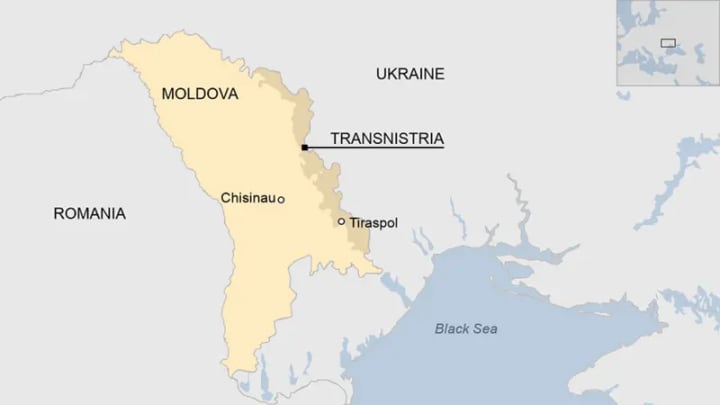
Map of Moldova and Transnistria (BBC, 2024)
Central Asia states and the Caucasus region: following footsteps
During the referendum in March 1991, 95% of Central Asians, which includes Kazakhstan, Kyrgyzstan, Tajikistan, Turkmenistan, and Uzbekistan, voted to preserve the Soviet Union, while Armenia, Azerbaijan, and Georgia did not desire to stay in the Soviet Union.
The aftermath of the August coup sparked independence movements in Central Asia and the Caucasus regions, which adding onto the rise of their individual national identities and unity groups between the states, led to the declaration of independence of Armenia, Azerbaijan, Georgia, Kyrgyzstan, Tajikistan, Turkmenistan, and Uzbekistan in August and September 1991. The countries then joined the CIS. Kazakhstan was the last to declare its independence from the Soviet Union on 16th December, 1991.
———
Reference(s):
Dewdney, J. C. (2025). Soviet Union | History, Leaders, Flag, Map, & Anthem. Britannica. https://www.britannica.com/place/Soviet-Union
Wikipedia contributors. (2023, October 1). Dissolution of the Soviet Union. Wikipedia, The Free Encyclopedia. https://en.m.wikipedia.org/wiki/Dissolution_of_the_Soviet_Union
U.S. Department of State. (2001-2009). Technical difficulties. https://2001-2009.state.gov/r/pa/ho/time/pcw/108229.htm
Ray, M. (2025). Why did the Soviet Union collapse? Britannica. https://www.britannica.com/story/why-did-the-soviet-union-collapse
Siegelbaum, L. (n.d.). Baltic independence. Seventeen Moments in Soviet History. https://soviethistory.msu.edu/1991-2/baltic-independence/
About the Singing Revolution. (n.d.). Singing Revolution. https://singingrevolution.com/about/history/#:~:text=The%20Singing%20Revolution%20is%20the,fifty%20years%20of%20Soviet%20rule.
Office of the Historian. (n.d.). Milestones in the history of U.S. foreign relations: The collapse of the Soviet Union. https://history.state.gov/milestones/1989-1992/collapse-soviet-union#:~:text=The%20Central%20Committee%20was%20dissolved,their%20independence%2C%20sought%20international%20recognition.
Association for Diplomatic Studies & Training. (2014, August). End of an era: The August coup and the final days of the Soviet Union. https://adst.org/2014/08/end-of-an-era-the-august-coup-and-the-final-days-of-the-soviet-union/
Wikipedia contributors. (2023, October 1). Independence of Moldova. Wikipedia, The Free Encyclopedia. https://en.m.wikipedia.org/wiki/Independence_of_Moldova
McDonald, K. (2022, June 30). Moldova: Independence and the Soviet legacy. BBC News. https://www.bbc.com/news/world-europe-18284837
About the Creator
LuckyToday Geography
greetings! this is krystal, director of LuckyToday Geography. ₊˚⊹☆
on here, i write geography blogs from own research.
feel free to join our journey by reading more.
best wishes, krystal of LuckyToday Geography <3
Keep reading
More stories from LuckyToday Geography and writers in Earth and other communities.
Why do UTC+14 even exist?
Have you ever wondered amongst the diversity of regions and countries around Earth, what other people on the other side might be doing? Putting this in a scenario, you could be commuting to work, while people on the other side of the world are already getting off school; how does that work? Why does time work like that, and what are the possible timezones around the world? This brings us to the topic of time zones and UTCs, a fundamental tool for the modern world to operate.
By LuckyToday Geography7 months ago in Earth
Old Red Cedar
Western red cedar, over 1000 years old, you grew for 200 years and towered over others, silently observing sights in the forest that are no more, your secrets buried within your spirit. The bark covering your tree trunk, said to be about 23 feet around, was hollow when men discovered you. Inside the hollow trunk, a fire somehow began; you cannot tell us when, how, or why, and there is no record of it. The fire caused your death. Slowly, you died, from the inside out. Such a sad loss for an old soul of the forest, with centuries of knowledge in its cells. Houses, watercraft, shingles, bowls, bows and arrows, and paper that men used to write what they knew of your history could have been made from your body, branches, and bark. Truly, fire was a better death for you than a logger’s saw.
By Andrea Corwin 6 days ago in Earth

Comments
There are no comments for this story
Be the first to respond and start the conversation.