
Future missions to the planet Venus
Venus exploration


The international scientific community urges a study of the planet's atmosphere and surface in situ and a higher resolution mapping that allows us to better understand the surface and solve several unknowns of the planet's past and present. Models of the planet's formation and evolution suggest a more benign past, with the possible existence of oceans of water on the surface. On the other hand, we do not know if it currently has active volcanism or is a dead planet geologically speaking.
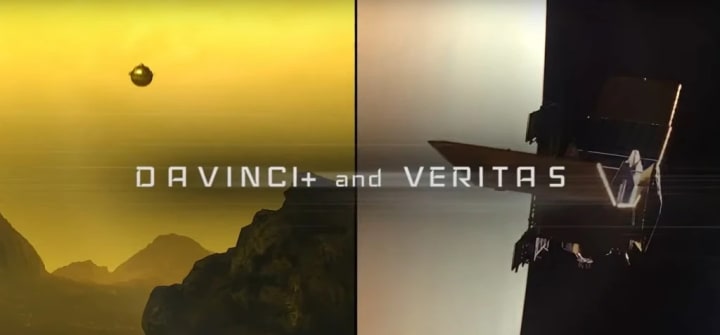
At the beginning of June 2021, NASA selected two missions to study Venus within its Discovery Program with different objectives, which should take off between 2028 and 2030. The VERITAS mission is an orbiter that, among other instruments, will carry a synthetic aperture radar for mapping the planet at a resolution of 30 meters, reaching 15 meters in some areas (the Magellan probe reached a resolution of 75 meters in some regions). On the other hand, the DAVINCI+ mission is a capsule that will study the composition of the planet's atmosphere as it descends to the surface, where it is expected to survive for a few minutes.
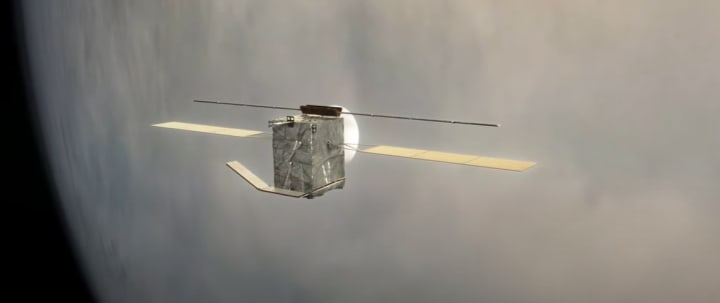
Within days of NASA's announcement to select two new missions to Venus, ESA has approved the EnVision mission to possibly launch in 2032 or 2033. The mission is an orbiter equipped like VERITAS with a synthetic aperture radar capable of reaching a resolution of 10 meters in some parts of the planet, in addition to several spectrometers for the study of the atmosphere and a radio experiment to analyze the interior of the planet.
Russia has plans to return to the planet and pick up the baton and legacy left by the Soviet Union with the Venera-D mission, but budget problems, the economic crisis and the war with Ukraine mean that it is postponed again and again, so it is unlikely that we will see this probe developed. The new players on the international space scene, China and India, have plans to explore the neighboring planet but have not yet been formally approved.
The Indian space agency ISRO has announced that the mission to Venus will be called Shukrayaan 1 and will be an orbiter that will have numerous instrumentation and great international collaboration. The objective will be the study of the surface and subsoil of the planet, the complex atmosphere and its interaction with the environment and solar wind. Unofficial sources point to the launch window of December 2024-January 2025 as the most likely for the launch of the mission.
The CNSA or Chinese space agency has not made any official announcement regarding the sending of a probe to the study of Venus, but at a conference in Shanghai a model of a probe for the study of the planet could be seen shown by CASC, the main contractor of the Chinese space agency. The probe would consist of an orbiter and a hot air balloon and is being considered in the middle of this decade, as the expected launch date, although nothing is in development.
Geological history and the possibility of the existence of life on Venus
Scientists believe that Venus may have had water on its surface in the past and that its conditions were not very different from those on Earth. However, a series of catastrophic events transformed Venus into the hot hell it is today. Understanding these processes not only provides us with information about the evolution of Venus, but also offers valuable lessons about planetary dynamics and the evolution and future of Earth-like planets in general.
Having ruled out the possibility of the existence of life on the infernal surface of Venus, the knowledge we currently have about the composition and structure of the planet's atmosphere as well as its thermal gradient indicate the existence of more benign conditions in the lower layer of clouds. At an altitude of about 55 km, temperatures are believed to be between 20 ºC and 30 ºC and half the pressure of sea level. These conditions could be suitable for certain extremophile microorganisms, but to date there is no direct or indirect evidence of the presence of life on the entire planet.
Exploring Venus is not only a feat of engineering and science, but it is also crucial to better understand the diversity of planetary environments in our solar system and beyond. Currently there are multiple exoplanets of the terrestrial type, but it is still too early to decide which of them could have followed the evolutionary path of Venus, to the hell that it currently is or on the contrary like Earth, that have more optimal conditions and appropriate temperatures to have water in a liquid state in a stable form on its surface. The information obtained from missions to Venus can shed light on the habitability of planets and the processes that can lead to such extreme conditions.
About the Creator
Dima Prystupa
With love to poetry, stories, cats, and painting. Spend my days making people happy and safe at their homes with Custom Exterior Innovations. Also like astronomy. Dreaming about the human colony and biofarm in the atmoshpere of Venus.
Keep reading
More stories from Dima Prystupa and writers in Earth and other communities.
Painting the Exterior of a House
The first piece of advice we can give about painting the exterior of a house is to choose the right paint. There are several options, such as vinyl paints, pliolite paints or plastic paints. Read on to learn about the main features of each.
By Dima Prystupa11 months ago in Lifehack
White House Backtracks Initial Claims About Alex Pretti After Intense Backlash
The Controversy Unfolds In recent days, the White House came under scrutiny after making initial claims about Alex Pretti, a figure involved in a politically sensitive incident. The statements, which were widely circulated by mainstream media and social platforms, faced immediate backlash from journalists, politicians, and the public. Critics accused the administration of misrepresenting facts and prematurely assigning narratives, prompting the White House to issue clarifications and revise its official statements. Who Is Alex Pretti? Alex Pretti, a public figure linked to [context-specific involvement, e.g., a political event, policy dispute, or social activism], became the center of national attention due to conflicting reports. Initial White House claims painted Pretti’s actions or statements in a certain light, which opponents argued did not align with evidence or eyewitness accounts. This discrepancy fueled a wider debate about the accuracy of information released by government officials and the consequences of premature public statements. White House Response and Backtrack Facing mounting criticism, White House officials clarified their earlier statements, acknowledging that the initial claims were misleading or incomplete. Spokespersons emphasized that the correction was necessary to ensure the public received accurate information. The revised statement addressed key points: Correcting factual errors from the initial release Acknowledging miscommunication or lack of verification Reassuring the public of commitment to transparency and accountability While the backtrack was intended to restore credibility, many commentators noted that the damage to public trust may be long-lasting, given the widespread media coverage of the original claims. Public and Media Reaction The response from journalists, political analysts, and social media users was immediate: Journalists highlighted the dangers of unverified government statements, emphasizing the need for fact-checking. Political commentators debated whether the administration acted out of political expediency rather than transparency. Social media users expressed skepticism and frustration, with hashtags criticizing the initial claims trending nationally. The incident underscores how rapid dissemination of information in the digital age can amplify errors and make retractions less effective than the original claims. Implications for Government Credibility The Alex Pretti controversy raises questions about government credibility and information management. Experts argue that mistakes like this can have broader consequences for public trust, particularly in an era of heightened political polarization. Key concerns include: Public skepticism toward official statements on sensitive issues Increased reliance on alternative media and citizen reporting to verify facts Pressure on government communications teams to balance speed with accuracy Observers note that while corrections are important, they rarely undo the initial impressions created by early statements. Political Fallout Politicians across the spectrum have weighed in on the situation. Opposition figures have criticized the administration for misleading the public, calling for stronger oversight and accountability measures. Supporters, meanwhile, have emphasized the importance of quickly correcting errors to maintain credibility. The incident is likely to influence how future communications are managed, with officials adopting more cautious approaches to statements involving controversial figures or events. Lessons for Crisis Communication Communication experts highlight several lessons from the Alex Pretti situation: Verify before issuing statements: In politically sensitive situations, fact-checking is essential. Anticipate backlash: Even minor errors can escalate rapidly in the media ecosystem. Act quickly to correct misinformation: Delayed corrections can exacerbate public distrust. Maintain transparency: Open acknowledgment of mistakes helps restore credibility. These principles are critical for government agencies, corporate communications, and public officials, demonstrating how one misstep can dominate headlines and public discourse. Broader Context The controversy also reflects larger trends in political communication, including: The influence of social media in shaping narratives The speed of news cycles, which can pressure officials to release statements before full verification Public demand for accountability and transparency in government Experts argue that the Alex Pretti incident is a reminder of the importance of responsible communication, especially in high-stakes political environments. Conclusion The White House’s backtrack on statements about Alex Pretti illustrates the delicate balance between rapid communication and accuracy in modern politics. While the clarification demonstrates a willingness to correct errors, the incident has already sparked discussions about government transparency, media scrutiny, and public trust. As the public continues to digest these developments, officials may need to reevaluate how sensitive information is communicated, ensuring that future statements are both timely and verified, minimizing the risk of controversy.
By Aarif Lashari7 days ago in Earth
Bradley Cooper’s Latest Movie Is This Thing On? Draws Inspiration from John Bishop’s Journey into Comedy
Hollywood actor and director Bradley Cooper is no stranger to versatile roles, but his latest project, Is This Thing On?, is turning heads for its unique inspiration: the career and journey of Liverpool-born comedian John Bishop. The film, a blend of humor, heart, and ambition, showcases how a global star like Cooper finds creative fuel in the life story of a working-class comedian from the UK.
By Aarif Lashari2 days ago in Earth



Comments
There are no comments for this story
Be the first to respond and start the conversation.