
Extreme heat is occurring almost simultaneously in many parts of the world
Global heat: Worst Drought in 500 years in Europe
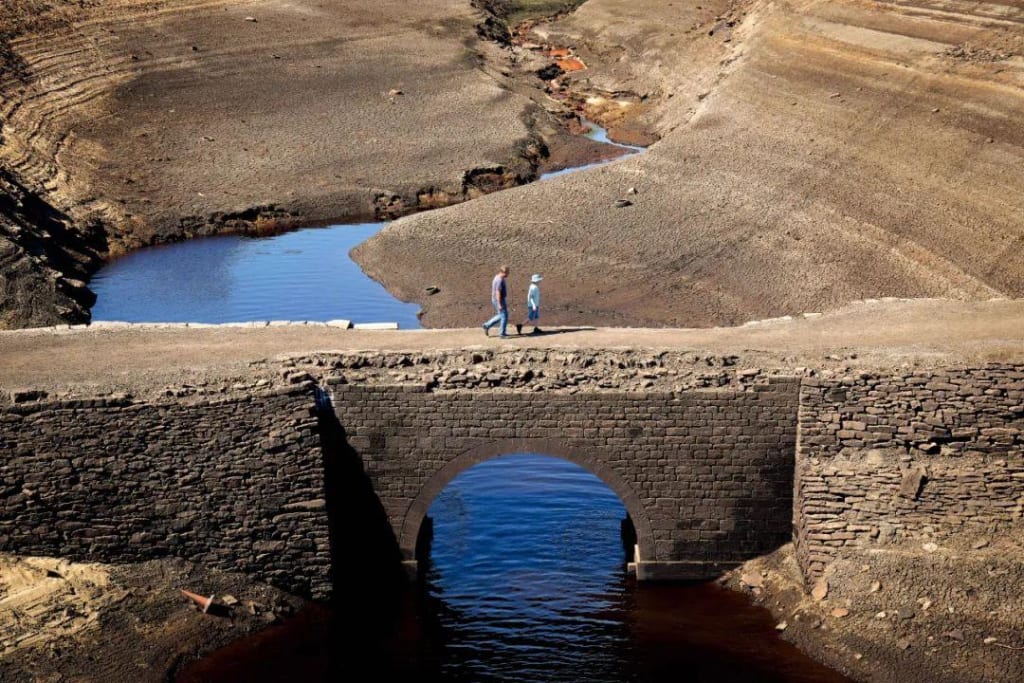
According to an article in the journal Nature in early August, heat extremes are occurring almost simultaneously in many parts of the world.
In South Asia, India and Pakistan have been hit by high temperatures since March. At least 90 people have died in parts of India, where temperatures exceeded 44 degrees Celsius in late March; In June, Tokyo's heatwave exceeded 35 degrees Celsius for nine consecutive days, the worst since records began in the 1870s. In mid-July, the UK recorded its first high temperature above 40C since temperature monitoring began. Meanwhile, drought and wildfires under heat waves are spreading in France, Spain, Greece, Germany and beyond.
This series of extreme events in many parts of the northern hemisphere is the embodiment of the dramatic change in the global climate. And in the future, meteorologists predict there will be more and more unexpected extremes. Scholars who study meteorology point out that the Earth's climate environment is evolving significantly, bringing new challenges to the development of human society.
Europe is suffering its worst drought in 500 years
In Spain, archaeologists have made an unexpected discovery, a prehistoric stone group known as Spain's Stonehenge. The Stonehenge, which was originally covered by the Valde Canas reservoir in the central province of Caceres, has been hit by the worst drought in decades and the water level has dropped to 28% of the reservoir's capacity, authorities said.
Drought has reduced the Danube, Europe's second-longest river, to one of its lowest levels in nearly a century, exposing more than 20 German warships that sank near the Serbian river section of Prahovo during World War II; Italy has declared a state of emergency around the Po River, where a 450kg bomb from World War II was found submerged by fishermen in late July in bare waters along a stretch of the country's longest river.
The drought has profoundly affected food, shipping, energy and other sectors in Europe. In the town of Kaub, on the middle Rhine, there is an old water level measuring station, to which any boat captain entering the upper Rhine would refer. After Aug. 12, the water level scale dropped below 40 centimeters, meaning the water level was no longer suitable for most boats.
The Rhine, which originates in the Alps, is the largest river in Western Europe and is known as the "lifeline" of the European economy. Commodities such as grain, coal and chemicals depend on this vital transport route to reach their destinations.
For Germany, 80% of its water transport is on the Rhine. 'It is only a matter of time before chemical or steel plants are closed, petroleum and other mineral products and construction materials cannot reach their destinations, and large volumes and heavy shipments cannot continue,' Mr. Holger, vice president of the Federation of German Industry, said in a statement in mid-August as the Rhine fell.
Tu Jianjun told Newsweek that the European energy market was already in a highly balanced state in the context of the Russia-Ukraine conflict this year. At present, the European Union is in a multi-pronged attempt to wean itself off its high dependence on Russian gas imports as soon as possible, and Europe is actively stepping up its energy reserves for the winter. Now, shipping, including coal, has been severely affected by high temperatures and dry weather, making the security of Europe's energy supply even more challenging.
Much of Europe is suffering from what is likely to be the worst drought in 500 years, although a comprehensive retrospective analysis is needed, said Andrea Schaeuer, a researcher at the European Commission's Joint Research Centre who collects data for the European Drought Observatory.
According to data released on August 3rd by the European Drought Observatory, 63% of land in the European Union and the UK is now under drought "warning" or "alert", covering an area almost the size of India.
Sunflowers wither due to drought in a field in the town of Bidar, southwestern France, on Aug. 14. Photo/Visual China
In France, only 9.7mm of rain fell in July, making it the wettest July since 1959. More than 100 French towns have no drinking water in their pipes and rely on tankers to supply them, French Minister for Ecological Transformation and Land Coordination Jean-Pierre Besch said on August 5. He did not rule out distributing bottled water in the hardest to reach areas.
The Joint Research Centre, the European Commission's scientific service, forecast in its latest report published on July 25th that yields of maize, sunflowers and soyabeans in the EU would fall by 8-9% because of a hot and dry summer.
Spain produces nearly half of the world's olive oil. Olive oil prices have been driven higher by fears that hot, dry weather in Spain will hurt this season's olive harvest, the Wall Street Journal reported on August 17. According to Kyle Holland, a market analyst at data provider Mintec, the market price of extra virgin olive oil in Spain has risen by about 7 percent in the past month. Unless the weather improves quickly in Spain over the next few weeks, olive oil production heading into the October harvest will fall by almost 30 per cent.
Days of drought and scorching heat have made 2022 on track to be the worst year for wildfires in Europe. The London Fire Brigade said it had dealt with 340 outdoor fires in the first week of August, more than eight times the number recorded during the same period last year. Spain has been the worst hit by forest fires in Europe this year, with dozens of wildfires burning 244,000 hectares of land, almost four times the annual average since records began in 2006.
Between January and mid-August, nearly 660,000 hectares of land were burned by wildfires across the continent, 56 per cent higher than the previous peak of 420,000 hectares recorded for the same period in 2017, according to the European Forest Fire Information System (EFFIS), a figure equivalent to a fifth of the size of Belgium. According to an analysis, if the current trend of wildfire outbreaks continues, more than one million hectares of land will be burned in Europe this year.
In addition, the US media Politico pointed out in a report in early August that Germany, Spain, Portugal, the Netherlands and other countries recorded thousands of deaths during the extreme heat wave in July through a preliminary analysis of data released by several European national statistical offices.
Li Zhaoxin, a dynamic meteorologist and researcher at the French National Centre for Scientific Research, told China News Weekly that Western European countries usually have a mild climate, with cool summers, frequent and evenly distributed precipitation, so they have a low tolerance to heat and drought, and the related equipment and infrastructure are not sound. The heat and drought in 2022 had a great impact on the social economy and People's Daily life.
People and Nature changed by hot weather
Drought usually accompanies high temperatures. The city where Li Chao, a senior scientist at the Max Planck Institute for Meteorology in Germany, works is Hamburg, Germany, which in latitude is close to Mohe, the northernmost part of China. Summer highs are usually well below 33 ° C, but on July 20, the hottest temperature ever recorded in the region was 40.3 ° C.
"In the summer of 2022, heat and drought events occurred in many parts of the northern Hemisphere, particularly the western United States, western and southern Europe, and large areas of China." Li Zhaoxin pointed out that each region has its own particularity and the changes of specific meteorological elements are also different, but they are closely related to atmospheric circulation anomalies, especially the strength and location of the Northern Hemisphere subtropical high, which plays a crucial role.
In summer, the entire mid-latitude region of the northern hemisphere of the world is controlled by high-pressure systems, which act as a downdraft that is not conducive to cloud formation and corresponds to high temperatures and little rain, Li told China Newsweek. Recently, it is the Western Pacific subtropical high that has affected the high temperature and drought in southern China, and the North Atlantic high on the European mainland.
A glacier is seen near the Svalbard archipelago in the Norwegian Arctic Ocean on July 17. Studies using satellite data since 1970 have shown that about 1.5 million square kilometers of sea ice has melted in the Arctic, and that sea ice is shrinking every year. Photo/Visual China
In normal years, however, typhoons from the ocean, storms and cyclones at higher latitudes bring warm, moist gases and rain, reducing the intensity of the mid-latitude subtropical high's influence. This year, the subtropical high has lasted longer and has been more intense.
In addition to Europe, the United States also saw the country's third warmest July, while the Copernicus Climate Change Service observed that the extent of Antarctic sea ice reached the lowest July level in 44 years of satellite data.
But this year's double whammy of heat and drought is not an exception to climate change. Lu Mengji, a Chinese-born scholar who has lived in Germany for 40 years, told China Newsweek that Germany has now seen high temperatures every year for three or four years in a row. Germany, which is located between 47° N and 55° N, is in the north temperate zone. During the years he lived here, he said, summer temperatures rarely exceeded 30 ° C, and in recent years, they sometimes reached 37 ° C. This brings a new set of challenges to life.
Britain, Germany, Spain, Italy and Greece and other countries were not used to the threat of extreme high temperature, for example, during the period of 2013 to 2019, only 3% to 5% of British families are equipped with air conditioning, the UK also has Europe's oldest housing stock, one 5 of the house was built in 1919, before the heat insulation ability is poor, limited air circulation.
Similarly, in the past, houses in Germany were designed for thermal insulation because it was cold in winter, but now, with climate change, heat dissipation in summer is a big problem. Now, when daytime temperatures are high, the curtains need to be drawn to keep out the sun, and in some cases, people need to go to the basement of the house to escape the heat, Mr. Lumengi said. Air CONDITIONING, WHICH is rarely needed by German families originally, also gradually began to come on stage, this year, Lu Mengji's neighbors in the renovation of the house, has installed air conditioning.
As temperatures rise in areas where latitudes are more northerly, the ecosystem as a whole is struggling to adapt. While working in his garden, Mr. Lumenji found that many plants that used to sprout in April or May now sprout in March. Then, when cold weather hits, the buds can't survive. A frequent hiker outdoors and in the forest, he has also observed that the lack of water in many artificial coniferous forests has reduced the ability to secrete pine resin, which can fight pests, making the trees more susceptible to pests, and leaves have turned yellow and fallen off in large areas.
Behind the extreme weather
Scott Denning, a professor of atmospheric sciences at Colorado State University in the US, pointed out in an interview with China Newsweek that scientific research shows that there is a basic hierarchy of extreme events that will be most affected by human-induced climate change. Evidence from observations, physical studies and computer simulations suggests that some of the weather anomalies are definitely linked to climate change.
Specifically, the extreme events most directly linked to climate change are heat waves, which are bound to increase dramatically with global warming; The next climate events are coastal flooding and storm surge, drought, wildfires... Finally, hail and tornadoes. "The evidence is clear that the more coal, oil and gas are burned, the more the planet warms and the more likely any given location is to experience heat waves." He said.
Most of the world's mountain glaciers are retreating due to climate change, and countries near the Arctic are experiencing unusually high temperatures. At the end of July, foreign media reported that Alpine glaciers may melt the most in at least 60 years as high temperatures continue. In July, temperatures in the Arctic Circle soared to 32.5 ° C and scientists in the region even played ice volleyball in short-sleeved shorts.
A warming Arctic, in turn, is involved in global climate change in complex ways. One of the hot questions in climate science is how melting sea ice in the Arctic and Antarctic will increase heat and drought in mid-latitudes, especially in Europe. In 2015, a paper published in the journal Science noted that in addition to exacerbating winter storms and cold waves, Arctic warming could also bring summertime shocks, such as the deadly Russian heat wave of 2010.
Indeed, Europe has been the "hot spot" for more heat waves in the Northern Hemisphere, breaking heat records more than once in the past five years. Kay Kornhuber, a climate scientist at Columbia University in the United States, told Nature in early August that his team had found that Western Europe is very prone to heat waves: Over the past 40 years, extreme heat has been three to four times more frequent in Western Europe than in other mid-latitudes in the Northern Hemisphere.
A change in atmospheric dynamics due to Arctic warming is a possible explanation, but it remains an inconclusive scientific hypothesis. Specifically, Chao Li, a senior scientist at the Max Planck Institute for Meteorology in Germany, explains that the theory suggests that continental Europe relies on the jet stream axis in the Arctic region to bring cold, moist air from mid and high latitudes to the continent. However, as Arctic temperatures rise and the temperature gradient between the polar and lower latitudes becomes smaller, the strength of the jet stream axis weakens. Li doesn't particularly agree with this mechanism, preferring to see it as an expression of a complex climate system rather than a causal link.
'The impact of rising greenhouse gas emissions on how much global warming will occur and what kind of climate will occur under what scenarios has been well studied,' Mr. Li said. The harder question now is how an increase in greenhouse gases will affect overall atmospheric circulation and what kind of weather it will bring, and weather information is crucial to society's response. For example, given carbon dioxide emissions in 2070 and corresponding socioeconomic development scenarios, the current study can roughly predict how much global temperature will rise that year, but it cannot predict what continental weather will be like in the summer of 2070, he said.
Li Zhaoxin also said that there are still great uncertainties and scientific debates about the specific shape, performance and quantitative intensity of extreme weather in the region, as well as the arrival time and course of events and other more precise issues. But climate scientists say two things are clear: that climate change will raise global temperatures and that extreme weather events, such as some unexpected heat events, will become more frequent in the future.
In Europe, according to the IPCC, about half of the European population could be at high or very high risk of heat coping in summer by 2050. On Aug 15, a new peer-reviewed study by the First Street Foundation, a US research group, predicted that by 2053, more than 100 million Americans will live in an "extreme high temperature belt", where the heat index will exceed about 52 degrees Celsius at least one day a year. The heat index is a combination of air temperature and humidity, and refers to the temperature felt by the body.
"Greenhouse gas emission reduction is still the fundamental measure to deal with climate change," Li said, noting that understanding the impact of extreme weather and how to deal with it are also important. In this respect, in addition to climate scientists, social sciences and other interdisciplinary disciplines should also join in the effort.
About the Creator
Keep reading
More stories from writers in Earth and other communities.
Top Australian Writers’ Festival Cancelled After Palestinian Author Barred
One of Australia’s most respected literary festivals has been cancelled following a fierce backlash over the decision to bar a Palestinian author from participating. What began as a programming dispute quickly escalated into a national debate about free speech, cultural inclusion, and political pressure in the arts. The cancellation has sent shockwaves through Australia’s literary community, raising urgent questions about whose voices are allowed on public platforms and at what cost.
By Aarif Lashari7 days ago in Earth
The Trans Youth Athletes in the US Fighting for Their Rights: ‘Playing Is an Act of Resistance’
Across the United States, sports have become an unexpected front line in the fight over transgender rights. For many trans youth athletes, simply stepping onto a field, track, or court is no longer just about competition—it is an act of resistance. As state legislatures debate and pass laws restricting transgender participation in school sports, young athletes are finding themselves at the center of a national culture war that reaches far beyond the locker room.
By Aarif Lashari7 days ago in Earth
The Devil's Cut
“Comrade, finally you’re awake.” The voice was smooth, sensual. A flickering incandescent bar was all that lit the white, sterile room. All Vladimir remembered was everything going black. He tried to move his arms and found them strapped to the gurney.
By Matthew J. Fromm6 days ago in Fiction



Comments
There are no comments for this story
Be the first to respond and start the conversation.