
"Echoes of World War II: How Today’s Conflicts Reshape Our World"
From Ukraine to Sudan, humanity faces its highest level of war since 1945 — one in six people now live amid violence

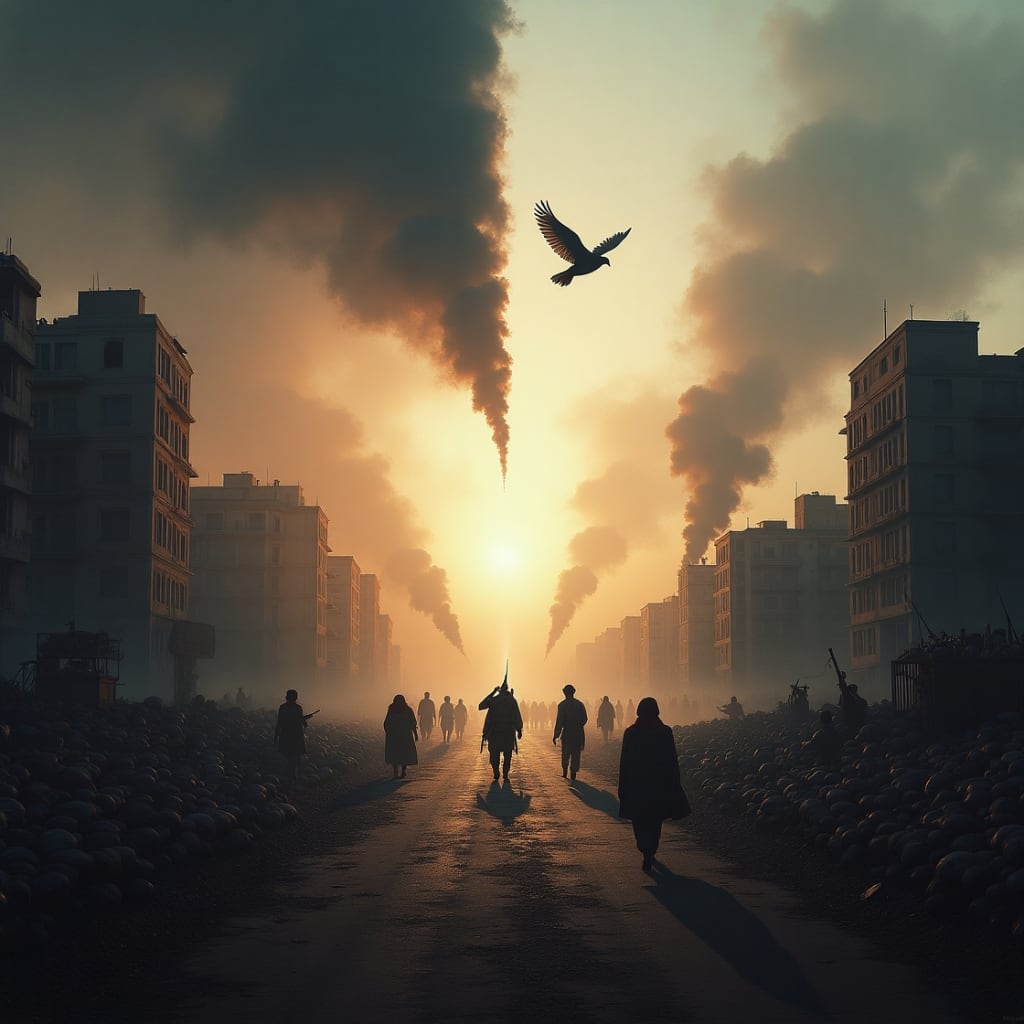
"Echoes of World War II: How Today’s Conflicts Reshape Our World"
The world in 2024 stands at a troubling crossroads. For many decades after World War II, humanity hoped that such large-scale devastation would never repeat itself. International institutions were formed, peace treaties signed, and global leaders often spoke of “never again.” Yet, almost eighty years later, the globe is witnessing a wave of violent conflicts that has reached levels unseen since the end of the Second World War.
According to international research, one in six people worldwide now live in areas affected by armed conflict. That means hundreds of millions of men, women, and children wake up daily to the sound of gunfire, drone strikes, or military occupation. Around 50 countries are currently touched by war or political violence. What makes this moment particularly concerning is not only the number of conflicts but also the variety of regions, scales, and political actors involved.
Let us take a closer look at the major ongoing conflicts and why experts call this era “the most violent since World War II.”
The Russo-Ukrainian War
The most high-profile conflict in recent memory is the war between Russia and Ukraine. What began in 2014 with the annexation of Crimea escalated dramatically in February 2022 when Russia launched a full-scale invasion. Cities like Mariupol and Bakhmut became symbols of resistance and destruction, while millions of Ukrainians fled across Europe seeking safety. The war reshaped global geopolitics, fractured energy markets, and reignited debates over NATO’s role in Europe. Today, it remains one of the deadliest and most consequential wars in the world.
The Israeli-Palestinian Conflict
Another long-standing conflict intensified in late 2023, when Hamas launched a surprise assault on Israel. The Israeli military responded with heavy strikes on Gaza, triggering one of the most violent escalations in the region in years. Thousands of civilians have been killed or displaced, and the humanitarian situation worsens daily. The cycle of retaliation between Israel and Palestinian groups continues to destabilize the Middle East, raising fears of broader regional war.
The Sudanese Civil War
Often overlooked in international headlines, Sudan is facing one of the world’s most devastating civil wars. Beginning in 2023, this conflict pits rival military factions against one another. Khartoum, the capital, has been transformed into a battlefield, while millions of civilians are caught in the crossfire. Humanitarian organizations warn of famine, disease, and mass displacement on a scale that could rival previous tragedies in East Africa.
The Syrian Civil War
Since 2011, Syria has been engulfed in a brutal conflict that shows little sign of fully ending. What began as a protest movement against authoritarian rule spiraled into a multi-front war involving regional and global powers. The rise and fall of ISIS was only one chapter in this long saga. Today, the country remains fractured, with Assad still in power but millions of Syrians displaced worldwide. It is one of the largest humanitarian crises in modern history, with entire cities reduced to rubble.
The Myanmar Civil War
Far from the Middle East and Europe, Southeast Asia too is gripped by violence. Myanmar, once on a slow path toward democracy, fell into chaos after the 2021 military coup. Pro-democracy forces, ethnic groups, and the military regime are locked in a devastating civil war. Civilians face relentless airstrikes and mass displacement. While it garners less international coverage, it remains a defining tragedy of our time.
A World of Many Wars
The list above only scratches the surface. From conflicts in Yemen to unrest in the Sahel region of Africa, violence has become an everyday reality for millions. Experts note that many of these wars do not receive widespread media attention unless they have major geopolitical consequences, such as Russia’s confrontation with NATO or the Middle East’s oil politics.
What is clear, however, is that the world is more unstable than at any point in the past 70 years. The United Nations, international peacekeepers, and humanitarian organizations are stretched thin. Refugee numbers are at record highs. Civilian suffering is immense.
Lessons from History
The comparison to World War II is not casual. That war left more than 70 million people dead, reshaped global borders, and created institutions like the United Nations in hopes of preventing another world catastrophe. Yet the persistence of today’s conflicts shows that humanity has not fully learned the lessons of the past.
Every conflict today echoes the divisions of the 20th century: struggles over land, ideology, religion, and power. And once again, innocent civilians pay the highest price.
The world may not be on the verge of another world war, but the sheer number of simultaneous conflicts reminds us that peace is fragile, and justice is unfinished.
Final Thoughts
When we read the headlines, it can be easy to focus on numbers, maps, or political speeches. But behind every statistic is a human story: a child separated from their parents, a family forced to flee their home, a community destroyed overnight.
The truth is stark: in 2024, war is not the exception — it is the reality for millions. The challenge for the global community is whether it can act to restore peace before the echoes of World War II become the soundtrack of the 21st century.
About the Creator
Wings of Time
I'm Wings of Time—a storyteller from Swat, Pakistan. I write immersive, researched tales of war, aviation, and history that bring the past roaring back to life
Keep reading
More stories from Wings of Time and writers in Earth and other communities.
The New World
The New World Humanity has always been defined by its ability to dream of a better tomorrow. From the first fire struck by stone to the satellites orbiting Earth, every invention has carried us a step closer to a new world. But never before has the pace of progress been so rapid, nor the possibilities so limitless. Today, we stand at the threshold of a technological revolution that is reshaping every part of life—medicine, communication, space travel, and even the way we think. This “new world” is not centuries away; it is being built around us right now.
By Wings of Time 5 months ago in Earth
Top Australian Writers’ Festival Cancelled After Palestinian Author Barred
One of Australia’s most respected literary festivals has been cancelled following a fierce backlash over the decision to bar a Palestinian author from participating. What began as a programming dispute quickly escalated into a national debate about free speech, cultural inclusion, and political pressure in the arts. The cancellation has sent shockwaves through Australia’s literary community, raising urgent questions about whose voices are allowed on public platforms and at what cost.
By Aarif Lashari5 days ago in Earth
The Trans Youth Athletes in the US Fighting for Their Rights: ‘Playing Is an Act of Resistance’
Across the United States, sports have become an unexpected front line in the fight over transgender rights. For many trans youth athletes, simply stepping onto a field, track, or court is no longer just about competition—it is an act of resistance. As state legislatures debate and pass laws restricting transgender participation in school sports, young athletes are finding themselves at the center of a national culture war that reaches far beyond the locker room.
By Aarif Lashari5 days ago in Earth
The Devil's Cut
“Comrade, finally you’re awake.” The voice was smooth, sensual. A flickering incandescent bar was all that lit the white, sterile room. All Vladimir remembered was everything going black. He tried to move his arms and found them strapped to the gurney.
By Matthew J. Fromm5 days ago in Fiction



Comments
There are no comments for this story
Be the first to respond and start the conversation.