
At Least 20 Dead After Magnitude-6.3 Earthquake Hits Afghanistan
Rescuers rush to remote villages as a powerful earthquake leaves death and destruction across western Afghanistan.

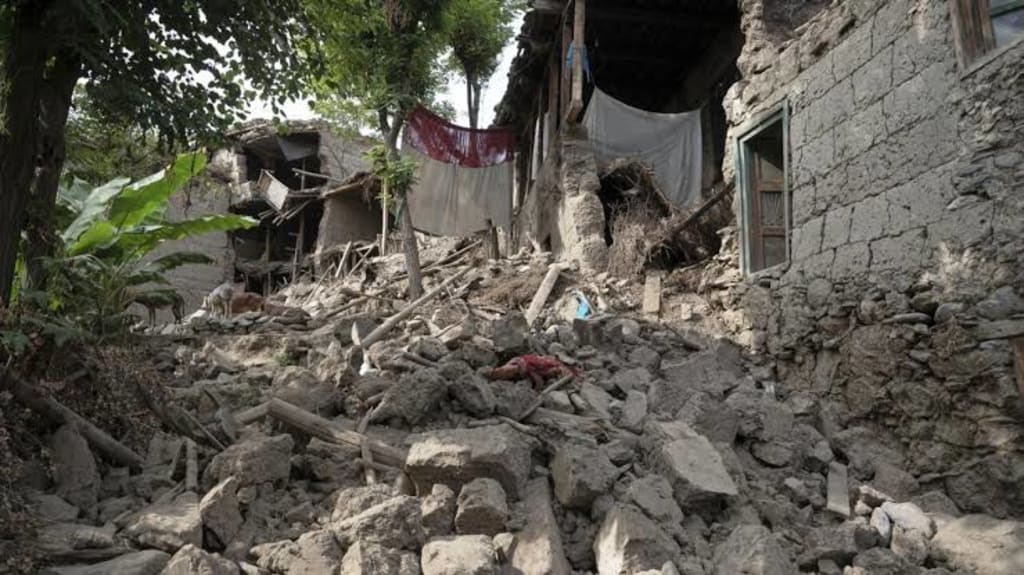
A powerful magnitude-6.3 earthquake struck western Afghanistan early Saturday, leaving at least 20 people dead and dozens more injured, according to local officials. The quake, which struck near the city of Herat, flattened homes, triggered landslides, and sent terrified residents running into the streets.
For a nation already facing economic hardship and humanitarian crises, this natural disaster has deepened the struggle of thousands of Afghan families.
---
A Morning of Panic and Destruction
The quake hit just after 11:00 a.m. local time, shaking wide areas across Herat Province and neighboring regions. Witnesses described scenes of chaos as walls cracked and rooftops collapsed. Many residents were inside their homes or mosques when the tremors began, giving them little time to escape.
> “The ground started shaking violently,” said Abdul Wahid, a Herat shopkeeper. “People were screaming and running. Buildings fell like paper. We have never seen anything like it.”
Local hospitals quickly filled with victims suffering from injuries ranging from broken bones to head trauma. Emergency teams struggled to reach the worst-hit areas, where narrow roads and fallen debris have made access nearly impossible.
---
Government Response and Rescue Efforts
Afghanistan’s Ministry of Disaster Management confirmed the early death toll and warned that the number of casualties could rise as rescue workers reach remote villages. Many rural homes in the area are made of mud bricks, which crumble easily during strong quakes.
Search and rescue operations are underway, with emergency personnel, volunteers, and local residents using bare hands and simple tools to dig through the rubble. “We are racing against time,” said Ali Karimi, a rescue worker in Herat. “There may still be people trapped beneath collapsed houses.”
Electricity and communication networks were temporarily disrupted, leaving many families unable to contact loved ones. Helicopters have been deployed to deliver aid and transport the injured to medical centers in Herat city.
---
A Country in Crisis
The earthquake adds to Afghanistan’s long list of challenges. Since the Taliban took control in 2021, the country has been largely cut off from international financial support, leaving the healthcare and infrastructure systems under severe strain.
Aid agencies say the government’s limited resources make it difficult to respond effectively to disasters like this. The United Nations Office for the Coordination of Humanitarian Affairs (OCHA) said it is monitoring the situation closely and preparing emergency relief shipments.
> “This earthquake has struck a population already suffering from poverty, displacement, and food insecurity,” said a spokesperson for OCHA. “We are working with local partners to provide tents, food, and medical supplies.”
Afghanistan’s geography makes it particularly prone to earthquakes. The country lies near the junction of the Eurasian and Indian tectonic plates, making it one of the most seismically active regions in the world.
---
Memories of Past Disasters
For many Afghans, Saturday’s quake brought back painful memories of previous disasters. In October 2023, a series of strong quakes in the same region killed more than 1,000 people and destroyed thousands of homes.
That tragedy highlighted the country’s fragile infrastructure and lack of earthquake-resistant housing. Many survivors from those earlier quakes were still living in temporary shelters when Saturday’s tremor struck.
> “It feels like we never recovered,” said Fatima Bibi, a mother of four who lost her home last year. “Now we must start all over again.”
---
International Reactions
Condolences and offers of support have begun pouring in from around the world. The United Nations, Red Crescent Society, and several neighboring countries, including Pakistan and Iran, have pledged to send aid and emergency supplies.
The World Health Organization (WHO) confirmed it has dispatched medical kits and emergency staff to Herat. “Our immediate priority is saving lives,” said Dr. Rik Peeperkorn, WHO’s representative in Afghanistan. “We are working alongside local health workers to ensure the injured receive care and hospitals are equipped to handle the surge in patients.”
However, ongoing political tensions and limited international recognition of the Taliban government may complicate relief efforts. Some Western nations continue to restrict direct aid, fearing funds could be misused or diverted.
---
The Human Toll
As night fell, thousands of Afghans were forced to sleep outside in the cold, fearing aftershocks that could bring down weakened buildings. Families huddled together in open fields, lighting fires for warmth.
In one Herat neighborhood, survivors gathered around makeshift tents built from blankets and wooden poles. “We have nowhere else to go,” said Mohammad Rahim, who lost his father in the quake. “We just want food, water, and safety for our children.”
Local mosques and community centers have opened their doors to provide shelter, while volunteers distribute bread and bottled water. Social media platforms are flooded with calls for help, donations, and messages of solidarity.
---
A Call for Global Support
Afghanistan’s repeated natural disasters have underscored a grim truth: without stronger international cooperation, recovery will remain painfully slow. Experts say that rebuilding efforts must focus not only on immediate aid but also on long-term resilience — including better building codes, improved infrastructure, and disaster education.
About the Creator
Fiaz Ahmed Brohi
I am a passionate writer with a love for exploring and creating content on trending topics. Always curious, always sharing stories that engage and inspire.
Keep reading
More stories from Fiaz Ahmed Brohi and writers in Earth and other communities.
Poetry of the Hunt: The Art of Pursuit in Nature and Life
The phrase “Poetry of the Hunt” may sound like a contradiction at first. Hunting feels primal, fierce, and physical, while poetry feels emotional, delicate, and reflective. Yet, when we look closer, the two are deeply connected. Both the hunter and the poet share a similar passion — the pursuit of something just out of reach. Whether it’s an animal in the forest or an idea in the mind, both are driven by instinct, patience, and a desire to capture something powerful and true.
By Fiaz Ahmed Brohi3 months ago in Earth
Denmark and Greenland Prepare for US Talks as Trump Says Territory’s PM Has a ‘Big Problem’
Denmark and Greenland are preparing for crucial talks with the United States amid renewed diplomatic tension, after former US President Donald Trump claimed that Greenland’s prime minister has a “big problem.” The remarks, reported as part of ongoing European political coverage, have drawn attention to the fragile balance between diplomacy, sovereignty, and strategic interests in the Arctic. As delegations ready themselves for discussions in Washington, the episode underscores how Greenland has once again become a focal point in global geopolitics.
By Aarif Lashari4 days ago in Earth


Comments
There are no comments for this story
Be the first to respond and start the conversation.