
After surviving for more than 890 million years, how come the sponge has fallen into trouble now?
most influential species

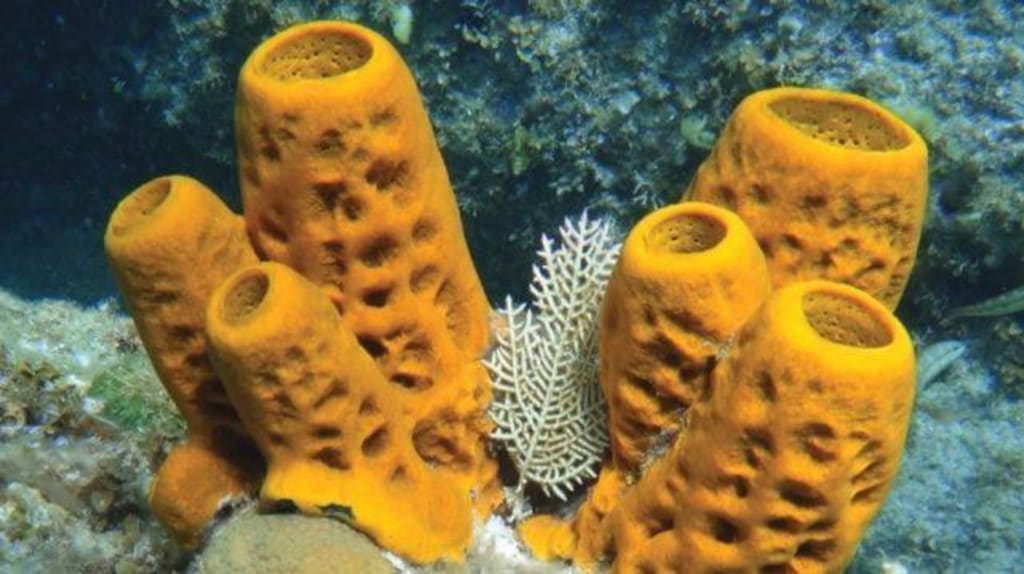
There have been five tragic mass extinctions on Earth, and each mass extinction was like a cleanup plan that wiped out more than 60% of the planet's species in a short period of time.
Few species have escaped the five mass extinctions, and even fewer have survived the five mass extinctions and still remain the most influential species on the planet. Sponges are one of the ten thousand.
The first mass extinction occurred 439 million years ago, at the end of the Ordovician period, so it is also called the Ordovician mass extinction, when 85% of the species on the earth disappeared in just 200,000 years.
Sponges are a collective term for organisms in the phylum Porozoa, and the oldest fossil record may date back to 890 million years ago, which is much older than the time when the first mass extinction occurred.
Previously published by paleontologists at the Nanjing Institute of Geology and Paleontology in China, sponges began to truly spread across the oceans after the first mass extinction.
Many species will rise in the dividend of mass extinction. For example, mammals are the fifth mass extinction-the rapid rise after the extinction of dinosaurs, but there are few species that have escaped mass extinction again and again like sponges and have not declined. .
Why are sponges animals?
Sponges are one of the world's simplest multicellular species, and they grow in a variety of shapes, sizes, colors and textures.
Their abundance is unimaginable, with more than 11,000 species of sponges described so far, with at least 14,000 more believed to be yet to be discovered.
They have long colonized all the world's oceans, including the deep, and can even be found in freshwater environments - such as ponds, lakes and streams.
Sponges are filter feeders, and they use cells lining their flagella to generate electrical currents that push water into their internal conduits, where they ingest tiny organic particles from the water.
If we only look at the appearance and anatomical characteristics of sponges, it is difficult for us to associate sponges with animals. They have no central nervous system, no digestive or circulatory system, and no organs as animals. They are motionless, It grows, reproduces, and survives just like plants, so it's no surprise that sponges in the past were classified as plants.
But starting in the 18th century, scientists began to notice the sponges' animal characteristics, including changes in the diameter of their central cavity, and the unique flow of water they produce as they filter food.
As a result, some of the more avant-garde scientists have classified sponges as animals, and they consider sponges to be an isolated, unconventional group in the animal kingdom.
Of course, these characteristics alone are not enough to prove that the sponge is an animal, so the identity of the sponge has been controversial for a long time in the past. Until the development of molecular biology, molecular tests proved that sponges and more complex animals (including humans) evolved from a common ancestor.
Why have sponges survived multiple mass extinctions?
There are two reasons why these ancient creatures have survived for so long, one is that they are simple enough, and the other is that they know how to cooperate.
If these two key factors of survival must be investigated at a deeper level, there is actually only one, and that is simple enough. Simple structures allow them to adapt and evolve rapidly, surviving in many different environments, but the reason they can survive so simply is that they know how to cooperate.
The cells of sponges are able to differentiate into functional cell types, but sponges don't, and they don't get the tissues, organs and systems associated with more complex animals.
The reason why they don't need to do this is actually to "outsource" some survival functions to other creatures.
In the long evolutionary history of sponges, they have developed a large number of symbiotic relationships with aquatic microorganisms, and then handed over the most critical survival functions of organisms, including metabolic functions and waste removal, to these symbiotic organisms. In return, sponges provide these microbes with a protected environment.
If you're wondering how important these symbiotic relationships are to sponges, one statistic that might surprise you is that any individual sponge will have more than 40 percent of its microbial volume.
So whether the sponge belongs to these microorganisms or its own is a bit hard to say. After all, starting a company without 51% of the shares is not guaranteed.
In addition, there is a more interesting fact that the key factors driving the evolution of sponges into various shapes, sizes and forms are also these symbiotic microorganisms. These mutually beneficial relationships have allowed sponges to evolve into many new and unique species, and their evolution seems to be Little concern for the little fish and shrimp that actually eat them.
Sponges are also disappearing
Some people may have sponge cleaning tools in their kitchen. These sponges are industrial products and are a material called polyurethane (PU), but in fact, sponge animals are also used as cleaning tools.
As early as BC, the ancient Greeks had developed the washing function of sponges. They used sponges to wash baths, wash dishes, and wipe their butts.
Now sponge animals still have many uses, so it is no surprise that some sponges have been almost extinct due to overfishing, so that they need to be farmed to ensure the relationship between supply and demand.
However, the impact of those fished sponges on the entire sponge population is very small. After all, there are many kinds of sponges and they are widely distributed, and people are basically fishing for those in the shallow sea.
However, the situation of all sponges is not optimistic now, and sponges are disappearing rapidly in all regions.
You might be wondering, they survived five mass extinctions, why not now?
In fact, the direct cause is global warming. The reason sponges are affected by global warming is that they are highly dependent on those symbiotic microorganisms, and these microorganisms are more susceptible to temperature changes.
As soon as sea surface temperatures of 33°C are reached, the relationship between many sponges and their microbes can easily rupture, the microbes won't work properly, and eventually parasites can colonize the sponge host, a study has shown.
The reason why sponges can't work now is of course that our current extinction event is very severe, and even many scholars and researchers have defined it as the sixth mass extinction. We may be experiencing a mass extinction, and this mass extinction is likely to be human-led.
Sponges haven't disappeared in the last five mass extinctions, meaning they were unaffected, they just popped up again after the extinction event.
at last
If the sixth mass extinction is going on now, it is normal for sponges to gradually disappear. Of course, according to past "experience", they are likely to re-emerge later. After all, their way of survival has been tested for hundreds of millions of years. Nothing has been proven wrong.
About the Creator
sondra mallen
Share a little bit of science every day
Keep reading
More stories from sondra mallen and writers in Earth and other communities.
A large number of ladybugs appear in Harbin, is it the disadvantage of not burning wheat straw?
As the weather turns cold, many insects have become less active, but these days in Harbin, it has been unusual. An insect suddenly gathered in large numbers and appeared densely, causing local residents a headache.
By sondra mallen3 years ago in Earth
Himalayas Bare and Rocky After Reduced Winter Snowfall, Scientists Warn
The Himalayas, often described as the world’s “Third Pole,” are facing a dramatic and worrying transformation. Scientists are warning that reduced winter snowfall is leaving vast stretches of the mountain range bare, rocky, and increasingly vulnerable to long-term environmental damage. Once known for their thick snow blankets and powerful glaciers, parts of the Himalayas are now showing exposed rock earlier than ever before—an alarming sign of climate stress in one of Earth’s most critical ecosystems. A Visible Change in the World’s Highest Mountains Winter snowfall plays a vital role in the Himalayan climate system. Snow acts as a protective layer, insulating glaciers and regulating the slow release of meltwater into rivers during warmer months. However, researchers monitoring satellite data and ground stations report that recent winters have brought significantly less snowfall across large areas of the range. As a result, snowlines are rising higher up the slopes, leaving lower and mid-altitude regions exposed. This has turned once-white mountain landscapes into expanses of dark rock, which absorb more heat from the sun, accelerating warming in a dangerous feedback loop. Why Reduced Snowfall Matters Snow is more than a scenic feature—it is essential to the health of Himalayan glaciers. When snowfall declines, glaciers lose their main source of replenishment. At the same time, exposed ice and rock melt faster under direct sunlight. Scientists warn that this imbalance is speeding up glacier retreat across the Himalayas. Many glaciers are now shrinking at rates not previously recorded, threatening the long-term stability of water systems that support nearly two billion people across South and Southeast Asia. Impact on Asia’s Major Rivers The Himalayas feed some of the world’s most important rivers, including the Indus, Ganges, Brahmaputra, Yangtze, and Mekong. These rivers depend on seasonal snow and ice melt to maintain consistent flow throughout the year. Reduced snowfall means less stored water for the dry season. In the short term, faster melting can cause floods and landslides. In the long term, however, shrinking glaciers could lead to water shortages, affecting agriculture, hydropower, and drinking supplies across multiple countries. A Growing Risk of Disasters Bare, rocky slopes are far more unstable than snow-covered ones. Snow helps bind loose material together, while exposed rock and soil increase the likelihood of landslides and avalanches. Scientists have already observed a rise in slope failures and glacial lake outburst floods in the region. As glaciers retreat, meltwater often accumulates in fragile lakes dammed by loose rock and ice. These lakes can burst suddenly, releasing destructive floods that threaten mountain communities and downstream infrastructure. Climate Change at the Core Researchers agree that climate change is the primary driver behind the declining snowfall. Rising global temperatures are altering weather patterns, causing more winter precipitation to fall as rain rather than snow. Even small temperature increases at high altitudes can drastically change how moisture behaves. Additionally, warming oceans and shifting atmospheric circulation are affecting the timing and intensity of winter storms that traditionally brought snow to the Himalayas. Effects on Local Communities and Wildlife Mountain communities that rely on predictable snowfall for farming, tourism, and water storage are already feeling the effects. Farmers report changes in planting cycles, while winter tourism has declined in some regions due to unreliable snow conditions. Wildlife is also under pressure. Species adapted to cold environments are losing habitat as snow cover shrinks. Plants that depend on snowmelt are struggling to survive in drier, warmer conditions, disrupting fragile alpine ecosystems. Scientists Call for Urgent Monitoring and Action Experts stress the importance of improved monitoring of snowfall, glacier health, and water flows across the Himalayan region. Better data can help governments plan for future water management challenges and disaster risks. At the same time, scientists emphasize that local adaptation alone is not enough. Reducing global greenhouse gas emissions remains critical to slowing temperature rise and preserving what remains of the Himalayan snow and ice. What the Future Holds If current trends continue, large parts of the Himalayas could see permanent changes within decades. Reduced snowfall and accelerating glacier loss may reshape landscapes, ecosystems, and human livelihoods on an unprecedented scale. The sight of bare, rocky Himalayan slopes is more than a visual change—it is a warning signal. The world’s highest mountains are responding rapidly to a warming planet, and the consequences will extend far beyond the peaks themselves.
By Fiaz Ahmed Brohi7 days ago in Earth



Comments
There are no comments for this story
Be the first to respond and start the conversation.