
Unraveling the Israeli-Palestinian Conflict
Exploring Histories, Perspectives and Paths to peace
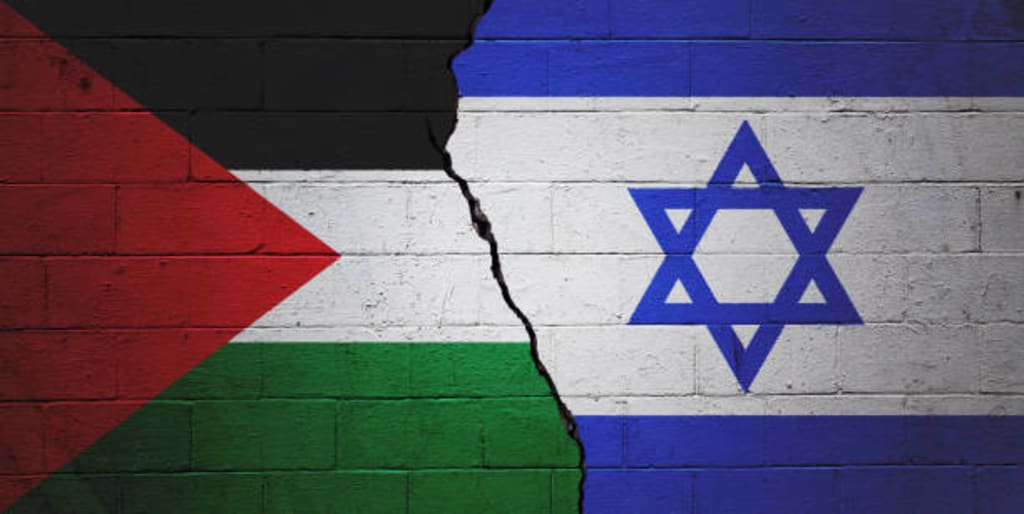
Echoes of Struggle: Tracing the Origins and Evolution of the Israeli-Palestinian Conflict:
The Israeli-Palestinian conflict has complex and multifaceted origins. It began to take shape in the late 19th and early 20th centuries, influenced by a combination of historical, political, and religious factors. Here's a brief overview:
Zionist Movement:
In the late 19th century, the Zionist movement emerged, advocating for the establishment of a Jewish homeland. The movement gained momentum under the leadership of figures like Theodor Herzl.
Balfour Declaration (1917):
During World War I, the Balfour Declaration (1917) expressed British support for the establishment of a "national home for the Jewish people" in Palestine.
British Mandate (1920-1948):
After World War I, the League of Nations granted Britain the mandate to administer Palestine.
Jewish immigration to Palestine increased during this period, leading to tensions with the Arab population.
Arab-Jewish Clashes (1920s-1930s):
Tensions between Jewish and Arab communities escalated, resulting in violent clashes and riots in the 1920s and 1930s.
World War II and Holocaust (1939-1945):
The Holocaust during World War II had a profound impact, increasing international sympathy for the establishment of a Jewish homeland. During the 25 years of the Palestine Mandate, from 1922 to 1947, large-scale Jewish immigration from abroad, mainly from Eastern Europe took place, the numbers swelling in the 1930s with the notorious Nazi persecution of Jewry.
Partition Plan (1947) and Establishment of Israel (1948):
In 1947, the United Nations proposed a partition plan to divide Palestine into Jewish and Arab states, with Jerusalem as an international city.
The establishment of the State of Israel in 1948 led to the Arab-Israeli War, as neighboring Arab states opposed the creation of Israel.
Arabs vehemently opposed the Balfour Declaration, concerned that a Jewish homeland would mean the subjugation of Arab Palestinians. The British controlled Palestine until Israel, in the years following the end of World War II, became an independent state in 1947.
1949 Armistice Agreements:
In 1949, with UN mediation, Israel concluded armistice agreements with Jordan, Egypt, Syria, and Lebanon, thus reaching an official cessation of hostilities of the first Arab-Israeli war that had started in May 1948. Iraq and Saudi Arabia, whose forces took part in the war, never signed any agreements with Israel.
Six-Day War (1967):
The Six-Day War, fought in June 1967, was a brief but pivotal conflict between Israel and its Arab neighbors, including Egypt, Jordan, and Syria. Tensions escalated over territorial disputes and military mobilizations. Israel launched a preemptive strike, swiftly gaining air superiority and conducting ground operations. In six days, Israel captured the Sinai Peninsula, Gaza Strip, West Bank, East Jerusalem, and the Golan Heights with the help of USA and France. The war reshaped the Middle East's geopolitical landscape, intensifying the Israeli-Palestinian conflict and leading to lasting regional ramifications. The United Nations passed Resolution 242, emphasizing the principle of "land for peace" and calling for Israeli withdrawal from occupied territories.
Creation of Hamas:
HAMAS formed in late 1987 at the beginning of the first Palestinian intifada (uprising). Its roots are in the Palestinian branch of the Muslim Brotherhood, and it is supported by a robust sociopolitical structure inside the Palestinian territories. The group is committed to armed resistance against Israel and the creation of an Islamic Palestinian state in Israel's place.
2023 Israel–Hamas war:
In the morning of 7 October, Palestinian militant groups launched a barrage of rockets against Israel, while around 3,000 militants breached the Gaza–Israel barrier attacking Israeli military bases and civilians in more than a dozen massacres, including one at a music festival. Over 200 Israeli civilians and soldiers, as well as some foreign nationals, were taken captive to the Gaza Strip. Hamas said its attack was in response to the blockade on Gaza, continued settlements, Israeli settler violence, and restrictions on movement between Israel and Gaza. Israel's declaration of a state of war the following day marked the start of the most significant military escalation in the region since the Yom Kippur War; its lengthy aerial bombardment of Gaza dropped 6,000 bombs in the first six days of the conflict. The airstrikes were coordinated with a total blockade of the Gaza strip in addition to cutting off water, fuel, food and electricity. Israel urged 1.1 million Gazans to evacuate northern Gaza, while Hamas called on residents to stay in their homes; on 27 October, Israel launched a ground invasion of the Gaza Strip which remains ongoing. More than 11,700 Palestinians in the Gaza Strip were killed (including 4,000 minors), and more than 1200 Israelis (including 900 civilians).
Conclusion:
Hamas attacks are also not acceptable but what Israeli forces are doing can not be neglected. Israeli forces dropped more than 10,000 bombs on Gaza. At least 10,328 Palestinians, including 4,237 children and 2,719 women, have been killed since then. Killing innocent people specially kids is not self defence. I am not taking side of Palestinians but it is the truth. This genocide must be stopped so that people on both side can live peacefully. The truth is that killing innocent people is always wrong - and no argument or excuse, no matter how deeply believed, can ever make it right. As Noam Chomsky said;
"Wanton killing of civilians is terrorism, not a war against terrorism."
About the Creator
Keep reading
More stories from Saad and writers in Confessions and other communities.
Word of the Day: ホチキス
I don't know the word for Staples. I remember I used to think that Hochikisu was an Onomatopoeia for a stapler rather than a brand name. I am pretty sure I already have this title as a theme, which is making me feel many sort of ways as Vocal is harassing me about payments currently.
By Kayla McIntosh29 days ago in Confessions
Word of the Day: 実習
Well my teacher did an impromptu zoom meeting with me which I really appreciated. Basically wrang me a new one very nicely about how I need to get my homework in. I am pretty sure I can actually do it now that I see what her methods are and the 3 channels she mostly uses so, that will make navigating things a lot easier as I wasn't sure where to look most of the time.
By Kayla McIntosh5 days ago in Confessions



Comments (1)
great work bro