
Trauma Makes it Hard to Consistently Write
The Self-Compassion of Driven Abuse Survivors

Writing is one of my favorite things in the world. It’s what I’ve always wanted to do, ever since I learned to read at age 5 and began devouring any book in sight.
So why, when I finally have time at the end of a long day, can I not bring myself to actually sit down and do one of my favorite things?
Why am I, as I write this article completely for fun, currently considering whether I should stop three paragraphs in for a tiny nap (which will inevitably result in my ignoring my alarm and sleeping for two hours)?
If you’ve read any of my other posts (or the title of this one), you can probably guess that the answer is trauma!
Symptoms of Complex Post-Traumatic Stress Disorder (CPTSD) can cast shadows on the lives of survivors. There are the symptoms one could guess: flashbacks, anxiety, nightmares. There are also many more covert ways trauma can infiltrate your mind.
In this post, we’ll briefly address a few of the lesser-known ways CPTSD symptoms can sneakily prevent us from doing the things we love such as pursuing our hobbies.
Disrupted Executive Function
CPTSD can impair cognitive difficulties and disrupt executive functions such as memory and problem-solving. As a result, even the simplest tasks, like organizing thoughts or starting a new piece, can feel like navigating a maze.
Writing requires meticulous planning and organized thinking, but trauma can make these tasks feel overwhelming, stifling creativity and inhibiting our ability to translate ideas into words.
Exhaustion
Sleep disturbances, such as nightmares and insomnia, are common companions of those with CPTSD. The lack of restorative sleep can leave you feeling perpetually drained, sapping the energy needed for the creative process.
The fatigue that results from these sleep disturbances can make it difficult to summon the mental and emotional stamina required for writing.
Lack of Focus
Maintaining focus is essential for productive writing and editing. However, the hypervigilance that often accompanies CPTSD can make maintaining focus feel like trying to catch smoke. The constant racing thoughts and scanning for threats can be incredibly distracting.
Fun fact about me: when these symptoms are particularly bad on a given day I call it my brain being loud. Today is one of those days.
The external world’s distractions and the internal whirlwind of thoughts can divert your attention away from the page.
Stress Response
Writing serves as a channel for my emotions and experiences. It has been an incredibly helpful tool when reflecting on the abuse I’ve experienced. While it can help me process certain memories, the chronically heightened stress response that characterizes CPTSD can amplify tough emotions that arise to an overwhelming degree.
The raw intensity of feelings can make it challenging to maintain the delicate balance between expressing your truth and retraumatizing yourself in the process. Sometimes certain memories can even be too triggering to write about at all.
Embracing Self-Compassion
Even though all of these symptoms and many others hold me back, I push through because writing saves me. It gives me back my voice. It’s crucial to remember that while CPTSD presents significant challenges, this journey also provides a unique perspective that can change the lives of others.
If you struggle to write after experiencing trauma, I encourage you to grant yourself permission to take breaks when needed, acknowledge your small victories, and recognize that writing doesn’t always have to be a linear path.
However you choose to channel your trauma, learn to understand the fluctuations and honor your feelings without judgment. By shedding light on these challenges, you not only validate your own experiences but also help others navigate similar terrain.
Subscribe in one click to receive your FREE digital copy of my new guided journal, “Empower and Heal: 90 Days of Transformational Prompts for Trauma Recovery, Self-Discovery, and Growth”, delivered straight to your inbox!
Veronica Wren Trauma Recovery Book Club
We are All so Good at Smiling – Amber McBride
This post may contain affiliate links. This just means if you click a link and decide to make a purchase, I'll earn a few extra pennies to support my book-buying habit (and do an elaborate, celebratory dance around my apartment just for you). My promise to you is that I'll only ever recommend resources I truly believe in and have found beneficial in my healing journey. Happy reading!
About the Creator
Keep reading
More stories from Test and writers in Confessions and other communities.
This Is What I Do When People Throw Rocks At Me
Rocks have been thrown at me for a greater part of my life. Some have been small and missed hitting me. When people don't get a reaction from me, they throw bigger rocks with a better aim. Many have been hurled at me with precision over the years. For a long time, I thought my only options were to dodge them or be crushed by them.
By Margaret Minnicks7 days ago in Confessions
Cold Coffee and Red Ink
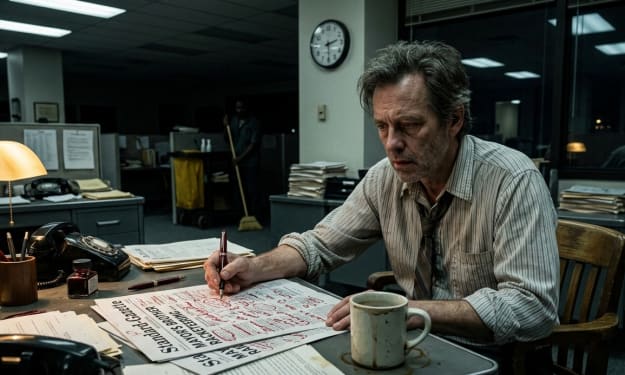
The clock on the wall of the Standard-Gazette newsroom didn’t tick; it thudded, a heavy, rhythmic reminder that Arthur Penhaligon was officially out of time.It was 3:14 AM. The fluorescent lights overhead hummed with a sick, flickering yellow energy that made the bags under Arthur’s eyes feel like lead weights. On his desk sat a ceramic mug—once white, now stained with a permanent ring of tannin. He took a sip. The coffee was stone cold, a bitter oily film coating his tongue. It tasted like failure and long division.Beside the mug lay the galley proofs for the morning edition. They were hemorrhaging.Arthur held a fountain pen gripped so tightly his knuckles were white. The ink was a shade of crimson called "Oxblood," and he had used it to eviscerate the lead story. Great sweeping strikes crossed out adjectives; jagged circles trapped grammatical errors like flies in amber. But the red ink wasn't just for style tonight. It was for survival."You’re bleeding it dry, Artie," a voice rasped from the shadows of the cubicle row.Arthur didn’t look up. He knew the scent of cheap cigars and peppermint anywhere. It was Elias, the night janitor, a man who had seen more scandals swept into dustpans than Arthur had ever printed."The truth is messy, Elias," Arthur muttered, his pen hovering over a paragraph that implicated the Mayor’s brother in a construction racketeering scheme. "It needs to be precise. If I miss one comma, the lawyers will have us for breakfast. If I miss one fact, I’ll be looking for a job at a greeting card company by noon.""You’ve been 'precise' for twelve hours," Elias said, leaning on his broom. "At some point, you're just stabbing the paper."Arthur finally looked up. His reflection in the dark window across the room looked like a ghost—gaunt, grey-skinned, and haunted. "I found a discrepancy."He pointed his red pen at the ledger notes he’d been cross-referencing. The ink there was different. It wasn't his. Someone had been in his office while he was at dinner, and they had made their own "corrections." Someone had tried to sanitize the blood out of the story, and they had used a red pen that matched his exactly."Look at this," Arthur whispered, his voice cracking. "The numbers in the second paragraph. They’ve been shifted by a single decimal point. It looks like a typo. It should be a typo. But $1.2$ million becoming $12$ million changes this from a local bribe to a federal conspiracy."Elias stopped leaning and stepped closer, his eyes narrowing. "And you didn't change it back?""I can't," Arthur said, gesturing to the cold coffee. "The editor-in-chief signed off on this version five minutes before he bolted out the door. If I change it back to the truth, I’m 'sabotaging' the paper. If I leave it, I’m publishing a lie that will ignite a firestorm the city can't put out."The silence of the newsroom felt heavy, like the air before a lightning strike. Arthur looked at the red ink on his fingers. It looked remarkably like the real thing. He realized then that the "Red Ink" of the title wasn't just about editing—it was about debt. The debt of the truth.He looked at the cold coffee, then at the clock. $3:22$ AM. The press started rolling at $4:00$."You know," Elias said softly, "sometimes the only way to fix a mess is to knock the whole bottle over. "Arthur looked at the bottle of Oxblood ink sitting precariously near the edge of the desk. He looked at the galley proofs. He thought about the years he’d spent chasing the perfect sentence, only to realize that the most powerful thing he could do wasn't to write—it was to erase.He didn't pick up the pen. Instead, he picked up the mug. He swirled the cold, dreg-filled liquid one last time."I'm not an editor anymore, Elias," Arthur said, a grim smile finally touching his lips. "I'm a witness."He stood up, grabbed the red ink, and headed toward the elevator that led down to the printing press. The coffee stayed behind, a cold monument to a career that was about to end in a very loud, very public explosion of ink and paper.
By aadam khan5 days ago in Confessions



Comments (1)