
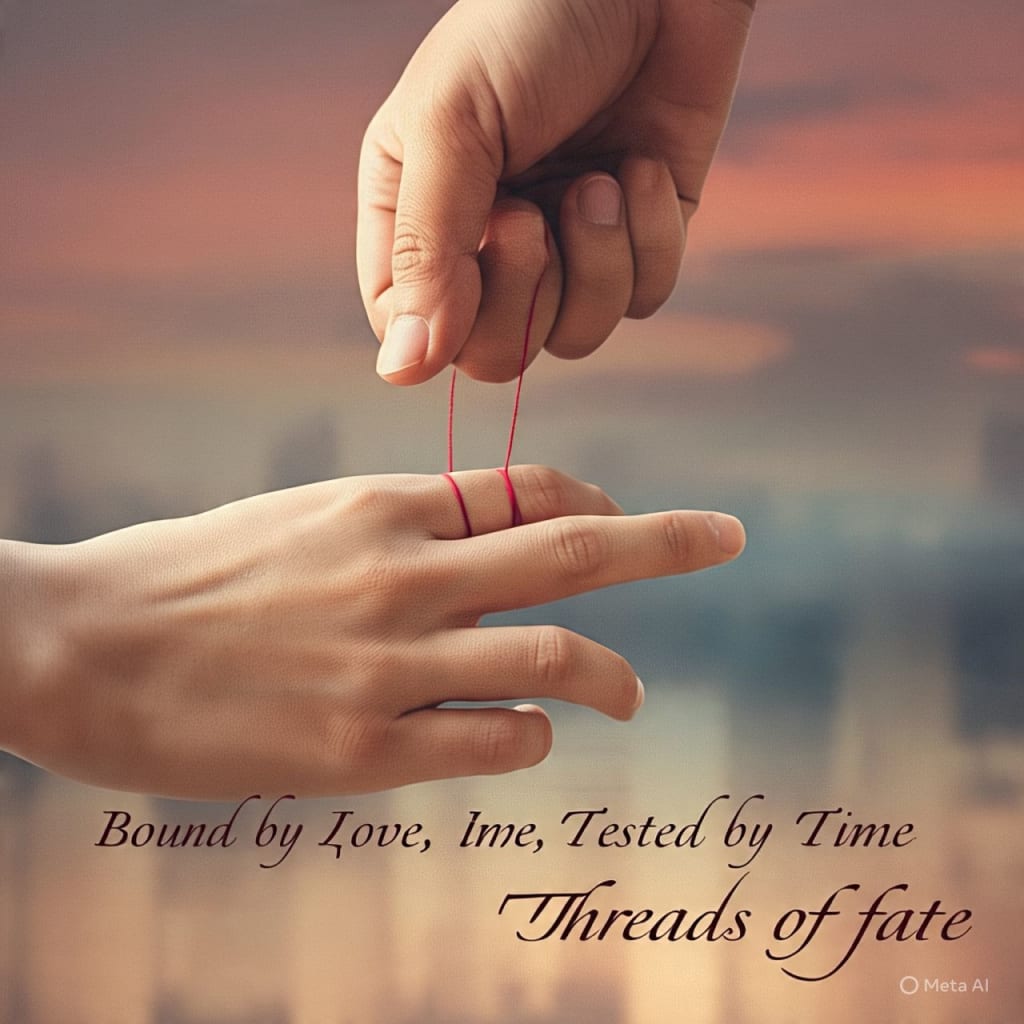
Threads of Us
Bound by Love, Tested by Time
They first met under a rusted clocktower on a rainy afternoon in Lahore. Ameer had taken shelter there while waiting for a bus, his coat soaked and his sketchbook tucked under one arm. Sara stood nearby, holding a broken umbrella that swayed helplessly in the wind. When he offered her half his coat to shield them both, she accepted with a smile that lit up the grayest part of the day.
That moment, however ordinary, was the first knot in the invisible thread that would bind their hearts.
Ameer was a struggling artist, painting portraits on the roadside and sketching dreams he couldn’t afford to chase. Sara was a literature student at Punjab University, her world filled with books and bold ideas. What began as brief meetings at the clocktower turned into hours spent walking along the canal, sharing tea and poetry, speaking of futures that seemed like fiction.
They never said the word “love” at first. They didn’t have to. The silence between them was laced with meaning. Ameer would draw Sara’s profile in the margins of his sketchpad, always starting with the eyes. “They hold the whole story,” he used to say. And Sara, in return, would read him Neruda under the trees, her voice soft but confident.
But time, as it always does, began to test their bond.
Sara’s family arranged a proposal for her — a wealthy engineer from Dubai. “He can give you a good life,” her father said. “Not some street painter who barely earns enough for his next meal.”
She didn’t say anything that night. She just walked to the clocktower the next day and handed Ameer a red thread, wrapped around a folded letter.
The letter said:
“We are stitched together by more than moments — we are sewn by longing, stitched by time. If we are meant to meet again, this thread will lead us back. But I can’t run. Not yet. Forgive me.”
And just like that, she was gone.
Years passed. Ameer moved to Karachi, then to Islamabad. He worked odd jobs, eventually earning enough recognition to display his paintings in local galleries. But he never stopped drawing the girl under the broken umbrella. He never cut the red thread she gave him — he tied it around his wrist and wore it like a quiet vow.
Sara, meanwhile, lived in Dubai with her husband. Their marriage was comfortable but silent. She taught literature at a school, often quoting poems about lost love, about threads of fate and second chances. Her students sometimes asked why she seemed sad when she read. She would smile and say, “Some stories are meant to be felt, not explained.”
She never told her husband about the boy who sketched stars or about the thread that still lay folded inside her diary.
It was fourteen years later, on a visit to Lahore for a school reunion, that Sara returned to the clocktower. It hadn’t changed much — still rusted, still forgotten. The sky was cloudy, just like the day they met. She stood there, wondering what pieces of herself she had left behind.
And then she saw him.
Ameer stood across the street, gray at the temples now, holding an umbrella and a worn sketchpad. Their eyes met. No words passed between them for a long moment. Just silence — full, sacred.
He walked toward her slowly, his steps unsure but steady. The rain began to fall.
“I wondered,” he finally said, “if the thread would lead us here again.”
Sara held up her wrist. Around it, tied delicately, was a faded red string.
“I never let it break,” she whispered.
Ameer smiled — not like a man who had waited, but like one who finally understood why he had to.
They didn’t talk about the past. Not about missed letters, or years lost to choices. They only talked about books, about paintings, about how the rain still smelled the same in Lahore. And as they stood there beneath the clocktower, Ameer opened his sketchpad and showed her the last drawing he had made.
It was of her — older, wiser, eyes still holding the whole story.
Sara reached out and touched the sketch gently. “You remembered every detail.”
“No,” Ameer said softly. “I never forgot.”
The thread hadn’t broken.
About the Creator
Keep reading
More stories from Muhammad Ansar and writers in Confessions and other communities.
The Lion and the Lamb
An Unlikely Friendship That Changed the Wild Forever In the heart of the vast Savanna, where the golden sun kissed the earth and the winds carried tales from faraway lands, ruled a mighty lion named Zar. His roar could silence rivers and scatter herds, and no creature dared cross his path. To all the animals, he was king—but he was also feared.
By Muhammad Ansar10 months ago in Confessions
I was in a Toxic Relationship, with my Workplace
“You got that?” My ex yelled. His hands were balled into fists at his side. At six foot three, he towered over me. A normal person would have been afraid, but I looked up a video of George Lopez repeatedly saying, “I got this,” and showed it to him. I had grown used to this treatment, so much so that I didn’t blink when he ripped the phone from my hand and threw it across the room.
By Jade M.5 days ago in Confessions



Comments
There are no comments for this story
Be the first to respond and start the conversation.