
The Upstairs Virtuoso's Shadow
When Passion Clashes with Peace in Apartment 3B

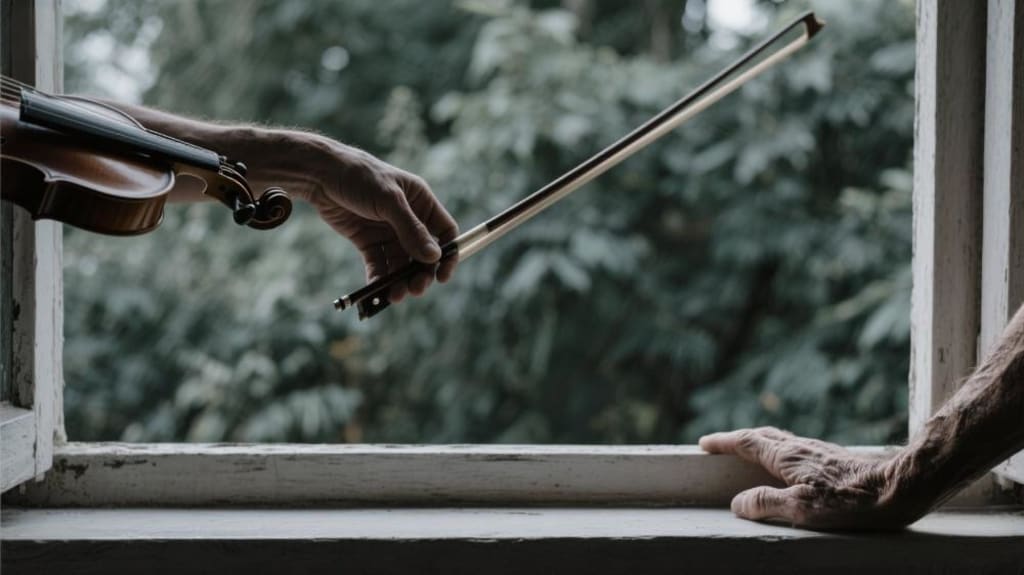
Charles lived above. Apartment 3B. He was a man of strong passions. He played the violin. Played it well, with a fierce concentration. He grew things. Green things. His balcony was a small, dense jungle. Ferns cascaded over the edges. Vines gripped the railings like determined fingers. He kept birds too. Finches, perhaps. Bright flashes of movement. He trained them. They answered his low whistle with sharp, clear trills. To Charles, it was a life lived fully. Sound. Leaf. Song. Good.
For a time, it was simply part of the old building’s rhythm. The late-night scales. The rustle of leaves. The dawn chorus.
Then the knock came. The building manager, Mr. Doyle, stood at Charles’s door. He held a folded paper. A complaint. Formal. From Lynch. Apartment 2B. Directly below. Charles’s passions, it seemed, were not shared.
The violin. Charles played with skill. True. But he played late. Very late. When the city outside had quieted and decent folk sought sleep. The notes, however precise, sliced through the fragile silence of Lynch’s apartment. They woke him. Abrupt. Jarring. Like glass breaking on stone. Charles frowned at the complaint. The music was good. Strong. Why wouldn’t Lynch appreciate it? He thought Lynch small. Tone-deaf.
The plants. Charles nurtured them expertly. They were thick. Verdant. A testament to water and light and constant care. But on Charles’s balcony, they grew tall. Too tall. They pressed against the lower edge of Lynch’s windows. A living, breathing wall. They stole the morning sun. They blocked the evening breeze. Lynch’s rooms stayed dim. Close. Stagnant. Charles saw only the triumph of his cultivation. The green vigor. He did not see the shadow he cast downward.
The birds. Charles loved their quick energy. Their bright, watchful eyes. Their songs pleased him. He taught them fragments of melody. They sang at first light. They sang intermittently through the day. To Charles, it was vitality. To Lynch, trapped beneath the jungle and the nocturnal rehearsals, it was incessant chatter. Piercing. Unwanted. A shrill counterpoint to the quiet he needed.
Lynch’s anger built slowly, then erupted. He went to Doyle. His words were clipped. Hard. His face was pale, etched with fatigue. The music stole rest. The plants stole light and air. The birds stole stillness. An invasion. Unbearable.
Charles listened to Doyle relay this. He was genuinely perplexed. Deep lines furrowed his brow. He looked at his violin, resting in its open case. He glanced at his thriving balcony, leaves shifting in a faint draft. He heard a finch chirp. How could these things, these good things, be wrong? It was a life of cultivation. Art. Nature. A man’s right pursuit. Why would any neighbor resent it? He shook his head slowly. Steadily. Utterly baffled.
Doyle arranged a meeting. The two men faced each other in the building’s small, utilitarian office. Fluorescent tubes buzzed overhead.
Lynch spoke of fractured nights, of gloom, of relentless, alien sound. His voice was low, rasping with exhaustion. Charles spoke of beauty unheeded, of gifts spurned. His gestures were precise, confined, bewildered. Their words passed like stones dropped into separate wells. No echo returned. They spoke languages of different needs. They inhabited different worlds within the same brick walls. Doyle watched them. He saw the chasm. Wide. Silent. Unbridgeable in that sterile room.
Doyle sighed. A weary sound. "One man’s concerto," he said flatly, "is another man’s racket. One man’s Eden is another man’s cage. One man’s lark song is another man’s alarm clock stuck on repeat."
Charles stared past Doyle, out the grimy window. Lynch fixed his eyes on the scuffed linoleum floor.
The world holds many truths. Loves are not the same. What feeds one spirit can starve another. A man’s treasure can be his neighbor’s torment. This is the hard ground. A man must keep his passions, but hold them tight enough that they don’t spill over and drown the man below. He cannot force his joy like medicine down another’s throat. He cannot build his bower so high it steals the light from the garden next door. To live among others is to know the space. To feel its boundaries. To understand that your bright note might be another’s discord.
There is a line. A clean line. It is not about dumping all you find good onto your neighbor’s stoop. It is not about drowning him in your own sweetness until he gags. It is harder. Cleaner. It is seeing what the other man needs. Truly needs. Air. Quiet. Light. And giving only that space. Cleanly. Sparingly. Stopping when your gift becomes a burden. When your sharing becomes a siege. Leave the air clear. Leave the quiet whole. Leave the light for the other man’s window.
Keep your own fire. Tend your own patch. Play your own tune. But know the limits of the shared ground. Listen for the silence from below. Mark the light in the window across the way. Respect the distance. That is the measure. That is how men share walls without breaking each other’s peace. That is the discipline. That is the grace. It is harder than any sonata. More demanding than any rare bloom. Quieter than the most trained songbird. And far more necessary for the long haul.
About the Creator
Heydo
A Story That Transforms a Life...
May my story be like a warm ray of sunshine, illuminating the corners of humanity. May it unlock the path to success for you and be a friend that lifts your life to higher heights.
Keep reading
More stories from Heydo and writers in Confessions and other communities.
The Chase of the Setting Sun: Musings on Farewells and New Beginnings
I find myself perpetually entangled in the enigma of whether reunion or initial encounter deserves the deeper recesses of my heart. The question lingers, a restless spirit in the night, with no definitive answer to anchor it. Yet, those of us with hearts attuned to the past, the nostalgic souls, often find our emotional scales tipped in favor of reunion. I crave friendships that stand unwavering, like ancient oaks, through the tempests of time. I envision bonds that remain unaltered, a steady compass in life's vast and turbulent sea. But when I pause to reflect, I see a different reality. These cherished connections have, in the quiet shadows of time, been eroded by the relentless tide of unsatisfactory circumstances. They have become blurred, like photographs left too long in the rain, and gradually disintegrated, piece by piece, until what was once clear and vibrant now feels distant and fragmented.
By Heydo9 months ago in Confessions
I was in a Toxic Relationship, with my Workplace
“You got that?” My ex yelled. His hands were balled into fists at his side. At six foot three, he towered over me. A normal person would have been afraid, but I looked up a video of George Lopez repeatedly saying, “I got this,” and showed it to him. I had grown used to this treatment, so much so that I didn’t blink when he ripped the phone from my hand and threw it across the room.
By Jade M.3 days ago in Confessions
Trickle Them Down, But Not Out
The thing about smart people is that they should know better, but alas, intelligence is not the same as wisdom. Not only do the mistakes of experts too short on vision—when they are not corrected—have the potential to do great and far-reaching damage, but they also undermine public confidence in the very notion of expertise. This is particularly so when expertise is wielded in defence of the rich and powerful as a cudgel against those laid low. As an academic, this lack of faith in “so-called experts” is painful to see as it plays out in the spread of dis-/misinformation, conspiracy theories, and anti-intellectualism writ large. But it is also an understandable impulse given the catastrophic failure of an economic ideology pushed by certain economic experts. Supply-side economics has shaped a broken system for the last half-century and has arguably done more to undermine the fabric of the American Dream than any policy framework of the past century.
By Cory Wright-Maley5 days ago in Humans




Comments
There are no comments for this story
Be the first to respond and start the conversation.