
The Red Flag That Made Me Stop Talking to Someone Immediately
Recognizing the Moment When Humor Crossed the Line and Revealed True Character


In life, relationships, whether personal or professional, are a cornerstone of our daily existence. We navigate countless interactions, forming bonds with some while maintaining polite distance from others. But every so often, we encounter a moment that shocks us, opening our eyes to the true nature of someone we thought we knew. Sometimes, it takes just one red flag to completely sever ties.
Let me share a story that taught me the importance of recognizing these warning signs early and acting decisively when they appear.
A New Colleague, a Promising Start
When a new colleague joined my department, she seemed like a breath of fresh air. She was witty, charming, and had a sharp sense of humor that drew people in. We worked similar shifts, and our early mornings were spent chatting over coffee before the rest of the team trickled in. Initially, I admired her quick wit and lighthearted banter. It felt like she had an ability to make even the dullest moments more bearable. Over time, we developed a camaraderie that seemed genuine. But, as I would soon discover, first impressions can be deceiving.
The Dark Turn
After a few weeks, her humor began to reveal a more sinister side. It started subtly, jokes with a slightly mean edge that I brushed off as playful teasing. Then one morning, she crossed a line that I couldn’t ignore. She started talking about her husband. At first, it sounded innocent, but her tone was off. It wasn’t affection or even frustration, it was mockery. Her husband, she explained, was blind and unable to walk. Instead of expressing care or concern, she laughed while sharing anecdotes that left me speechless. She boasted about hiding his wheelchair before leaving for work, leaving him to struggle on his own throughout the day. And then she dropped the bombshell: she had installed cameras around their house, not for safety, but to record his attempts to navigate without assistance. She found his struggles hilarious and had even saved videos to share with her co-workers.
The Workplace Reaction
To my horror, when she showed the videos at work, the reaction wasn’t shock or disgust, it was laughter. Supervisors, co-workers, and even managers joined in. They treated her behavior as if it were a harmless joke, an amusing anecdote to lighten their day. I felt sick to my stomach. What I was witnessing wasn’t just one person’s cruelty; it was a workplace culture that normalized and encouraged toxic behavior. I realized I couldn’t be part of an environment where such blatant disrespect and bullying were met with applause.
Taking a Stand
That moment was my red flag, the one that made me stop interacting with her entirely. It wasn’t just her actions that alarmed me; it was the collective complicity of everyone around us. I knew I had to distance myself, not just from her, but from that entire department. I couldn’t look the other way or pretend that what I saw was acceptable. Within days, I requested a transfer to another department. Thankfully, my request was approved, and I never looked back.
Reflections on Red Flags
This experience taught me the importance of trusting my instincts. When someone shows you who they truly are, believe them. Her “humor” wasn’t just a coping mechanism or a quirky personality trait, it was a reflection of her complete lack of empathy and humanity. Here are some key lessons I took from that experience:
Humor Isn’t Always Harmless
While humor can be a great way to connect with others, it can also be used as a mask for cruelty. Pay attention to the targets of someone’s jokes—are they punching up or punching down?
2. Watch How People Treat the Vulnerable
How someone treats those who are vulnerable—whether it’s a spouse, a co-worker, or a stranger—speaks volumes about their character. Kindness and empathy are non-negotiable qualities in any relationship.
3. Toxic Environments Breed Toxicity
The workplace culture in this story was just as problematic as the woman’s behavior. If the people around you normalize harmful actions, it’s time to reconsider whether that environment aligns with your values.
4. Act Decisively
When faced with a red flag, don’t ignore it. Take action, whether that means distancing yourself, speaking up, or removing yourself from the situation entirely.
Why Red Flags Matter
Red flags are life’s way of warning us when something—or someone—isn’t right. They may not always be as glaring as the example in this story, but they are always worth paying attention to. Whether it’s a friend who constantly undermines you, a partner who lacks empathy, or a co-worker who thrives on cruelty, recognizing red flags is essential to protecting your peace of mind and emotional well-being.
Choose Integrity Over Convenience
The decision to leave that department wasn’t easy, but it was necessary. Looking back, I’m grateful for the experience, because it reinforced my commitment to surrounding myself with people who embody kindness, respect, and integrity. Life is too short to waste time on relationships that make you question your values or compromise your sense of right and wrong. When you encounter a red flag, listen to it, act on it, and never feel guilty for choosing yourself over toxicity. What’s your red flag moment, the one that made you walk away without hesitation? Share your story and let’s remind each other why it’s so important to stand firm in the face of what’s wrong.
----------------------------------------------------------------------------------------
Suggested Readings
"Throning": A New Term for an Old Dating Habit - New!
10 Benefits of a Mentally Healthy Family
12 Essential Characteristics of Countries to Consider When Moving Abroad
2 Key Tools to Improve Any Relationship
3 Flirting Mistakes: Are You a Bad Flirter and Don't Know It?
About the Creator
Faraz
I am psychology writer and researcher.
Keep reading
More stories from Faraz and writers in Confessions and other communities.
Is growing up as awful as it seems?
Yes and no. So I am probably what you would consider an old (early 40s) and yes growing up is absolutely awful it really is. You know I think every kid thanks to themselves when I become an adult I'm going to do whatever I want I'm grown no one's going to tell me what to do and then when you become an adult that does not happen. So maybe by that time you're no longer living with your parents although given the state of rent prices in this country a lot of adult children end up moving back home but even not including that your life constantly feels like it is controlled by others. If you are working for someone else you are having to give a great chunk of your time at least 8 hours a day 5 days a week probably doing work that you absolutely hate doing just so you can be told when you can take a lunch break when you can take a cigarette break and when you can leave for the day. And adding further insult to injury your pay is insulting because it's not even covering basic needs such as rent food utilities Child Care etc. There is a likelihood that if you are living alone by this time you will probably have roommates and God help you if they are horrible because then you have to contend with other assholes that either or obnoxious or they don't want to pay their share of the rent or they make too much noise that sort of thing. If you are in a relationship that may be even extra stress for you especially if that other person does not really have the same values that you do and if you two are not communicating if there isn't that mutual respect and understanding and care and concern for each other you're going to have a lot of problems. Same thing with your friends once you become an adult. Hopefully, you will have good people in your life that you can bond with that really care about you and you care about them and you're both contributing to each other's peace as opposed to contributing to each other's stress. So because adults have to invest so much of their time working and meeting the basic needs they don't have as much time as they would like to rest take on hobbies go for a walk enjoy conversations with people that they care about just to be able to do those things that make life beautiful.
By Faraz4 years ago in Confessions
This Is What I Do When People Throw Rocks At Me
Rocks have been thrown at me for a greater part of my life. Some have been small and missed hitting me. When people don't get a reaction from me, they throw bigger rocks with a better aim. Many have been hurled at me with precision over the years. For a long time, I thought my only options were to dodge them or be crushed by them.
By Margaret Minnicks8 days ago in Confessions
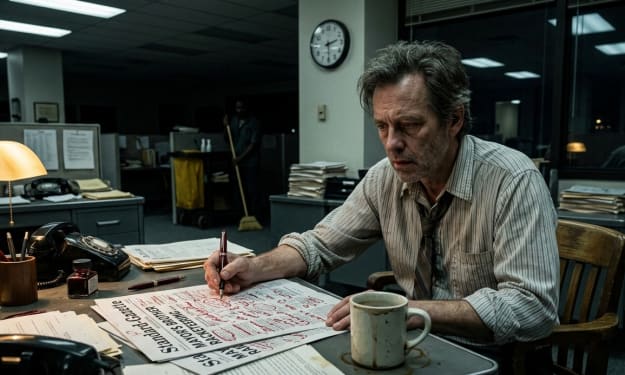
Cold Coffee and Red Ink
The clock on the wall of the Standard-Gazette newsroom didn’t tick; it thudded, a heavy, rhythmic reminder that Arthur Penhaligon was officially out of time.It was 3:14 AM. The fluorescent lights overhead hummed with a sick, flickering yellow energy that made the bags under Arthur’s eyes feel like lead weights. On his desk sat a ceramic mug—once white, now stained with a permanent ring of tannin. He took a sip. The coffee was stone cold, a bitter oily film coating his tongue. It tasted like failure and long division.Beside the mug lay the galley proofs for the morning edition. They were hemorrhaging.Arthur held a fountain pen gripped so tightly his knuckles were white. The ink was a shade of crimson called "Oxblood," and he had used it to eviscerate the lead story. Great sweeping strikes crossed out adjectives; jagged circles trapped grammatical errors like flies in amber. But the red ink wasn't just for style tonight. It was for survival."You’re bleeding it dry, Artie," a voice rasped from the shadows of the cubicle row.Arthur didn’t look up. He knew the scent of cheap cigars and peppermint anywhere. It was Elias, the night janitor, a man who had seen more scandals swept into dustpans than Arthur had ever printed."The truth is messy, Elias," Arthur muttered, his pen hovering over a paragraph that implicated the Mayor’s brother in a construction racketeering scheme. "It needs to be precise. If I miss one comma, the lawyers will have us for breakfast. If I miss one fact, I’ll be looking for a job at a greeting card company by noon.""You’ve been 'precise' for twelve hours," Elias said, leaning on his broom. "At some point, you're just stabbing the paper."Arthur finally looked up. His reflection in the dark window across the room looked like a ghost—gaunt, grey-skinned, and haunted. "I found a discrepancy."He pointed his red pen at the ledger notes he’d been cross-referencing. The ink there was different. It wasn't his. Someone had been in his office while he was at dinner, and they had made their own "corrections." Someone had tried to sanitize the blood out of the story, and they had used a red pen that matched his exactly."Look at this," Arthur whispered, his voice cracking. "The numbers in the second paragraph. They’ve been shifted by a single decimal point. It looks like a typo. It should be a typo. But $1.2$ million becoming $12$ million changes this from a local bribe to a federal conspiracy."Elias stopped leaning and stepped closer, his eyes narrowing. "And you didn't change it back?""I can't," Arthur said, gesturing to the cold coffee. "The editor-in-chief signed off on this version five minutes before he bolted out the door. If I change it back to the truth, I’m 'sabotaging' the paper. If I leave it, I’m publishing a lie that will ignite a firestorm the city can't put out."The silence of the newsroom felt heavy, like the air before a lightning strike. Arthur looked at the red ink on his fingers. It looked remarkably like the real thing. He realized then that the "Red Ink" of the title wasn't just about editing—it was about debt. The debt of the truth.He looked at the cold coffee, then at the clock. $3:22$ AM. The press started rolling at $4:00$."You know," Elias said softly, "sometimes the only way to fix a mess is to knock the whole bottle over. "Arthur looked at the bottle of Oxblood ink sitting precariously near the edge of the desk. He looked at the galley proofs. He thought about the years he’d spent chasing the perfect sentence, only to realize that the most powerful thing he could do wasn't to write—it was to erase.He didn't pick up the pen. Instead, he picked up the mug. He swirled the cold, dreg-filled liquid one last time."I'm not an editor anymore, Elias," Arthur said, a grim smile finally touching his lips. "I'm a witness."He stood up, grabbed the red ink, and headed toward the elevator that led down to the printing press. The coffee stayed behind, a cold monument to a career that was about to end in a very loud, very public explosion of ink and paper.
By aadam khan6 days ago in Confessions



Comments
There are no comments for this story
Be the first to respond and start the conversation.