
THE RACIAL BURDEN
Is it a necessary truth or a new weight in an already heavy world?


Some people feel it every day, without knowing the name. Others learn about it through books or personal experience. The “racial burden” — or charge raciale, as French writer Douce Dibondo calls it — is the invisible weight carried by many people of color in societies where whiteness is the norm.
It’s not always violent or loud. It’s often quiet, internal. It’s the feeling that you always need to watch yourself. The pressure to speak “correctly,” to smile, to stay calm even when someone says something offensive. To represent your entire community in a classroom, a meeting, or a job interview. It’s the fear of being “too much” — too angry, too visible, too different.
Douce Dibondo describes this in her book La charge raciale as something that is both mental and physical. It’s a feeling of constant tension, like holding your breath without realizing it. She says this weight is not only created by others, but also lives inside the person who experiences it. It affects the way they walk, speak, laugh, even breathe.
So is this concept useful? Does it help us understand how racism works on a deeper level? Or could it make things worse — by adding another layer of difficulty in a world that’s already stressful for everyone?
Let’s look at both sides.
Why this concept matters
The idea of “racial burden” gives a name to something many people have felt for years but couldn’t explain. Just like the concept of “mental load” helped describe the invisible work women do at home, the racial burden shows how people of color have to manage extra emotional and social work every day.
It’s not just about open racism. It’s about small things that happen all the time. Someone touches your hair without asking. A teacher always calls on you when talking about “Africa” or “immigration.” You hear, “Wow, you speak so well!” as if surprise was expected. Each moment alone seems small, but together, they build a mountain. And this mountain is heavy to carry.
Naming the burden helps people not feel alone. It shows that the problem isn’t in their head. And once the problem has a name, it can be addressed — in schools, in workplaces, in therapy, in activism. It can also help people who are not affected by it understand what others go through every day, without judgment or guilt, just with openness.
But is it adding more weight?
Some critics say that focusing on the racial burden might actually create more suffering. In other words: if you always think about how heavy the world is, won’t it feel even heavier?
It’s a fair question. Talking constantly about pain, identity, and trauma can become exhausting. Some people fear that it turns life into a struggle where everything is political, even simple things like how you dress or what music you like. They wonder: isn’t it possible to just live, without overthinking everything?
Others say that everyone feels pressure in today’s world. White people, too, may feel anxious, judged, or out of place in multicultural spaces. Some experience what’s called “white guilt” — a discomfort or sadness about the injustices of the past, or fear of saying the wrong thing. They may feel blamed for problems they didn’t create. In very diverse environments, they may feel like “the outsider” and fear being called racist even if they mean no harm.
So is the racial burden unique? Or is it part of a bigger human burden we all carry, in different ways?
A useful comparison, but not an equal one
Yes, white people can feel anxious or lost in diverse societies. But the difference is that they don’t face the same systemic obstacles. Their discomfort is real, but it’s not tied to violence, exclusion, or constant doubt about their worth. They don’t have to represent their race. They are not followed in stores, asked where they’re “really” from, or told their names are “too difficult.”
The racial burden is not just emotional. It’s social, historical, and institutional. It comes from centuries of inequality, and it still shapes access to jobs, housing, healthcare, and respect. Even when it’s invisible, it’s always there — like background noise that never stops.
So yes, everyone suffers in this world. But the suffering is not the same. And recognizing one form of suffering doesn’t erase the others. It simply allows for a more honest and fair conversation.
So what should we do?
First, we should take the concept seriously — but not use it as a label to feel superior or different. It’s not about making people feel guilty. It’s about understanding how racism works, even in polite, modern, “diverse” spaces.
Second, we should avoid turning everything into identity politics. People of color are not only their pain. They are joy, creativity, complexity. The racial burden exists, but it shouldn’t define everything. Knowing the weight is there can help us start putting it down — together.
Third, white people can take part in this process. Not by speaking over others, but by listening, learning, and taking action. By reflecting on their role in society, without falling into guilt or shame. Empathy is not a competition. It’s a bridge.
Conclusion
The racial burden is not a myth. It is a real, powerful force in many lives. Naming it helps. Talking about it helps. But we must also be careful not to turn it into a cage. The goal is not to carry the burden forever — the goal is to live fully, with truth and with freedom.
Yes, life is already difficult. But ignoring the weight doesn’t make it lighter. Facing it might be the only way to finally breathe.
About the Creator
Bubble Chill Media
Bubble Chill Media for all things digital, reading, board games, gaming, travel, art, and culture. Our articles share all our ideas, reflections, and creative experiences. Stay Chill in a connected world. We wish you all a good read.
Keep reading
More stories from Bubble Chill Media and writers in Confessions and other communities.
Is Marriage Still Worth It?
When Happily Ever After Meets Harsh Reality They say love conquers all. But does it still conquer time, bills, infidelity, and societal pressure? Is marriage—the ultimate symbol of commitment and devotion—still worth the risk in today’s fast-paced, self-focused world? Or is it an outdated ritual clinging to relevance in a world that’s moved on? These are not just abstract questions. For millions, they’re deeply personal dilemmas. Some dream of white dresses and diamond rings; others flinch at the mere mention of wedding vows. So what’s the truth? And is forever still a goal… or just a fantasy?
By Bubble Chill Media 9 months ago in Confessions
This Is What I Do When People Throw Rocks At Me
Rocks have been thrown at me for a greater part of my life. Some have been small and missed hitting me. When people don't get a reaction from me, they throw bigger rocks with a better aim. Many have been hurled at me with precision over the years. For a long time, I thought my only options were to dodge them or be crushed by them.
By Margaret Minnicks5 days ago in Confessions
Cold Coffee and Red Ink
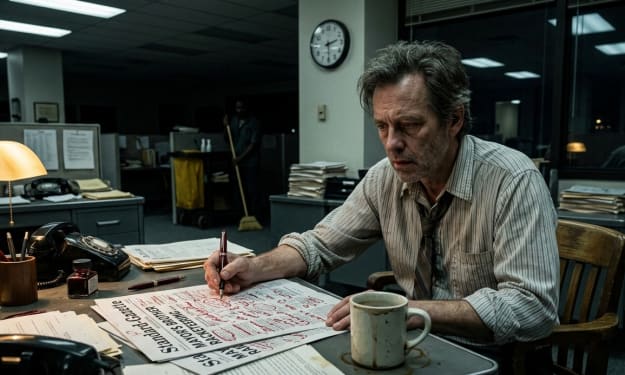
The clock on the wall of the Standard-Gazette newsroom didn’t tick; it thudded, a heavy, rhythmic reminder that Arthur Penhaligon was officially out of time.It was 3:14 AM. The fluorescent lights overhead hummed with a sick, flickering yellow energy that made the bags under Arthur’s eyes feel like lead weights. On his desk sat a ceramic mug—once white, now stained with a permanent ring of tannin. He took a sip. The coffee was stone cold, a bitter oily film coating his tongue. It tasted like failure and long division.Beside the mug lay the galley proofs for the morning edition. They were hemorrhaging.Arthur held a fountain pen gripped so tightly his knuckles were white. The ink was a shade of crimson called "Oxblood," and he had used it to eviscerate the lead story. Great sweeping strikes crossed out adjectives; jagged circles trapped grammatical errors like flies in amber. But the red ink wasn't just for style tonight. It was for survival."You’re bleeding it dry, Artie," a voice rasped from the shadows of the cubicle row.Arthur didn’t look up. He knew the scent of cheap cigars and peppermint anywhere. It was Elias, the night janitor, a man who had seen more scandals swept into dustpans than Arthur had ever printed."The truth is messy, Elias," Arthur muttered, his pen hovering over a paragraph that implicated the Mayor’s brother in a construction racketeering scheme. "It needs to be precise. If I miss one comma, the lawyers will have us for breakfast. If I miss one fact, I’ll be looking for a job at a greeting card company by noon.""You’ve been 'precise' for twelve hours," Elias said, leaning on his broom. "At some point, you're just stabbing the paper."Arthur finally looked up. His reflection in the dark window across the room looked like a ghost—gaunt, grey-skinned, and haunted. "I found a discrepancy."He pointed his red pen at the ledger notes he’d been cross-referencing. The ink there was different. It wasn't his. Someone had been in his office while he was at dinner, and they had made their own "corrections." Someone had tried to sanitize the blood out of the story, and they had used a red pen that matched his exactly."Look at this," Arthur whispered, his voice cracking. "The numbers in the second paragraph. They’ve been shifted by a single decimal point. It looks like a typo. It should be a typo. But $1.2$ million becoming $12$ million changes this from a local bribe to a federal conspiracy."Elias stopped leaning and stepped closer, his eyes narrowing. "And you didn't change it back?""I can't," Arthur said, gesturing to the cold coffee. "The editor-in-chief signed off on this version five minutes before he bolted out the door. If I change it back to the truth, I’m 'sabotaging' the paper. If I leave it, I’m publishing a lie that will ignite a firestorm the city can't put out."The silence of the newsroom felt heavy, like the air before a lightning strike. Arthur looked at the red ink on his fingers. It looked remarkably like the real thing. He realized then that the "Red Ink" of the title wasn't just about editing—it was about debt. The debt of the truth.He looked at the cold coffee, then at the clock. $3:22$ AM. The press started rolling at $4:00$."You know," Elias said softly, "sometimes the only way to fix a mess is to knock the whole bottle over. "Arthur looked at the bottle of Oxblood ink sitting precariously near the edge of the desk. He looked at the galley proofs. He thought about the years he’d spent chasing the perfect sentence, only to realize that the most powerful thing he could do wasn't to write—it was to erase.He didn't pick up the pen. Instead, he picked up the mug. He swirled the cold, dreg-filled liquid one last time."I'm not an editor anymore, Elias," Arthur said, a grim smile finally touching his lips. "I'm a witness."He stood up, grabbed the red ink, and headed toward the elevator that led down to the printing press. The coffee stayed behind, a cold monument to a career that was about to end in a very loud, very public explosion of ink and paper.
By aadam khan4 days ago in Confessions



Comments
There are no comments for this story
Be the first to respond and start the conversation.